Printable Savings Tracker: Free PDF and How to Use It
A printable savings tracker lists your goals, progress bars and monthly target. Get a free one-page PDF and see how to fill it in.
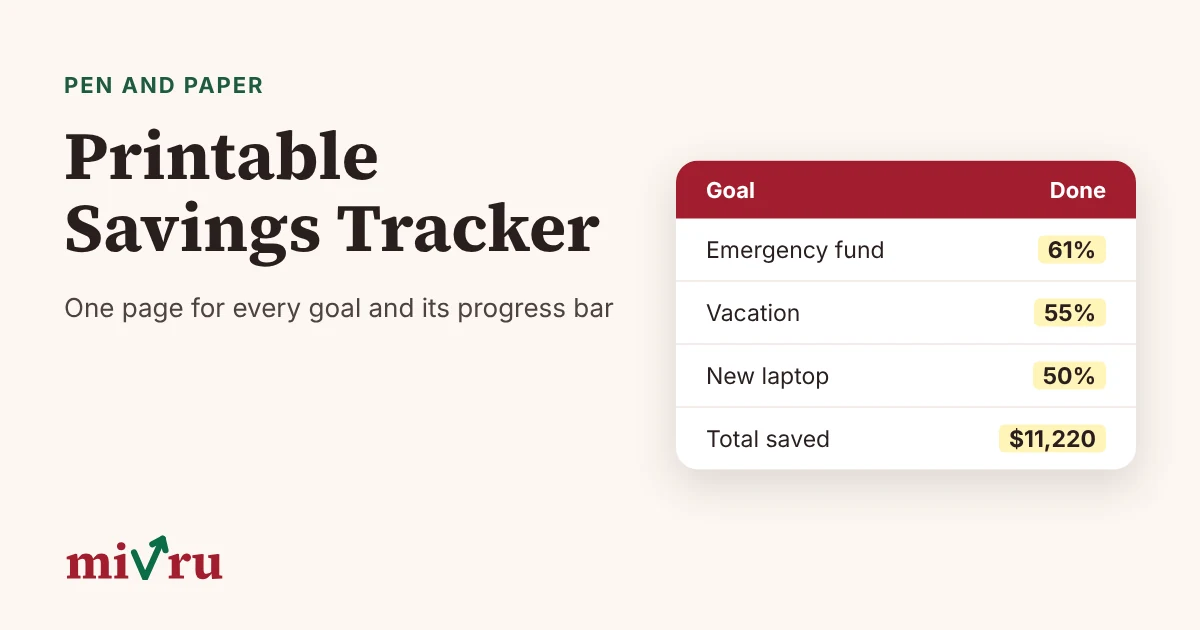
A printable savings tracker puts all your goals on one page. You can see what you are saving for, how much is done and what to put aside this month. Stick it on the fridge or keep it in a folder next to your bills.
Below you will find what to write on it, a filled-in example and a free one-page PDF.
What to write on the page
For each goal:
- Goal, like Emergency fund.
- Target, the amount you want.
- Target date, when you want it.
- Saved so far, what you have today.
- Save per month, the amount left divided by the months left.
Then colour in one square of the progress bar for every 10% you reach. At the bottom write your monthly savings target, the amount you will move to savings on payday.
An example
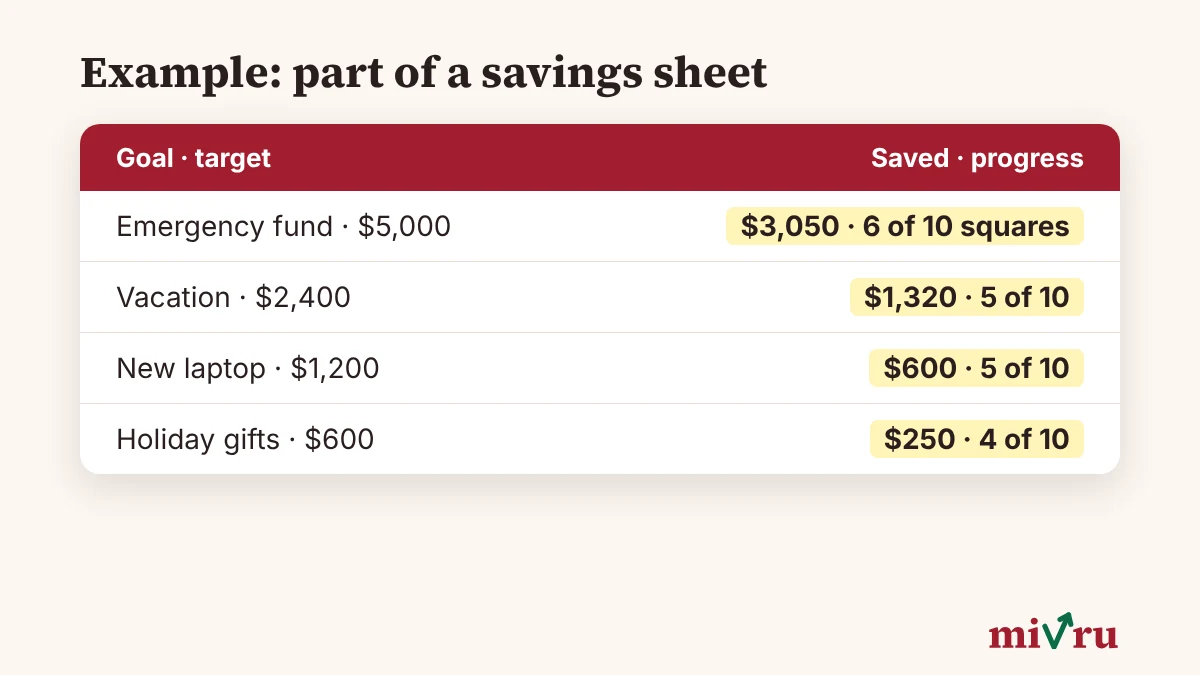
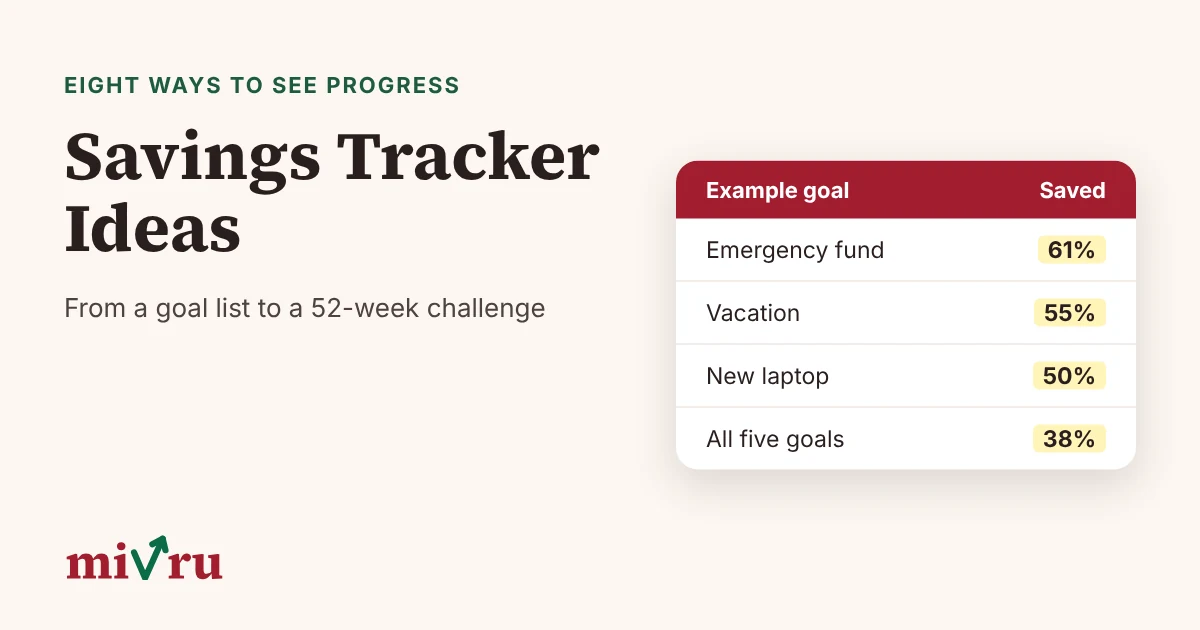
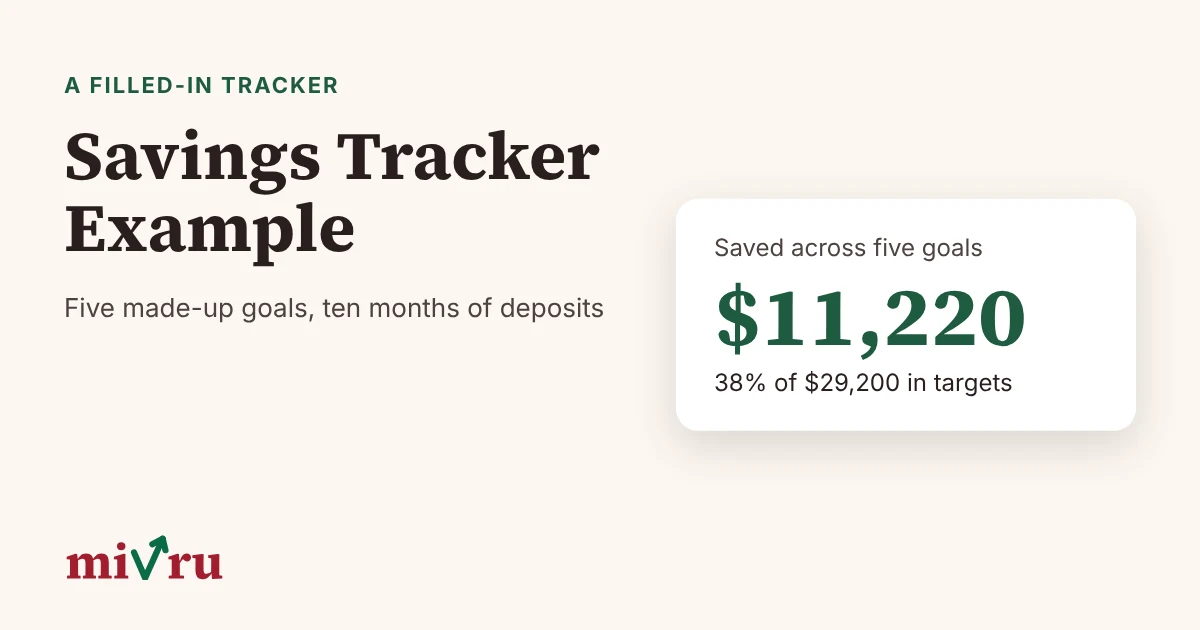
Example: Five made-up goals totalling $29,200. Emergency fund $5,000 with $3,050 saved (61%, 6 squares coloured). Vacation $2,400 with $1,320 saved (55%). New laptop $1,200 with $600 saved (50%). House down payment $20,000 with $6,000 saved (30%). Holiday gifts $600 with $250 saved (42%). In total $11,220, or 38%.
For the laptop, $600 is left and there are 2 months to the target date, so the sheet shows $300 in the Save per month column. Read how to choose and combine ideas in our savings tracker ideas.
How to use it each month
- On payday, move the money to savings.
- Write the new amount in the Saved so far column.
- Colour in the progress bar.
- Check the Save per month column and change it if a date has moved.
Move the money first. The U.S. Consumer Financial Protection Bureau suggests scheduling transfers for right after payday so you pay yourself first, and checking your balance to avoid overdraft fees.
The CFPB also describes a simple plan: set a goal, test it for a month, then save automatically.
Tips for making the page work
- Print two copies. Keep one in sight and one blank in case you change your goals.
- Use a pencil for amounts and a pen for names. Amounts change every month. The list of goals only changes when you reach one or add one.
- Write the date next to a finished goal. A date beside a full bar is a small reward and a record of how fast you moved.
- Put the most urgent goal first. If two goals compete, the one with the nearest date gets the money first.
- Give each goal a reason. A goal like "three months of bills" is easier to keep than "savings".
Common mistakes
- No dates. A goal without a date never feels urgent.
- Targets that are too big at once. Split a big goal into a first milestone and a final target.
- Mixing everything in one pot. If your emergency fund and your vacation share one account balance, you will not know which is which. Write the goal on the sheet even if the money sits in one account.
- Forgetting withdrawals. If you take money out, subtract it on the sheet.
The 52-week challenge on paper
A popular add-on is the 52-week challenge: save $1 in week 1, $2 in week 2, up to $52 in week 52, and tick each box. The total is $1,378. The full planner has a page for it, and our savings tracker in Excel shows how to build the same checklist in a spreadsheet.
Paper or spreadsheet?
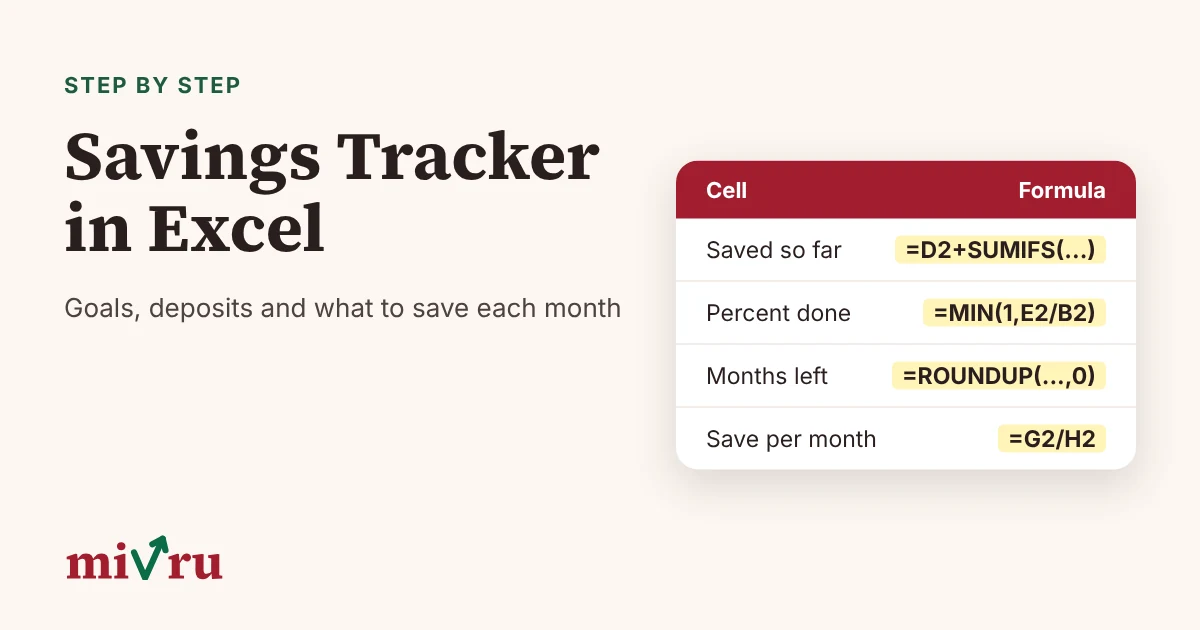
Paper is visible and needs no setup. A spreadsheet works out the percent done and the amount to save each month by itself. Many people print the one-page sheet and keep a spreadsheet too. You can build your own in Google Sheets.
This is general information, not financial advice. For other printables, see the printable debt payoff tracker and the printable expense tracker.
The five goals in a table
| Goal | Target | Saved | Done |
|---|---|---|---|
| Emergency fund | $5,000 | $3,050 | 61% |
| Vacation | $2,400 | $1,320 | 55% |
| New laptop | $1,200 | $600 | 50% |
| House down payment | $20,000 | $6,000 | 30% |
| Holiday gifts | $600 | $250 | 42% |
| Total | $29,200 | $11,220 | 38% |
What to do on payday
- Move the money first. Transfer the savings amount before you spend.
- Write the deposit next to the goal on the page.
- Color in the squares to match the new percent.
- Check the next deadline. If a goal is close to its date, decide whether to move extra money to it.
- Initial the page so you can see at a glance that this month's deposit is done.
Paper helps with motivation
Seeing squares fill in is satisfying, and a page on the fridge reminds everyone in the home what you are saving for. If you want totals worked out for you, a spreadsheet adds the deposits and shows the amount per month.
Common questions about the page
What if I miss a month? Write a zero and carry on. The page shows where you are, and one missed month is not the end.
What if I take money out? Write the withdrawal in a different color and lower the colored squares. Seeing the drop is part of being honest about the goal.
Should every goal get money every month? Not necessarily. Choose the goal with the nearest deadline first, and give the others what is left.
How often should I print a new page? When a page is full, or when you add or finish a goal. Keep the old pages in a folder, so you can see your progress over the year.
The full planner
The Mivru Savings Tracker includes a 12-page printable planner in colour and in black and white, with a goals page, a monthly savings plan, two years of savings trackers, a deposit log, a 52-week challenge, progress bars and more. It also includes the spreadsheet that does the math. See the Savings Tracker Spreadsheet.
Frequently asked questions
What is a printable savings tracker?
A paper sheet where you write your savings goals, the target and date for each, what you have saved, and color in a progress bar as you get closer.
What should I write on a savings tracker?
For each goal: the name, the target amount, the target date and the amount saved so far. Then the amount to save each month and your monthly target.
Is the free PDF really free?
Yes. The one-page Savings Goal Tracker is free to download and print on US Letter paper.
How often should I update it?
Once a month is enough. Update it the same day you move money to savings, so the sheet is never behind.
Is paper or a spreadsheet better?
Paper is visible and has no setup. A spreadsheet adds up deposits and works out the amount to save each month. Many people use both.