Savings Tracker Example: Five Goals, Month by Month
See a filled-in savings tracker: five example goals, ten months of deposits, the percent done and what to save each month. Free printable.
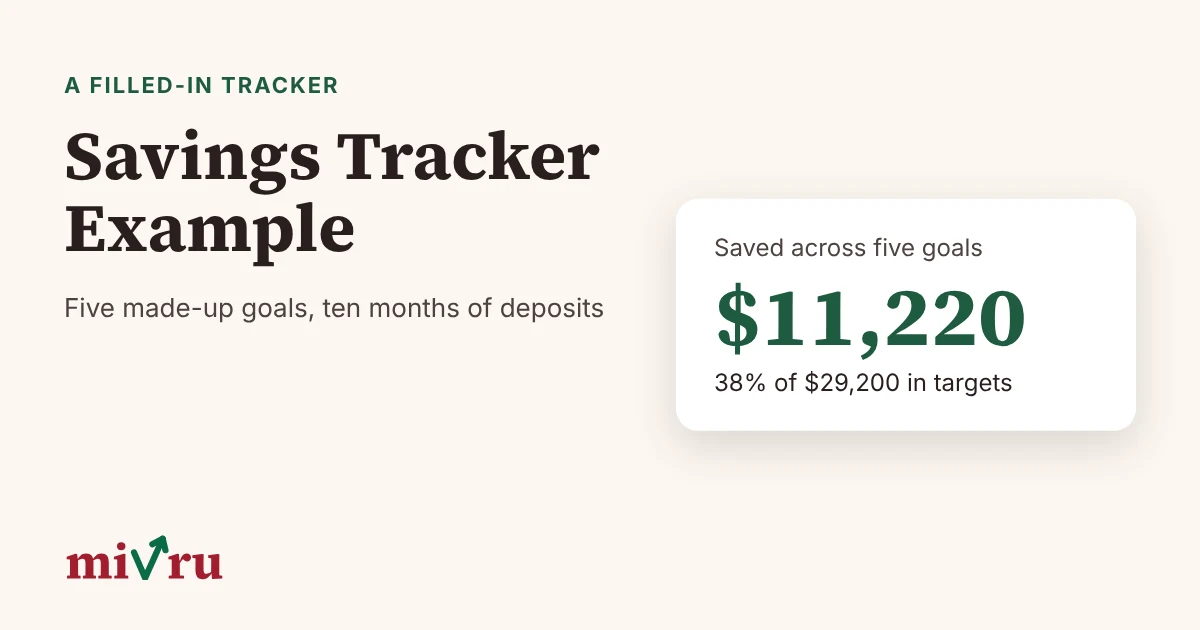
This savings tracker example shows five goals, ten months of deposits and the progress after each one. Every name and number is made up. Use it as a pattern for your own tracker.
The goals
The household is saving for five things. Each has a target, a start date, a target date and an amount that was already saved when the tracker began.
Example: Emergency fund, $5,000 by June 30, 2027, with $800 saved at the start. Vacation, $2,400 by March 15, 2027. New laptop, $1,200 by December 15, 2026. House down payment, $20,000 by December 31, 2028, with $3,000 saved at the start. Holiday gifts, $600 by December 1, 2026.
The targets add up to $29,200.
The deposits
Each month the household moves money to its goals right after payday: $200 to the emergency fund, $300 to the house fund, $150 to the vacation (from March), $100 to the laptop (from May) and $50 to holiday gifts (from June). Three extra entries are in the log: a $600 tax refund into the emergency fund in April, $120 from selling an old bike into the vacation fund in July, and a $350 withdrawal from the emergency fund for a car repair in August.
Where each goal stands on October 23
Example: Emergency fund $3,050 (61%), on track. Vacation $1,320 (55%), behind. New laptop $600 (50%), behind. House down payment $6,000 (30%), on track. Holiday gifts $250 (42%), behind. In total $11,220 of $29,200 is saved: 38%.
The tracker calls a goal "behind" when the saved amount is lower than the share of the target that matches the time passed. The laptop is 77% of the way from its start date to its target date but only 50% funded.
What to save each month
The tracker divides what is left by the months left.
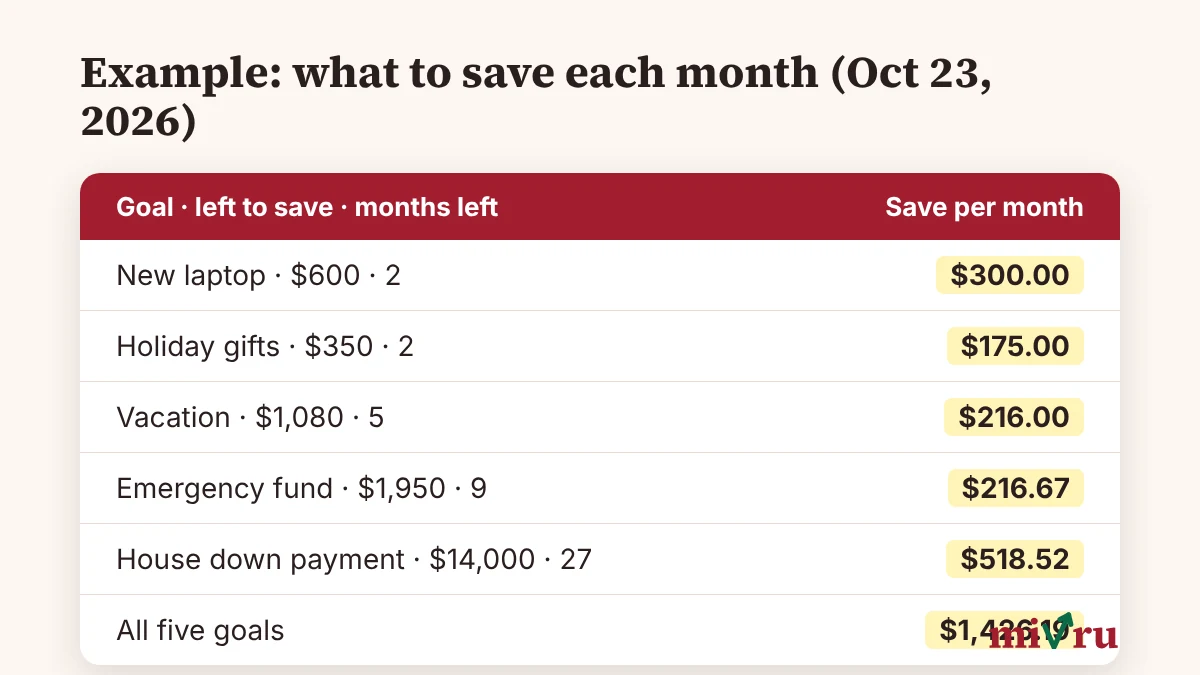
Example: Laptop: $600 left, 2 months, $300 a month. Holiday gifts: $350 left, 2 months, $175 a month. Vacation: $1,080 left, 5 months, $216 a month. Emergency fund: $1,950 left, 9 months, about $216.67 a month. House down payment: $14,000 left, 27 months, about $518.52 a month. All five together: about $1,426.19 a month.
That is about $626 more than the $800 the household saves now. The tracker makes the gap visible, and there are three ways to close it: save more, move the dates, or lower a target.
The monthly view
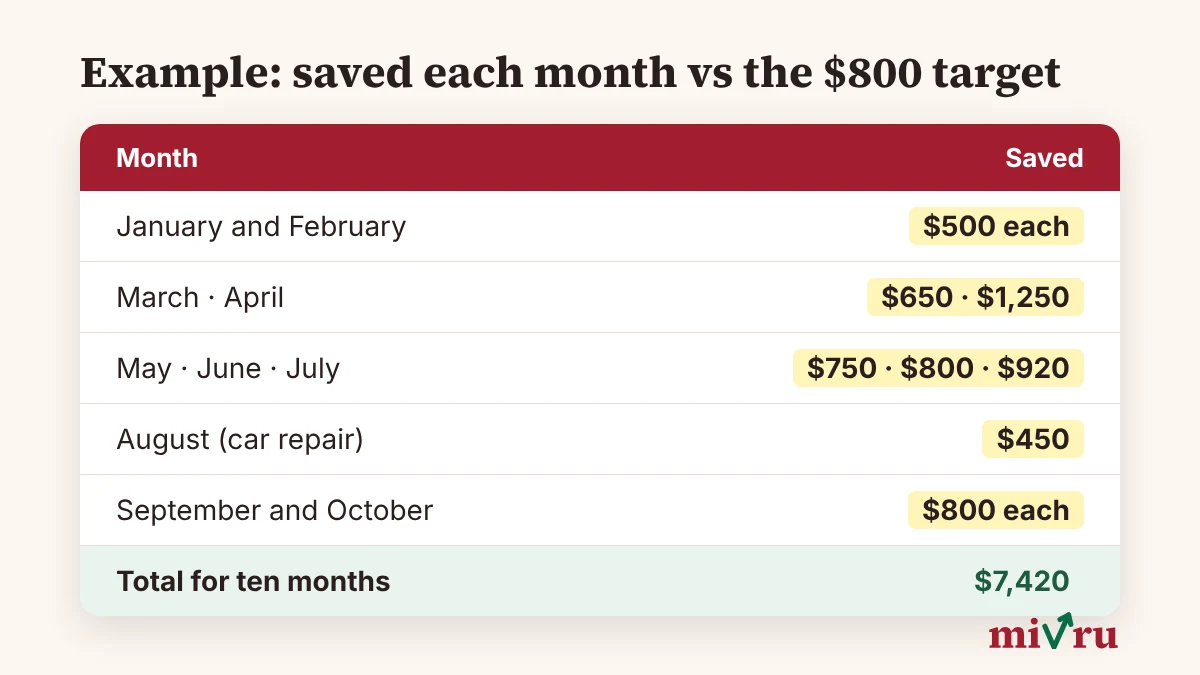
The household saved $7,420 in ten months. Month by month: $500, $500, $650, $1,250, $750, $800, $920, $450, $800 and $800. The monthly target is $800, and the household hit it in 5 of 10 months. April stands out because of the tax refund. August is low because of the withdrawal.
What the example teaches
- One big month does not fix a plan. April's $1,250 helped, but the long goals still need steady deposits.
- Withdrawals should be visible. The August withdrawal shows up in the log and in the month total, so the emergency fund's lower balance is not a mystery.
- Dates drive the amount. The same $600 left costs $100 a month over six months and $300 over two.
- Short goals can lag. The laptop and the holiday gifts are due first and are behind. Moving a few dollars from a long goal for a month or two is a choice the tracker lets you see.
Make your own
- List your goals with a target and a date.
- Write what you have already saved.
- Record each deposit and withdrawal with its date.
- Work out the percent done and the amount to save each month.
- Review once a month.
You can build one with our guides for Excel or Google Sheets, or print a free one-page sheet. For more ways to track, see savings tracker ideas.
The U.S. Consumer Financial Protection Bureau suggests testing your savings plan for a month and adjusting before you set up automatic transfers. Its guide to making saving automatic suggests scheduling them right after payday. This is general information, not financial advice.
If debt competes with your savings, see our debt payoff tracker example, and to find where the money goes, the expense tracker example.
The five goals in one table
| Goal | Target | Saved | Progress | Status | Needed a month |
|---|---|---|---|---|---|
| Emergency fund | $5,000 | $3,050 | 61% | On track | about $216.67 |
| Vacation | $2,400 | $1,320 | 55% | Behind | $216 |
| New laptop | $1,200 | $600 | 50% | Behind | $300 |
| House down payment | $20,000 | $6,000 | 30% | On track | about $518.52 |
| Holiday gifts | $600 | $250 | 42% | Behind | $175 |
The five targets add up to $29,200, and $11,220 is saved, which is 38%.
What "behind" means and what to do about it
A goal is behind when the amount saved so far is less than a steady path from the start date to the deadline. It is a signal, not a failure. If a goal is behind you have three honest options:
- Save more each month. The "needed a month" column shows how much.
- Move the deadline. A later date lowers the monthly amount.
- Lower the target. A cheaper laptop or a shorter trip may be fine.
Example: The laptop needs $300 a month for two months, and the holiday gifts need $175 a month. Both deadlines are close, so the household may choose to move the holiday money first and let the vacation slip a month.
Reading the table once a month
- Start with goals that have a deadline within three months. They need the most attention.
- Look at the needed-a-month total: about $1,426.19. Is that realistic next to your income and your other spending?
- If it is not, decide which goal is first, rather than spreading small amounts across everything.
- Update the saved amounts from your real account balances, so the sheet matches what is in the bank.
Want it filled in for you?
The Mivru Savings Tracker has all of this ready: the goals sheet, deposit log, dashboard, monthly table and a 52-week challenge. The example is included so you can see how it works. Clear it and enter your own goals. See the Savings Tracker Spreadsheet.
Frequently asked questions
What does a filled-in savings tracker look like?
It lists each goal with a target, a date and the amount saved, shows the percent done and what to save each month, and logs every deposit. This page walks through a made-up example with five goals.
Are the numbers in this example real?
No. The goals, amounts and deposits are made up to show how a tracker works. Use your own numbers.
What does On track mean?
On track means you have saved at least your share of the target for the time that has passed. For example, a goal that is halfway to its date should be at least half funded.
How is the save-per-month amount worked out?
It is the amount left to save divided by the months left until the target date, rounded up to whole months.
Where can I get a template?
Build one with our Excel or Google Sheets guides, print the free one-page sheet, or use the ready-made spreadsheet with the example included.