Printable Debt Payoff Tracker: Free PDF and How to Use It
A printable debt payoff tracker lists every debt, the payoff order and your progress. Get a free one-page PDF and see how to fill it in.
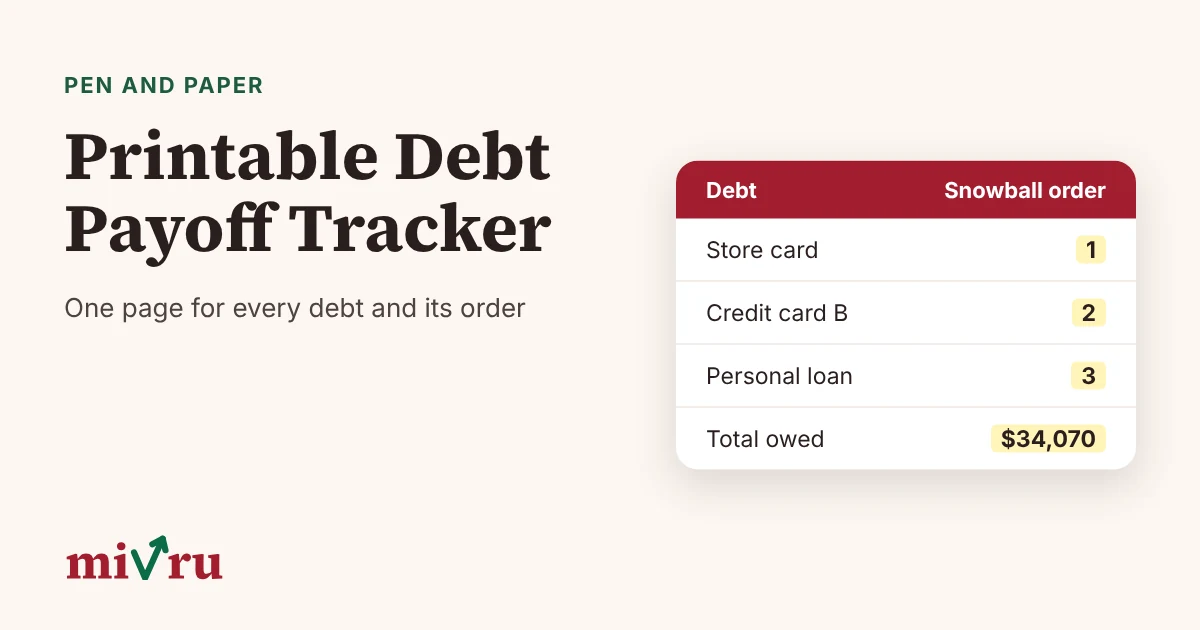
A printable debt payoff tracker puts all your debts on one page. You can see what you owe, which debt is next and how far you have come. Stick it on the fridge or keep it in a folder.
Below you will find what to write on it, an example and a free one-page PDF.
What to write on the page
For each debt:
- Name, like Credit card A.
- Balance, what you owe today.
- APR, the yearly interest rate.
- Minimum payment, the amount due each month.
- Order, the number showing when to pay it off.
Then write your extra payment for the month at the top. The extra goes to debt number 1.
An example
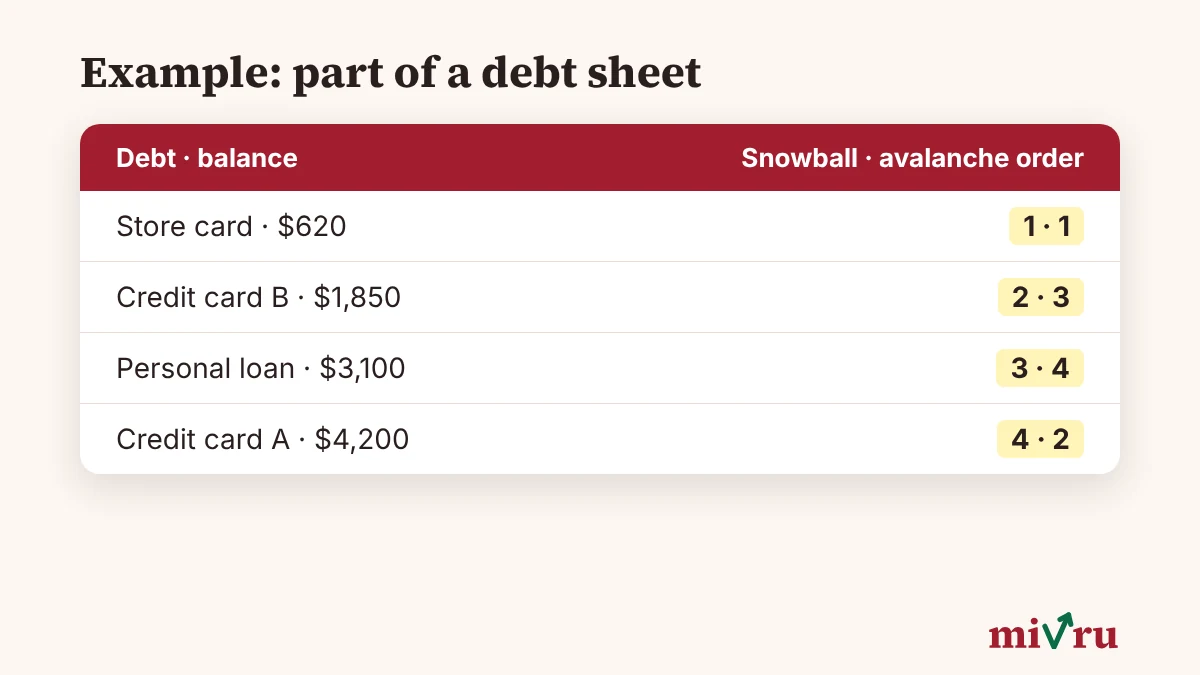
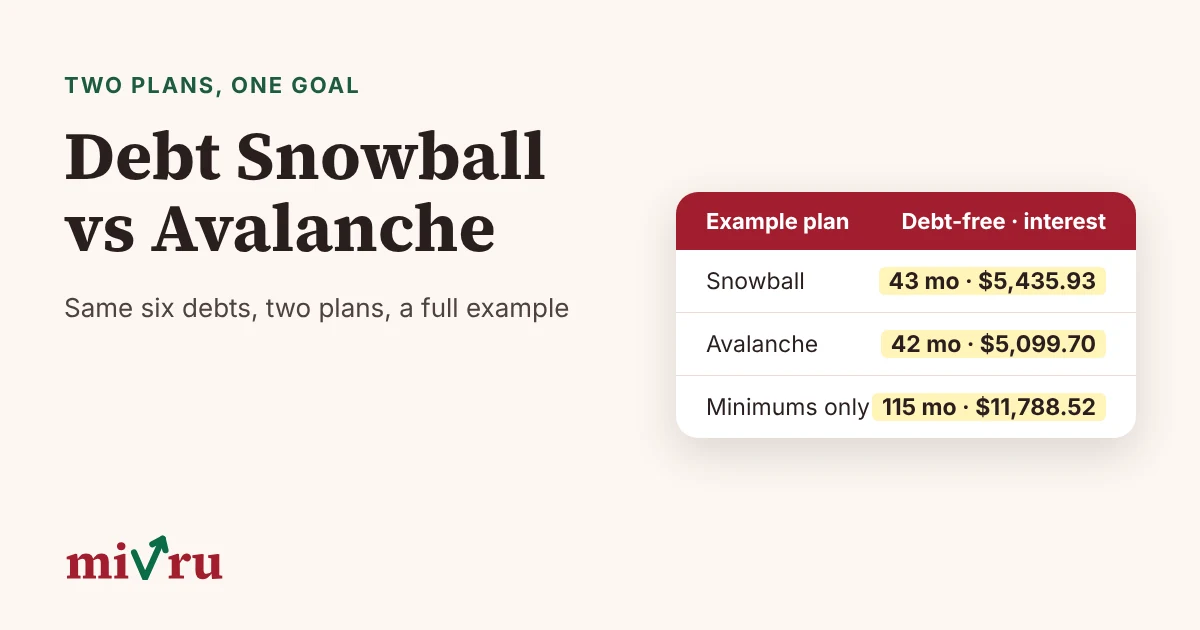
Example: Six made-up debts totalling $34,070. Snowball order (smallest balance first): store card $620, credit card B $1,850, personal loan $3,100, credit card A $4,200, car loan $9,800, student loan $14,500. Avalanche order (highest rate first): store card 29.99%, credit card A 24.99%, credit card B 19.99%, personal loan 11.50%, car loan 7.49%, student loan 5.05%.
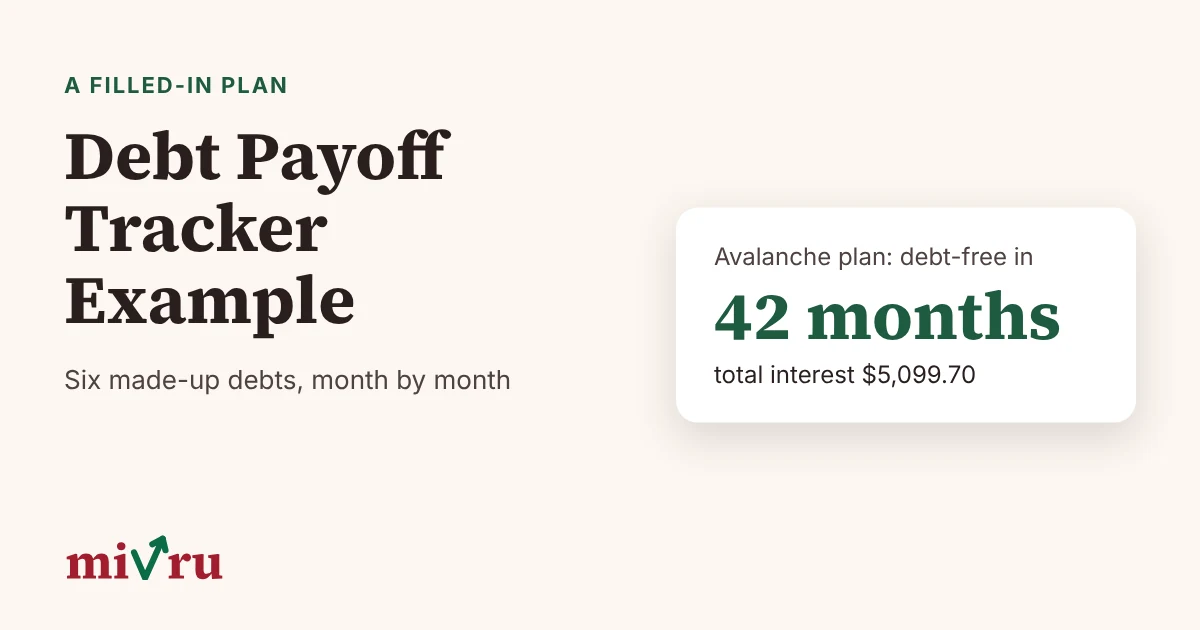
With $735 in minimums and $200 extra, the snowball in this example finishes in 43 months and the avalanche in 42. Read how they compare in our guide to debt snowball vs avalanche.
How to use it each month
- Pay every minimum on time.
- Pay the extra on debt number 1.
- Write the new balances on the sheet.
- When a debt is gone, color it in, and add its payment to the next debt.
Seeing the finished debts is a motivator. A study in the Journal of Consumer Research found that concentrating repayments on fewer accounts increased consumers' motivation to get out of debt.
Tips for making the page work
- Print two copies. Keep one in sight and one blank in case you change your plan.
- Update on payday. Write the new balances the same day you make the payments, so the page is never out of date.
- Use a pencil for balances and a pen for names. Balances change every month, but the list of debts only changes when one is paid off or a new one appears.
- Write the date each debt is paid off. A finished debt with a date next to it is a small reward, and a record of how fast you are moving.
- Review the order every few months. If a rate changes, or you get a lump sum such as a tax refund, check whether the order still makes sense. A one-time payment on the first debt can bring its payoff date forward by months.
Common mistakes
- Forgetting a debt. Check your credit card statements, loan accounts and any money you owe to family. A missing debt means a wrong plan.
- Using the wrong rate. The APR is on your statement. A promotional rate may end on a set date, so write that date next to the debt.
- Skipping a minimum. The extra money goes to one debt, but every other debt still needs its minimum.
- Adding new charges. Each new purchase on a paid-down card makes the page less accurate.
Paper or spreadsheet?
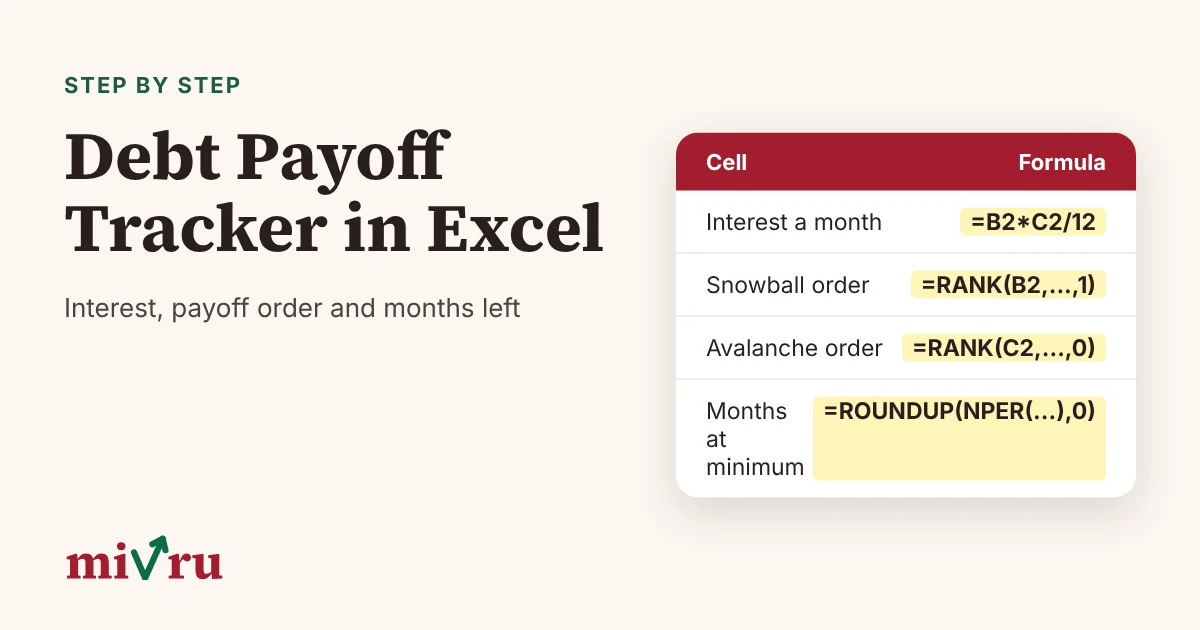
Paper is visible and has no setup. But working out the interest and the payoff date by hand is slow. A spreadsheet does the math each month. Our guides show how to build one in Excel or Google Sheets.
This is general information, not financial advice. The U.S. Federal Trade Commission's guide Choosing a Credit Counselor can help if the debt feels too large.
Other printables
Finding extra money is easier on paper too. See the printable subscription tracker and the printable expense tracker.
The two orders in one table
| Debt | Balance | Rate | Snowball order | Avalanche order |
|---|---|---|---|---|
| Store card | $620 | 29.99% | 1 | 1 |
| Credit card B | $1,850 | 19.99% | 2 | 3 |
| Personal loan | $3,100 | 11.50% | 3 | 4 |
| Credit card A | $4,200 | 24.99% | 4 | 2 |
| Car loan | $9,800 | 7.49% | 5 | 5 |
| Student loan | $14,500 | 5.05% | 6 | 6 |
The two orders agree on the first debt and the last two, and differ in the middle. If your own list gives the same order for both plans, you do not have to choose.
How the payment rolls forward
Suppose the household pays $935 a month in total. While the store card is being paid, the other five debts get only their minimums. Once the store card is gone, its payment moves to the next debt. In the snowball plan, credit card B then gets its $55 minimum plus the money freed up: $935 minus the minimums of the four other debts ($655) is $280 a month.
Example: The other four minimums are $105, $285, $160 and $105, which add up to $655. $935 - $655 = $280 for credit card B. The total never changes. It only moves to the next debt.
What to do on the page each month
- Write the new balance next to each debt, using your statements.
- Tick the payment box when you have paid.
- Color in the progress bar for each debt as the balance falls.
- Circle the debt you are working on and write the extra amount.
- Write one line about the month. A short note helps you remember what happened.
Keep it where you will see it
A printable tracker works when it is in view. Put it on the fridge, in a planner or in a folder with your statements. Update it the day you pay, and the habit will stick.
The full planner
The Mivru Debt Payoff Tracker includes a 12-page printable planner in color and in black and white, with a debt list, a plan chooser, a payoff plan, a payment tracker, balance trackers, progress bars, an interest worksheet and an extra money finder. It also includes the spreadsheet that does the math. See the Debt Payoff Tracker Spreadsheet.
Frequently asked questions
What is a printable debt payoff tracker?
A paper sheet where you list your debts with balance, rate and minimum payment, choose a payoff order, and cross off progress each month.
What should I write on a debt payoff tracker?
For each debt: the name, balance, APR and minimum payment. Then the order to pay them, your extra payment and the balance each month.
Is the free PDF really free?
Yes. The one-page debt snowball starter sheet is free to download and print on US Letter paper.
Should I use snowball or avalanche on paper?
Either works. Number your debts by smallest balance for the snowball or highest rate for the avalanche. Our guide compares them.
Is paper or a spreadsheet better?
Paper is simple and visible. A spreadsheet does the month-by-month math and shows the debt-free date. Many people use both.