Savings Tracker Ideas: 8 Simple Ways to Track Your Savings
Eight savings tracker ideas that work: goal list, deposit log, progress bars, monthly target and a 52-week challenge. Free printable included.
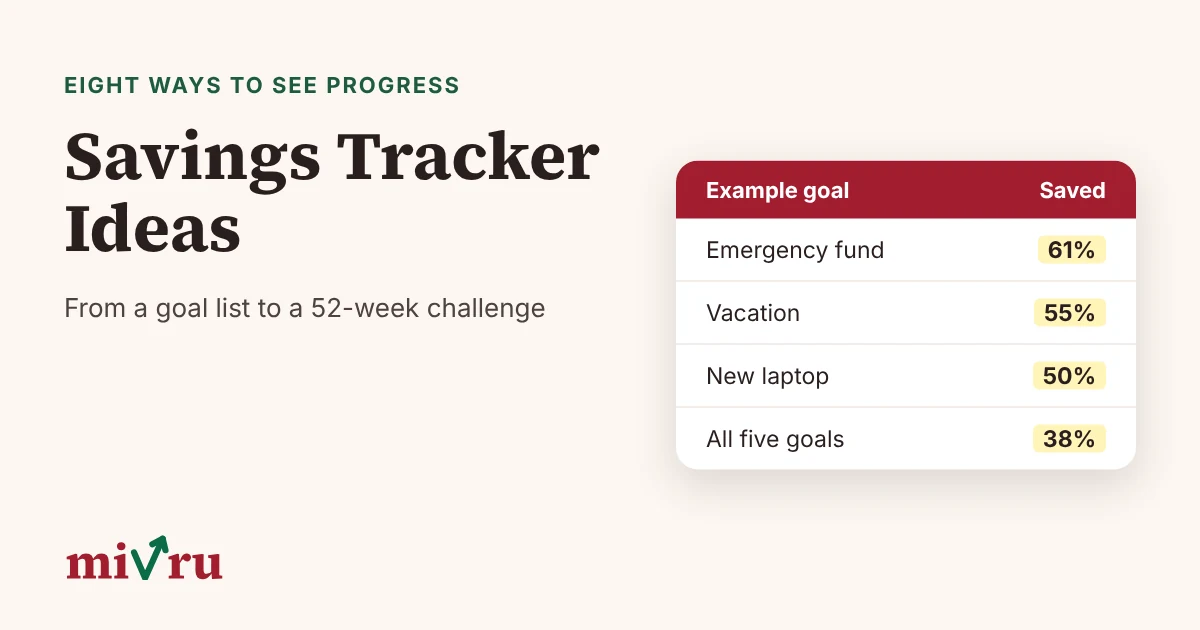
Savings tracker ideas come down to one question: how will you see your progress? Saving feels slow when the balance sits in an account and nothing shows how far you have come. A tracker fixes that. It turns "I should save more" into goals with amounts, dates and a bar that fills up.
This guide gives eight ideas, from a simple goal list to a 52-week challenge. Each one is easy to set up on paper or in a spreadsheet, and you can combine them. The numbers in the examples are made up.
1. A one-page goal list
Start with a list of what you are saving for. Write the goal, the target amount and the date you want it by. Naming the goal makes it real, and the date makes it urgent.
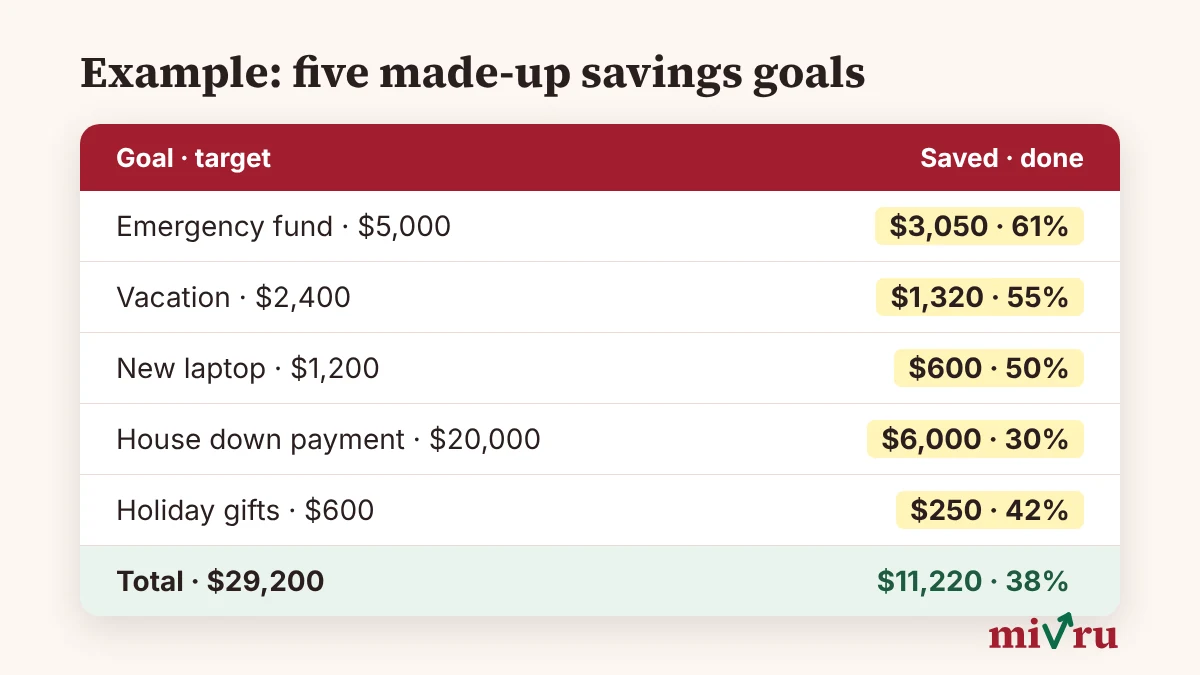
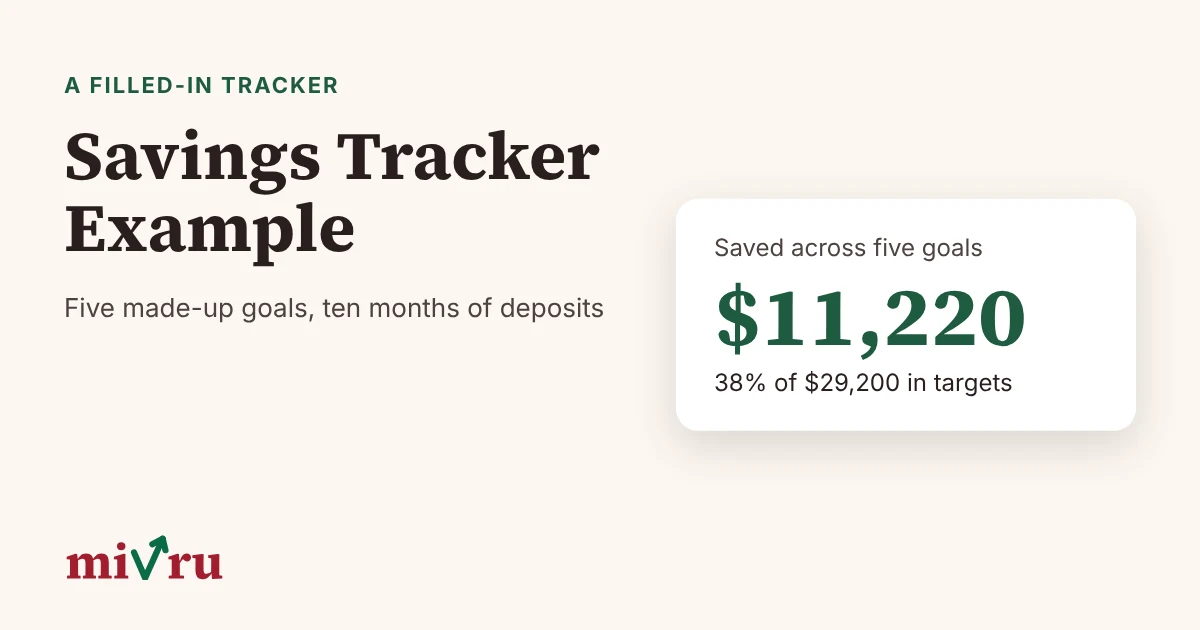
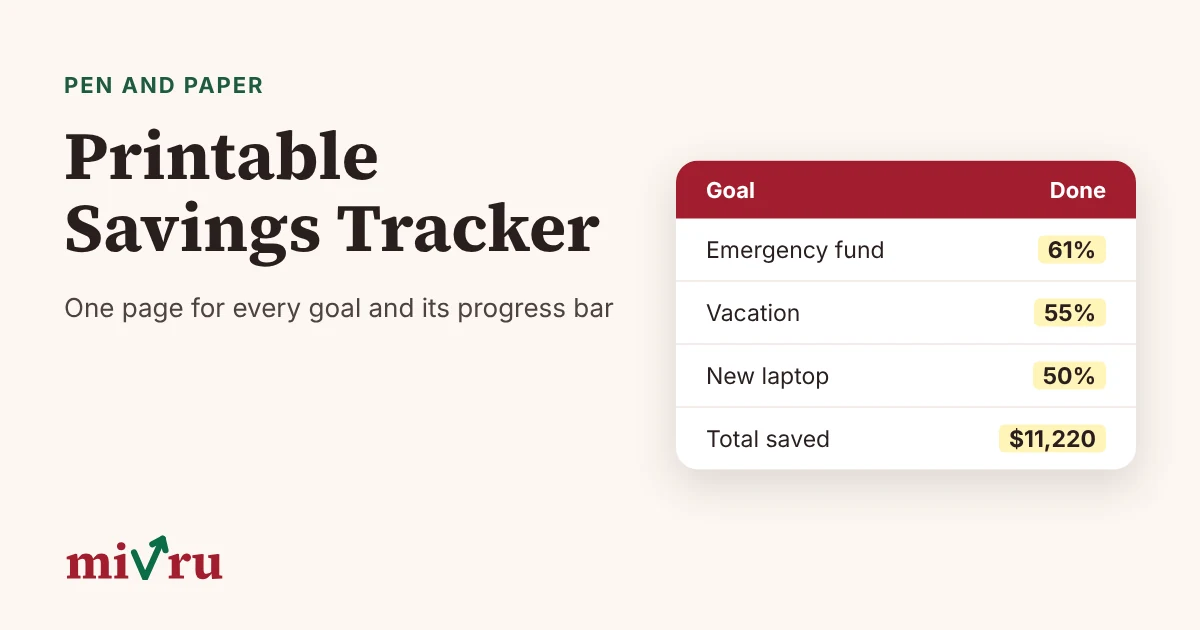
Example: An emergency fund of $5,000 by June 2027 with $3,050 saved (61%). A vacation of $2,400 by March 2027 with $1,320 saved (55%). A new laptop of $1,200 by December 2026 with $600 saved (50%). Together the five example goals add up to $29,200, and $11,220 is saved: 38%.
2. A monthly amount for each goal
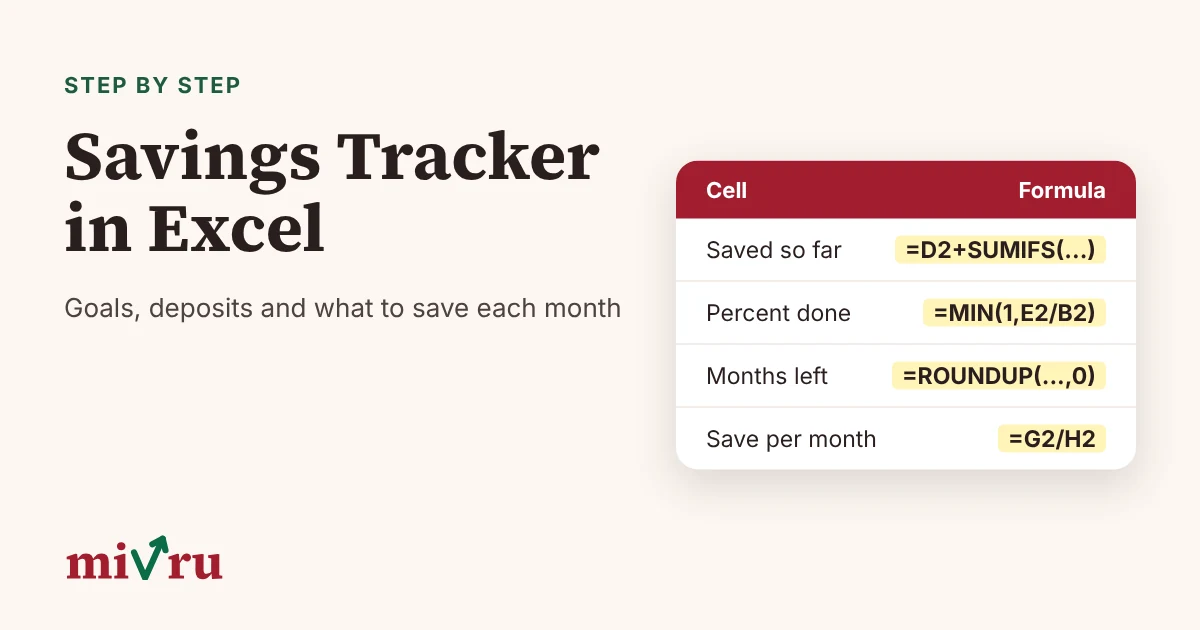
A date turns a goal into a monthly amount. The formula is simple: amount left divided by months left. For the laptop, $600 is left and there are 2 months, so the plan is $300 a month. For the emergency fund, $1,950 is left and there are 9 months, so about $216.67 a month.
If the monthly amount is too high, you have two choices: move the date or lower the target. Both are better than giving up.
3. A deposit log
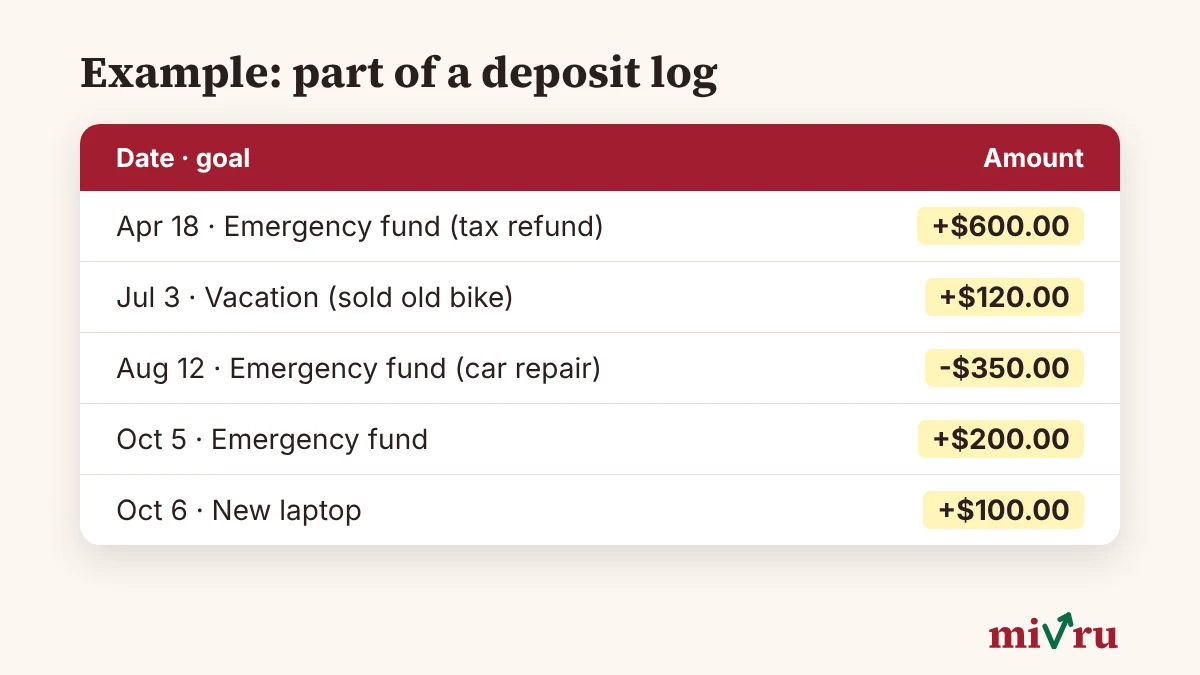
A deposit log records every time money goes in or out: the date, the goal, the amount and a short note. It takes ten seconds and gives you a history. When you look back you can see what worked, such as a tax refund that gave one month a big boost, or a car repair that took money out.
4. Progress bars
A bar that fills up is the most motivating part of a tracker. On paper, draw a row of ten squares and color one in for every 10% of the goal. In a spreadsheet, divide the saved amount by the target and let a data bar show the result. The bars in our example show the emergency fund at 61% and the house down payment at 30%. The second one is a long goal, so a lower bar is normal.
5. A monthly target and a scorecard
Choose one number for the whole month, for example $800, and compare it with what you really saved. A scorecard row shows the difference: ahead, on target or behind.
Example: Over ten months, the made-up household saved between $450 and $1,250 a month. It hit the $800 target in 5 of 10 months. April was the best month at $1,250 because of a $600 tax refund. August was the weakest at $450 because $350 came out for a car repair.
A scorecard makes a slow month visible without making it a failure. It also shows what is normal for you.
6. A 52-week challenge
The 52-week challenge is a checklist: save $1 in week 1, $2 in week 2, $3 in week 3, and so on up to $52 in week 52. The total is $1,378. Start with $2 and the total doubles to $2,756. Start with $5 and it is $6,890.
The challenge works because each week is a small, clear step. Tick a box when you have put the money aside. If the amounts at the end of the year are too high, flip the order and start with the big weeks first, when your motivation is highest.
7. Separate pots for known costs
Some costs are not surprises: holiday gifts, car registration, a yearly insurance bill. Give each one its own goal with a date and save a little each month. When the cost arrives, the money is already there. In the example, $600 for holiday gifts saved at $50 a month from June is paid in cash in December.
8. Automatic transfers on payday
The easiest way to save is not to decide each time. The U.S. Consumer Financial Protection Bureau suggests setting up automatic transfers from checking to savings, ideally right after payday, so you pay yourself first. It also advises checking your balance to avoid overdraft fees. A tracker then shows what arrived and whether you are on pace.
In an earlier post, the CFPB gives a simple plan: set a goal, test the plan for a month, then save automatically.
Putting the ideas together
You do not need all eight. A good starter set is the goal list (1), the monthly amount (2) and the progress bars (4). Add the deposit log when you want a history, and the 52-week challenge when you want a fun extra. See the full set filled in with example data in our savings tracker example.
To find money to save, track where it goes first. Our guide to tracking expenses shows how, and if debt is part of the picture, read debt snowball vs avalanche. This guide is general information, not financial advice.
Want it all in one place?
The Mivru Savings Tracker has these ideas built in: a goals sheet with percent done, months left and save-per-month, a deposit log, a dashboard with progress bars, a month-by-month savings table and a 52-week challenge. It works in Excel and Google Sheets and includes a 12-page printable planner. See the Savings Tracker Spreadsheet.
Frequently asked questions
What is a savings tracker?
A savings tracker is a sheet, on paper or in a spreadsheet, where you list your savings goals, record each deposit and see how close you are to each target.
What should I track on a savings tracker?
For each goal write the target amount, the target date and how much you have saved. Then record every deposit and withdrawal. The sheet can work out the percent done and the amount to save each month.
How do I stay motivated to save?
Make progress visible. Progress bars, a 52-week challenge checklist and a monthly target you can tick off all show you what you have done. A specific goal with a date is easier to keep than a vague wish to save more.
How much should I save each month?
Divide what is left to save by the months left. A $1,200 goal with $600 saved and 6 months to go needs $100 a month. If that is too much, move the target date or lower the target.
Is a spreadsheet better than paper?
Paper is quick and visible. A spreadsheet adds up deposits, shows the percent done and works out what to save each month by itself. Many people print a one-page sheet and keep a spreadsheet as well.