Vacation Savings Tracker Printable Free: Plan and Save
A vacation savings tracker printable free plan: budget the trip, work out the weekly amount and tick off a savings challenge. Free chart and guide.
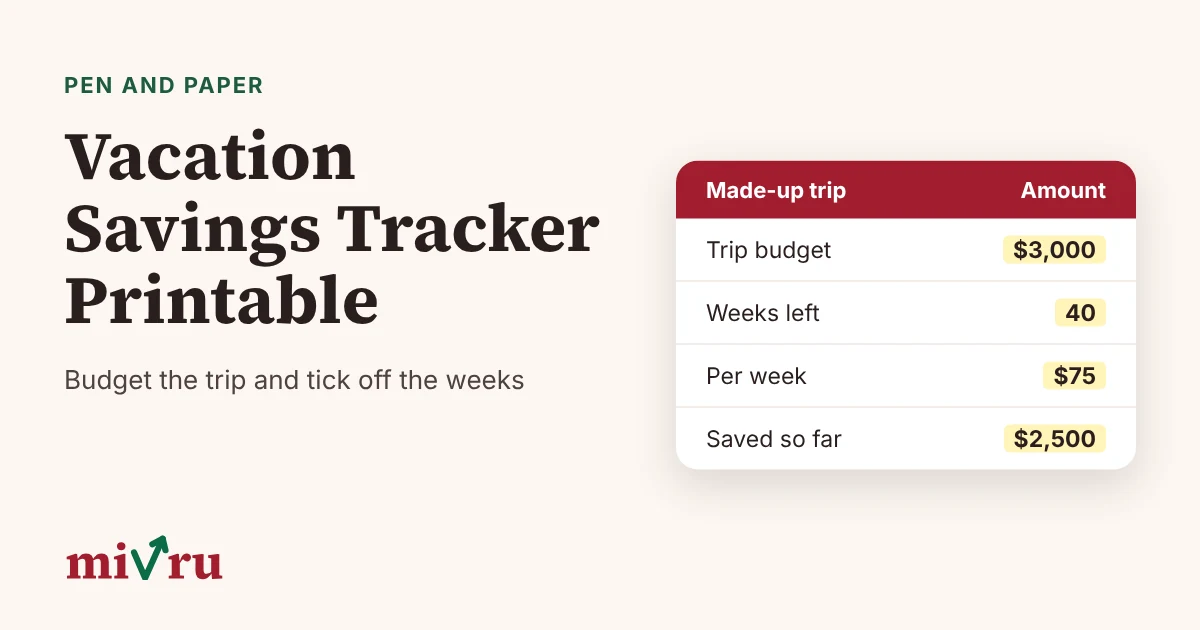
A vacation savings tracker printable free of any special software is a page for the trip budget, a weekly amount and a chart you can tick. This guide shows how to plan a trip on paper, work out how much to save each week and keep yourself on track with a savings challenge. The numbers are made up.
Our free 52-week savings challenge is the chart. If you prefer a spreadsheet, see the vacation savings tracker in Google Sheets guide.
Step 1: Budget the trip
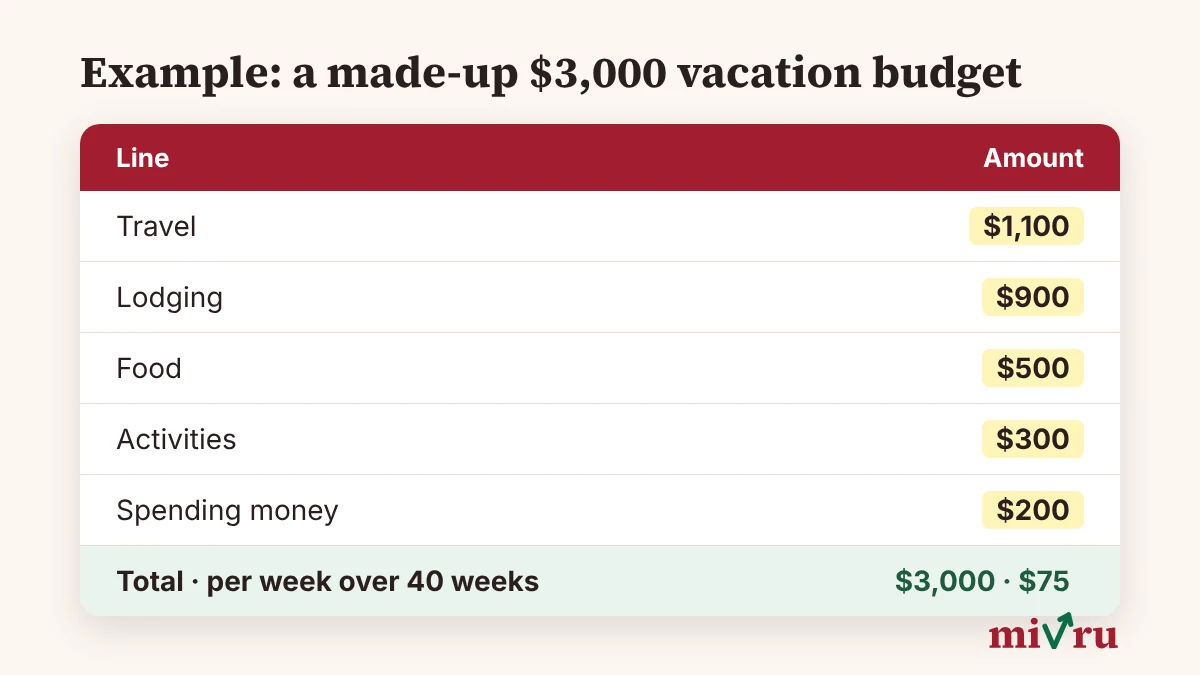
Write five lines: travel, lodging, food, activities and spending money. Add them up. Add 5% to 10% for things you did not think of.
Example (made up): Travel $1,100, lodging $900, food $500, activities $300 and spending money $200 add up to $3,000.
Step 2: Choose the date
Pick the date you leave and count the weeks from today. If you have 40 weeks, you have 40 chances to save. A date makes the goal real. Without it, the plan is just a wish.
Step 3: Work out the weekly amount
Divide the total by the weeks. $3,000 / 40 weeks = $75 a week. If you already have some money saved, subtract it first. $3,000 minus $500 already saved is $2,500, and $2,500 / 40 is $62.50 a week.
If the weekly amount is too high, change one of three things: the date, the budget or the amount. A longer runway is usually the easiest.
Step 4: Open a place for the money
The Consumer Financial Protection Bureau suggests setting a goal, testing a plan for a month and saving automatically. A separate savings account for the trip keeps the money away from daily spending, and a weekly automatic transfer means you do not have to remember.
Step 5: Add a challenge for the fun of it
A tick chart makes saving visible. Choose one:
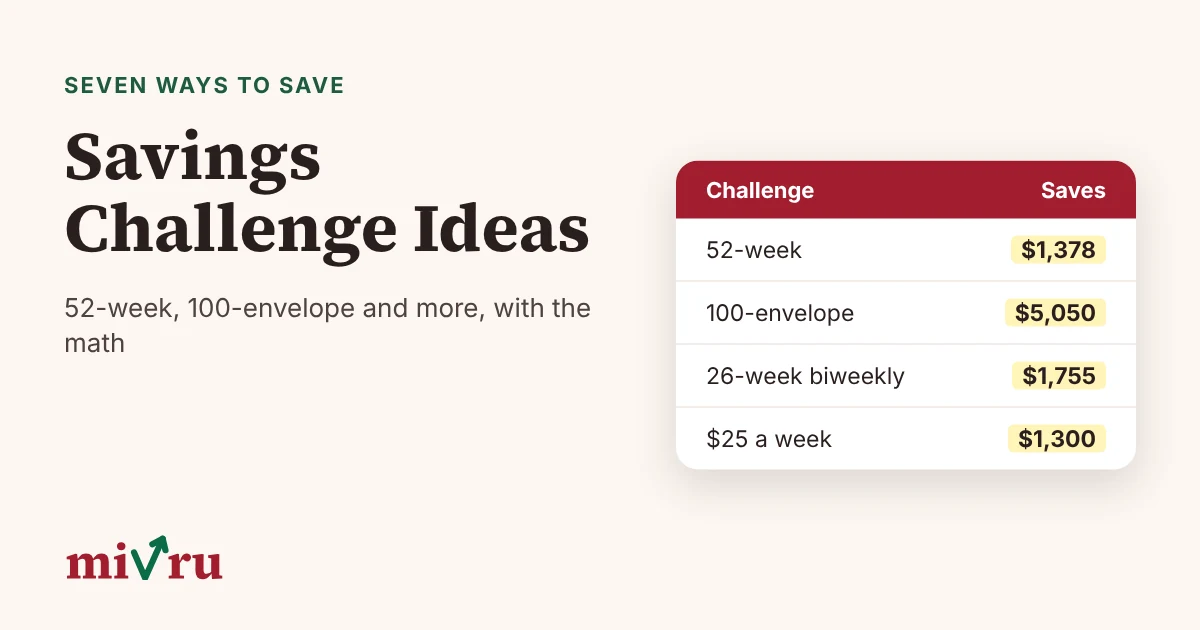
- 52-week challenge: $1 in week 1 up to $52 in week 52 saves $1,378.
- Fixed weekly amount: your $75 from step 3, ticked off each week.
- 100-envelope challenge: saves $5,050, which could fund a bigger trip.
See our savings challenge ideas for more formats and the math behind each.
Step 6: Log every deposit
On a deposit log, write the date, the amount and the total so far. In the example, ten monthly deposits of $250 give $2,500, which is 83% of the $3,000 goal. Seeing 83% is more motivating than seeing a bank balance.
Step 7: Plan the spending too
Once the trip is paid for, the savings are not the whole story. Prices change, and extras show up. Our guide on the holiday travel budget shows how to set a spending plan for a trip with a buffer so nothing surprises you.
What to do when you fall behind
Falling behind is normal. Look at the chart. If you skipped a few weeks, you can catch up with a larger amount, move the date or trim the budget. The CFPB's guide to emergency funds says that even a small amount can provide some financial security, and the same applies to a trip fund: small steady amounts add up.
Print, then track
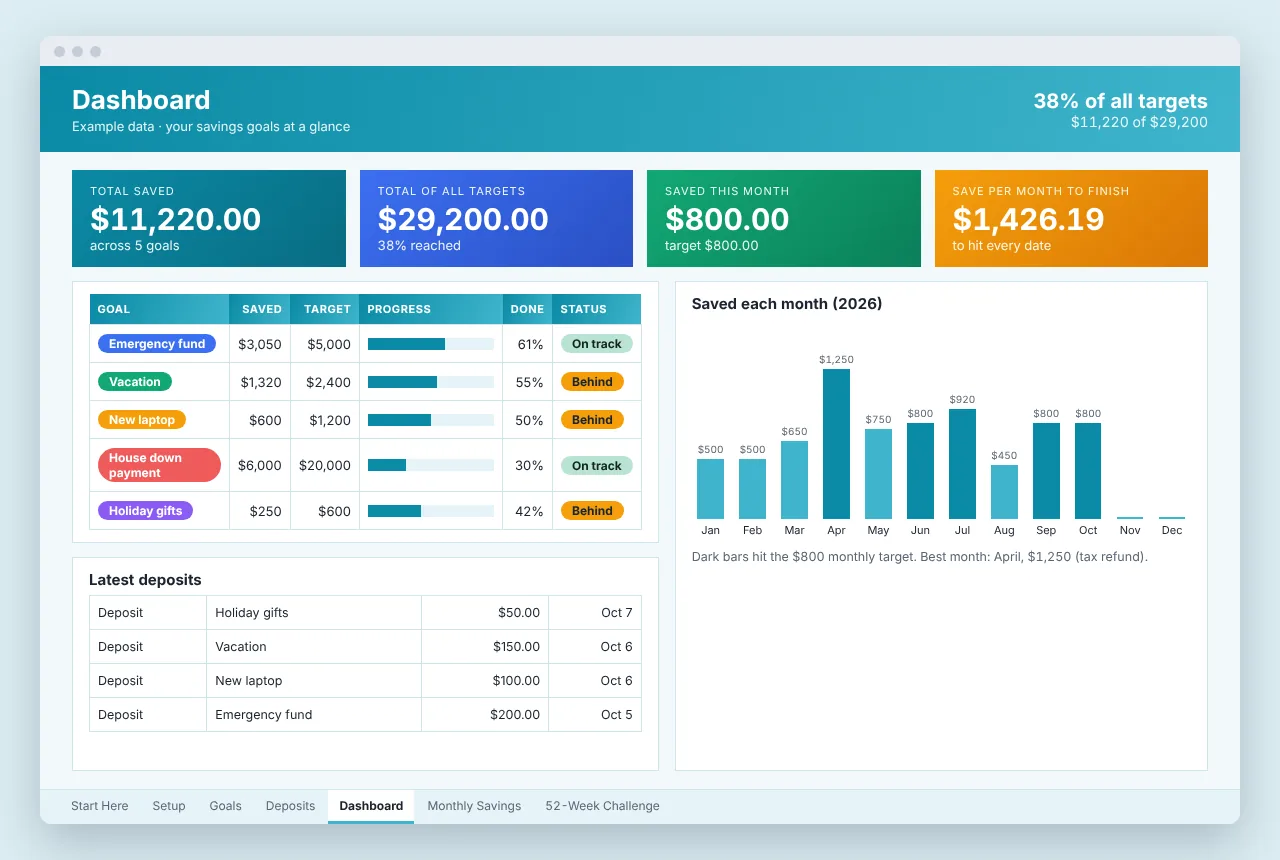
A printed chart is fun to tick. If you also want a spreadsheet that totals deposits and tracks several goals, see the savings goal tracker in Excel guide, or our printable savings tracker for another paper style. This is general information, not financial advice.
The trip budget in a table
| Line | Amount | Share of the total |
|---|---|---|
| Travel | $1,100 | 37% |
| Lodging | $900 | 30% |
| Food | $500 | 17% |
| Activities | $300 | 10% |
| Spending money | $200 | 7% |
| Total | $3,000 | 100% |
The shares are rounded, so they add to 101%. The dollar amounts add up exactly: 1,100 + 900 + 500 + 300 + 200 = 3,000.
How the weekly amount changes with the date
| Weeks to save | Amount a week for $3,000 |
|---|---|
| 20 | $150.00 |
| 30 | $100.00 |
| 40 | $75.00 |
| 52 | $57.69 |
A longer runway lowers the weekly amount. If you add a 5% to 10% buffer, the budget becomes $3,150 to $3,300, and at 40 weeks that is $78.75 to $82.50 a week.
A simple weekly routine
- Move the weekly amount to the trip account on the same day each week.
- Tick the chart.
- Write the deposit in the log with the running total.
- Once a month, compare the total with your plan.
Before you book
Wait until the money is saved before you pay for the trip, if you can. If you book early, a refund policy and a deposit date are worth reading, so the trip does not become a bill you have to pay from your daily budget.
A short checklist before you start
- Is the date real? Pick a month and write it on the chart.
- Is the budget written down? Five lines, one total.
- Is the weekly amount something you can keep up? If not, move the date.
- Is the money in its own place? A separate account keeps it out of daily spending.
Get the whole set
The Mivru Savings Challenge & Goal Tracker has an 11-page printable in color and black and white: a 52-week chart, a 100-envelope chart, two goal thermometers to color, a goal planner, a vacation fund planner, a deposit log and a month-by-month grid. It also has a spreadsheet for Excel and Google Sheets in five color themes. See the Savings Challenge & Goal Tracker Printables.
Frequently asked questions
Is there a free vacation savings tracker printable?
Yes. Mivru has a free one-page 52-week savings challenge printable. A vacation fund planner page is part of the full printable set.
How do I plan a vacation budget on paper?
List travel, lodging, food, activities and spending money, add them up, add a small buffer, then divide by the weeks until you leave to get the weekly amount.
How much should I save per week for a vacation?
Divide the trip cost by the weeks left. A $3,000 trip with 40 weeks left is $75 a week.
Should I save in cash or in an account?
Many people use a separate savings account so the money is not spent. A cash envelope works for small amounts but is easy to dip into.
What if I cannot reach the goal by the trip date?
Move the date, shorten the trip, lower the budget or save more per week. The tracker shows early enough to change the plan.