Savings Challenge Ideas: 7 Printable Challenges to Try
Savings challenge ideas with the math: 52-week, 100-envelope, biweekly and more, how much each saves, and which one fits your budget. Free chart included.
Savings challenge ideas all do the same thing: they turn a big goal into a small amount you can save this week, and a chart you can tick. This guide gives seven challenges with the math for each, so you can choose one that fits your budget, and a free chart to start today.
The examples use made-up numbers. Our free 52-week savings challenge is a one-page chart.
Why challenges work
Saving "more" is vague. Saving $14 this week is not. A challenge gives you a number, a box to tick and a total that grows. The Consumer Financial Protection Bureau suggests setting a goal, testing a plan and then saving automatically, and a challenge chart is a simple way to test a plan before you automate it.
1. The 52-week challenge
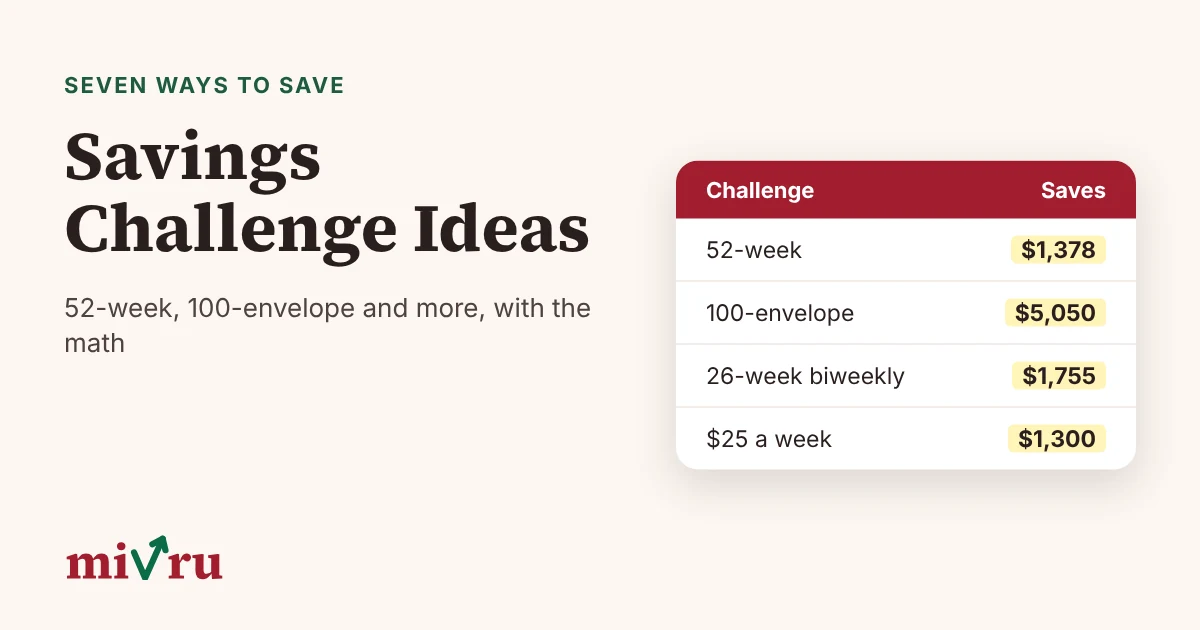
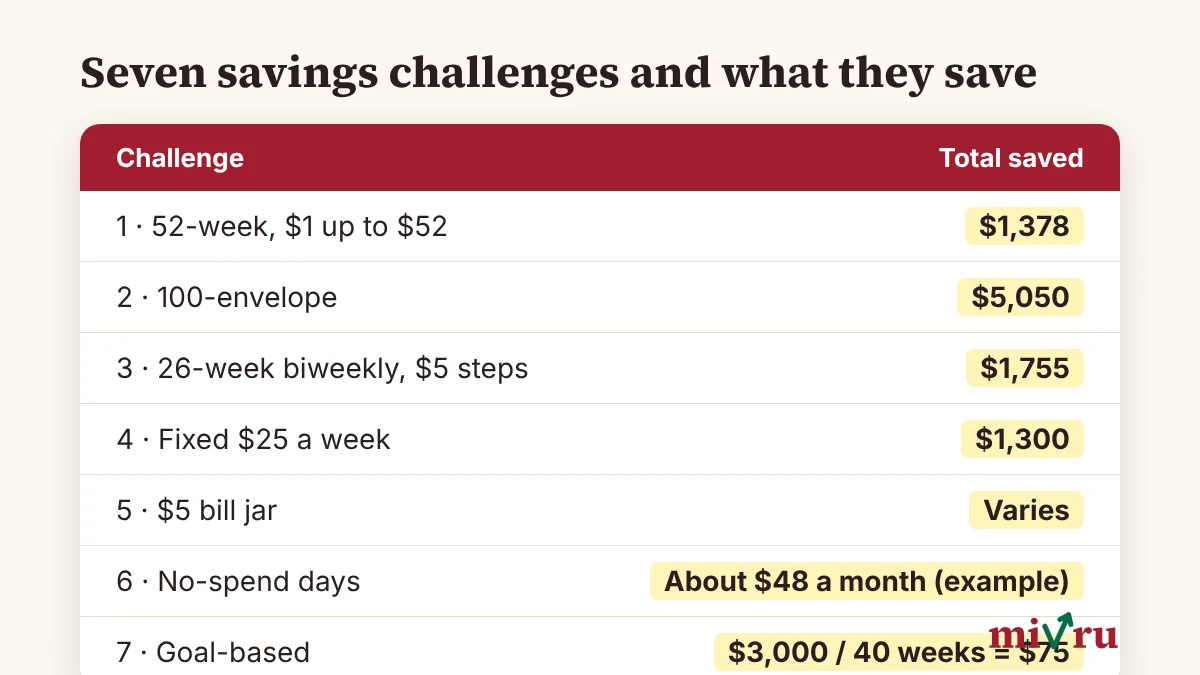
Save $1 in week 1, $2 in week 2 and so on up to $52. The total is $1,378. The hardest weeks come at the end, when the amounts are biggest. If that is a problem, flip the order and start with $52.
2. The 100-envelope challenge
Number 100 envelopes from 1 to 100. Pick one at random, put that many dollars in and tick it off. The total is $5,050. It is a fun challenge, but it needs cash and a place to keep envelopes, so many people do it with a savings transfer instead.
3. The 26-week biweekly challenge
Save every two weeks. Start at $5 and add $5 each time: $5, $10, $15 up to $130. The total over 26 pay periods is $1,755, and it fits people who are paid every two weeks.
4. The fixed weekly amount
Pick one number you can afford, such as $25, and save it every week. In a year that is $1,300. It is the easiest to automate and the easiest to keep going.
5. The $5 bill challenge
Every time you get a $5 bill in change, put it aside. There is no fixed total, but it feeds a jar quietly. Move the jar to your savings account each month.
6. The no-spend challenge
Pick a number of days a month with no spending apart from bills, such as four. Put what you would have spent into savings. If a normal day costs about $12 in small purchases, four no-spend days save about $48 a month.
7. The goal-based challenge
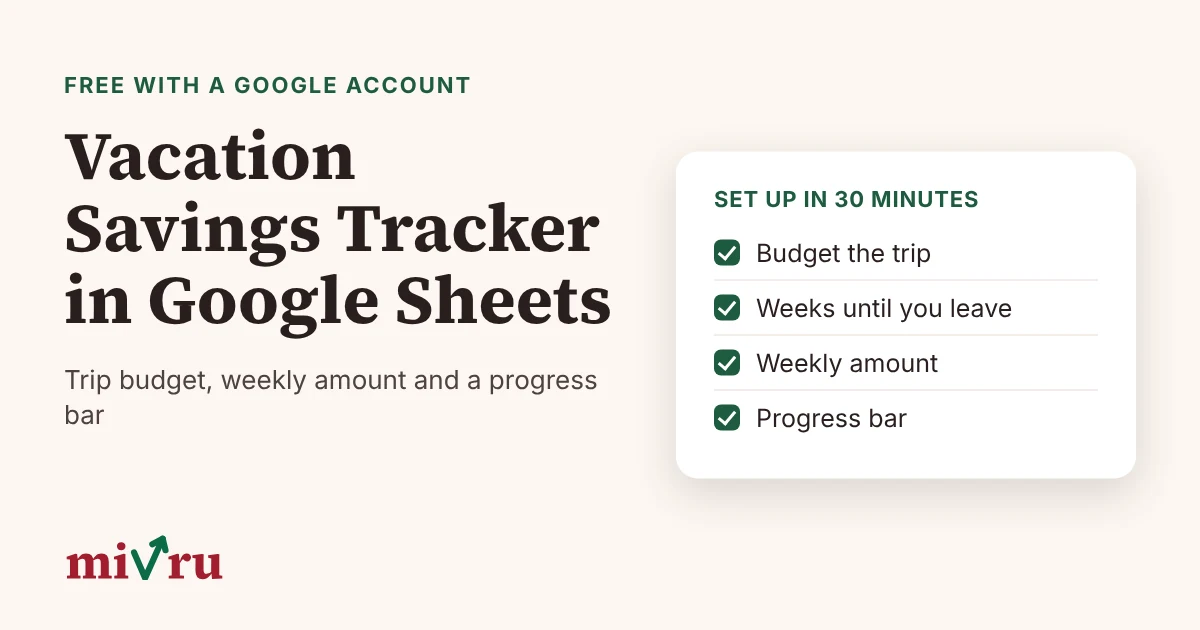
Instead of a random amount, divide a goal by the weeks you have. A $3,000 vacation in 40 weeks is $75 a week. This is the most practical challenge because the total matches something you want. See our vacation savings tracker guide for how to build one.
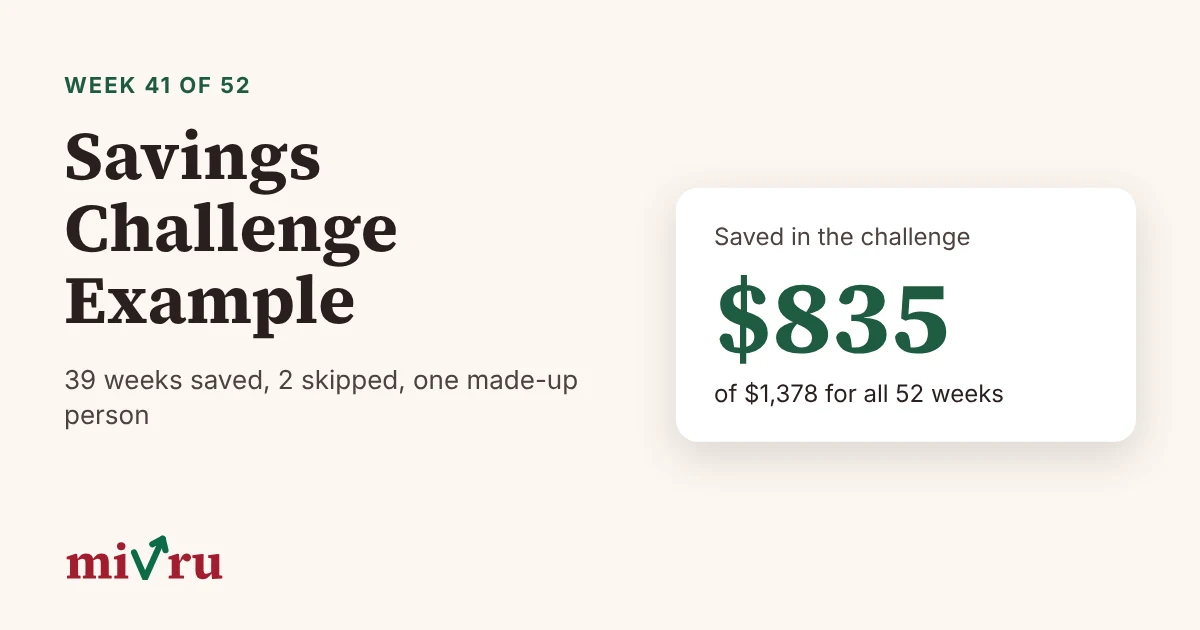
Example (made up): A person runs the 52-week challenge and a $75-a-week vacation fund at the same time. In week 41 they have saved $835 in the challenge, after skipping weeks 9 and 17, and $2,500 toward the vacation. Our savings challenge example walks through the numbers.
How to choose
- Tight budget: a fixed small weekly amount, or the 52-week challenge in reverse.
- Irregular income: the goal-based challenge, adjusted each month.
- You like games: the 100-envelope challenge.
- Paid biweekly: the 26-week challenge.
- You want a quick start: the 52-week challenge. It is the one most people know.
Make it stick
- Move the money when you tick. A box with no transfer is only a drawing. Set up a weekly standing transfer if your bank allows it.
- Keep the savings apart. The CFPB's guide to emergency funds suggests recurring transfers from checking to savings as one of the easiest ways to build savings, and says even a small amount can provide some financial security.
- Put the chart where you see it. The fridge works.
- Pick a reward for each milestone, a small one that costs little.
- Forgive a missed week. Note it and carry on.
Print, type or both
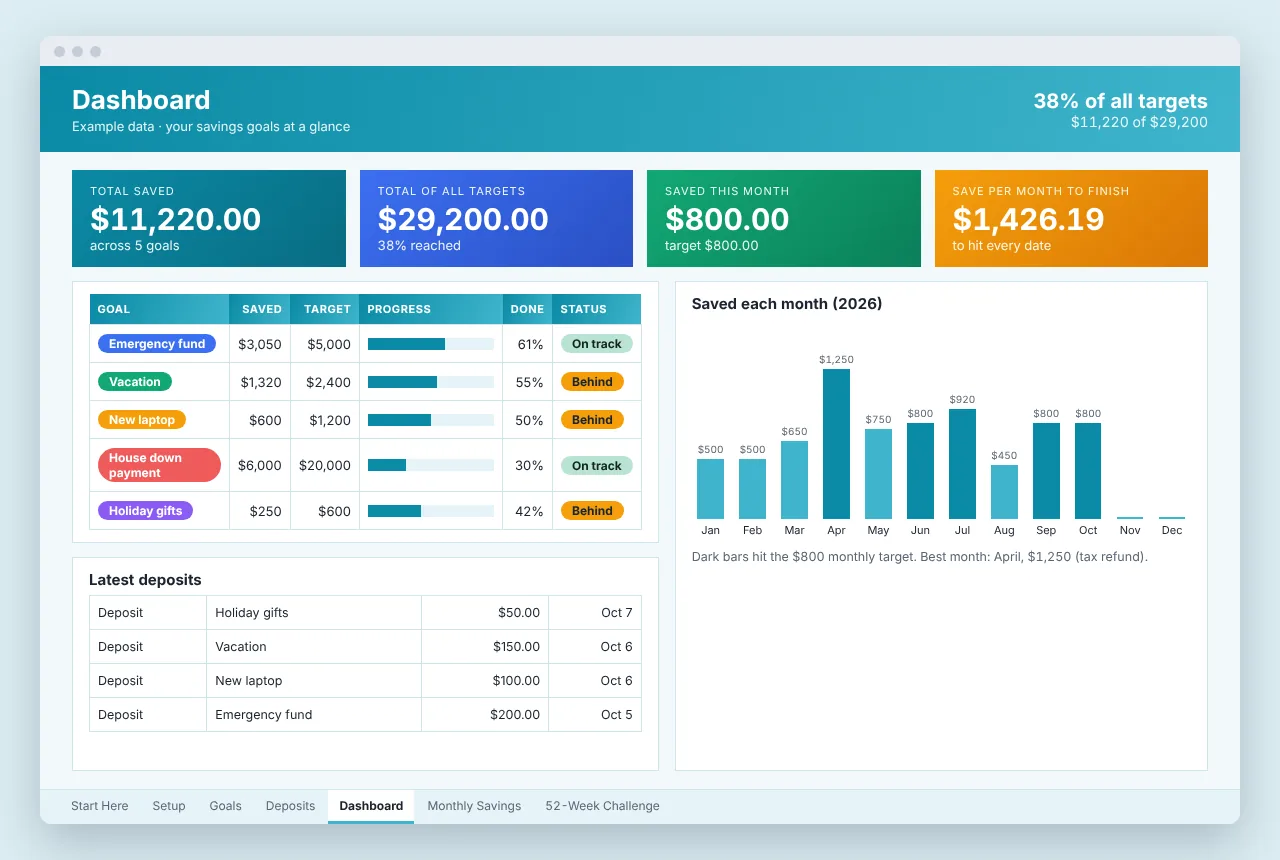
A printed chart is satisfying to tick. A spreadsheet adds the totals for you and tracks several goals. See our savings tracker ideas for more ways to see progress, and the savings tracker example for goals and deposits. This is general information, not financial advice.
What the 52-week challenge adds up to
In the 52-week challenge you save $1 in week 1, $2 in week 2 and so on up to $52 in week 52. The total is $1 + $2 + ... + $52 = $1,378. After 41 weeks you would have saved 41 x 42 / 2 = $861.
Example: A person who skips weeks 9 and 17 has saved $861 - $9 - $17 = $835 by week 41. That matches the example above.
| Week | Saved in that week | Running total |
|---|---|---|
| 10 | $10 | $55 |
| 20 | $20 | $210 |
| 30 | $30 | $465 |
| 41 | $41 | $861 |
| 52 | $52 | $1,378 |
What to do if you miss a week
Missing a week does not break the challenge. Either skip the week, as the example does, or add it to a later week. What matters is the habit, not a perfect chart.
Combining a challenge with a goal
A challenge is a fun way to start. A goal gives it a purpose. The example runs both: the 52-week challenge builds a general fund, and a fixed $75 a week builds a vacation fund. If you do both, make sure the weekly total fits your budget.
Want charts and tracking together?
The Mivru Savings Challenge & Goal Tracker has an 11-page printable (a 52-week chart, a 100-envelope chart, goal thermometers to color, a vacation fund planner and a deposit log) plus a spreadsheet for Excel and Google Sheets in five color themes with a dashboard. See the Savings Challenge & Goal Tracker Printables.
Frequently asked questions
What is a savings challenge?
It is a plan that tells you exactly how much to save each week or day, often with a chart to tick. The best-known one is the 52-week challenge, which starts at $1 in week 1 and adds $1 each week.
How much does the 52-week challenge save?
$1,378 in total, because 1 + 2 + 3 and so on up to 52 equals 1,378. The 100-envelope challenge saves $5,050.
Which savings challenge is best for a tight budget?
Start with the 52-week challenge in reverse: begin with the big amounts when you have the most money left, or pick a smaller fixed weekly amount.
Do savings challenges work?
They work when they turn into a habit. A chart makes saving visible, but the money has to move to savings each time you tick a box. Automatic transfers help.
What if I miss a week?
Skip it, catch up later or move on. A missed week does not ruin the challenge. Mark it as skipped so you can see it.