Savings Challenge Example: 41 Weeks of the 52-Week Plan
A savings challenge example: a made-up person on week 41 of the 52-week plan with 2 skipped weeks, $835 saved and six goals with progress bars.
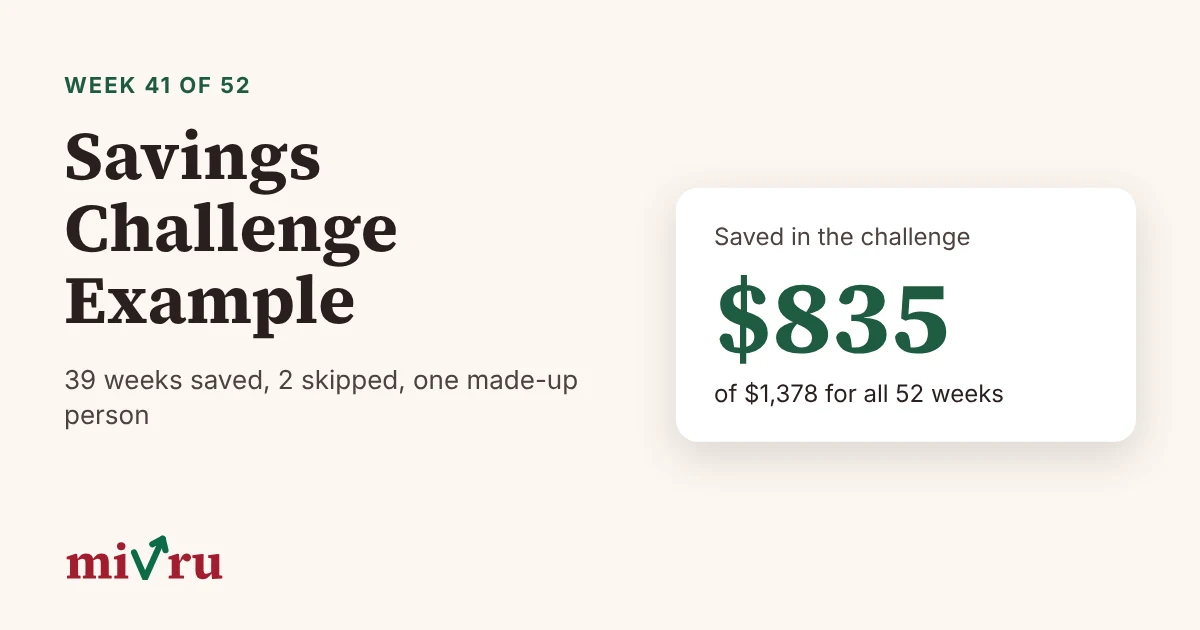
This savings challenge example shows a made-up person at week 41 of the 52-week challenge: 39 weeks saved, 2 skipped and $835 put aside, alongside deposits toward six goals. Every number is invented. Use it as a pattern for your own challenge.
The plan
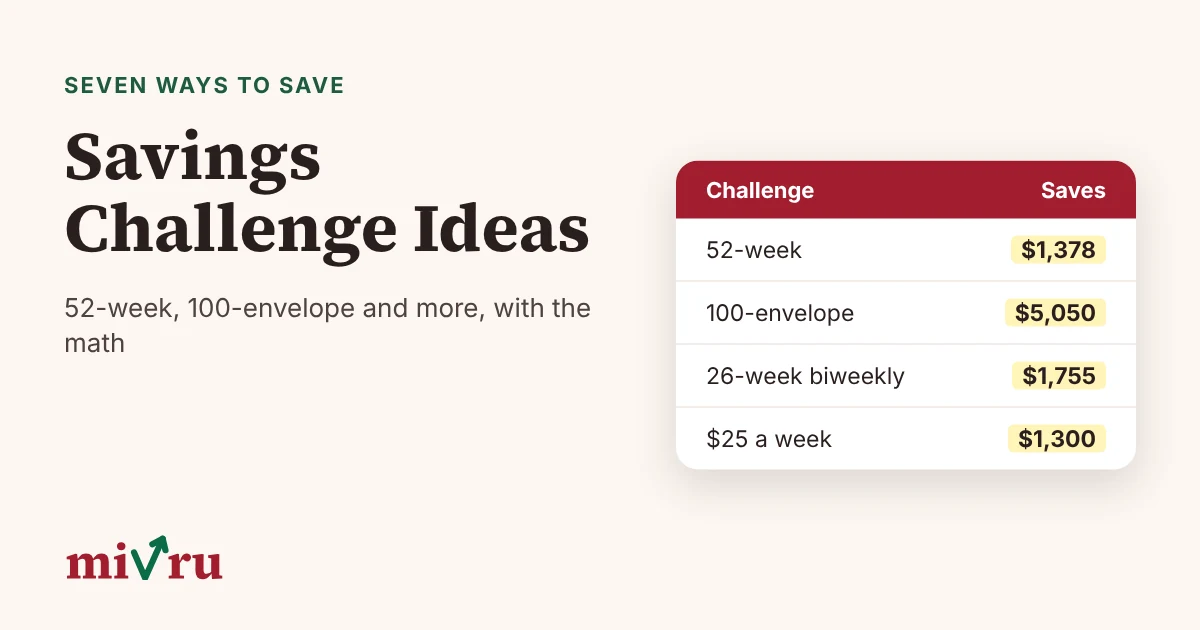
The 52-week challenge starts at $1 in week 1 and adds $1 each week, so week 41 is $41 and week 52 is $52. A full year saves $1,378. The made-up person started on January 4, 2026 and ticks a week as soon as the money moves to savings.
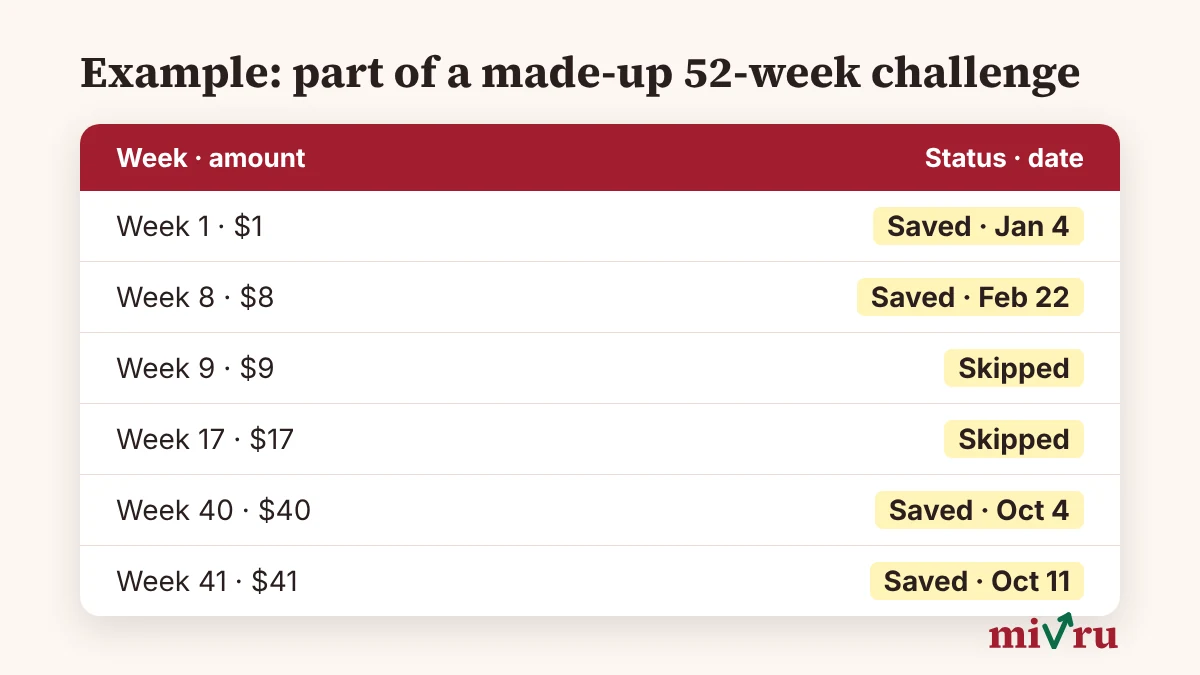
Where the challenge stands
| Count or amount | |
|---|---|
| Weeks saved | 39 |
| Weeks skipped | 2 (weeks 9 and 17) |
| Saved so far | $835 |
| Full challenge total | $1,378 |
| Weeks still to come | 11 (weeks 42 to 52) |
Adding weeks 1 to 41 gives $861. Taking away the two skipped weeks ($9 and $17) leaves $835. The weeks still to come add up to $517, because weeks 42 to 52 are $42 through $52.
Example: If the person catches up the skipped weeks later, the total after 52 weeks is still $1,378. If they never do, it is $1,352. Either way, the chart shows exactly where they stand.
Deposits toward six goals
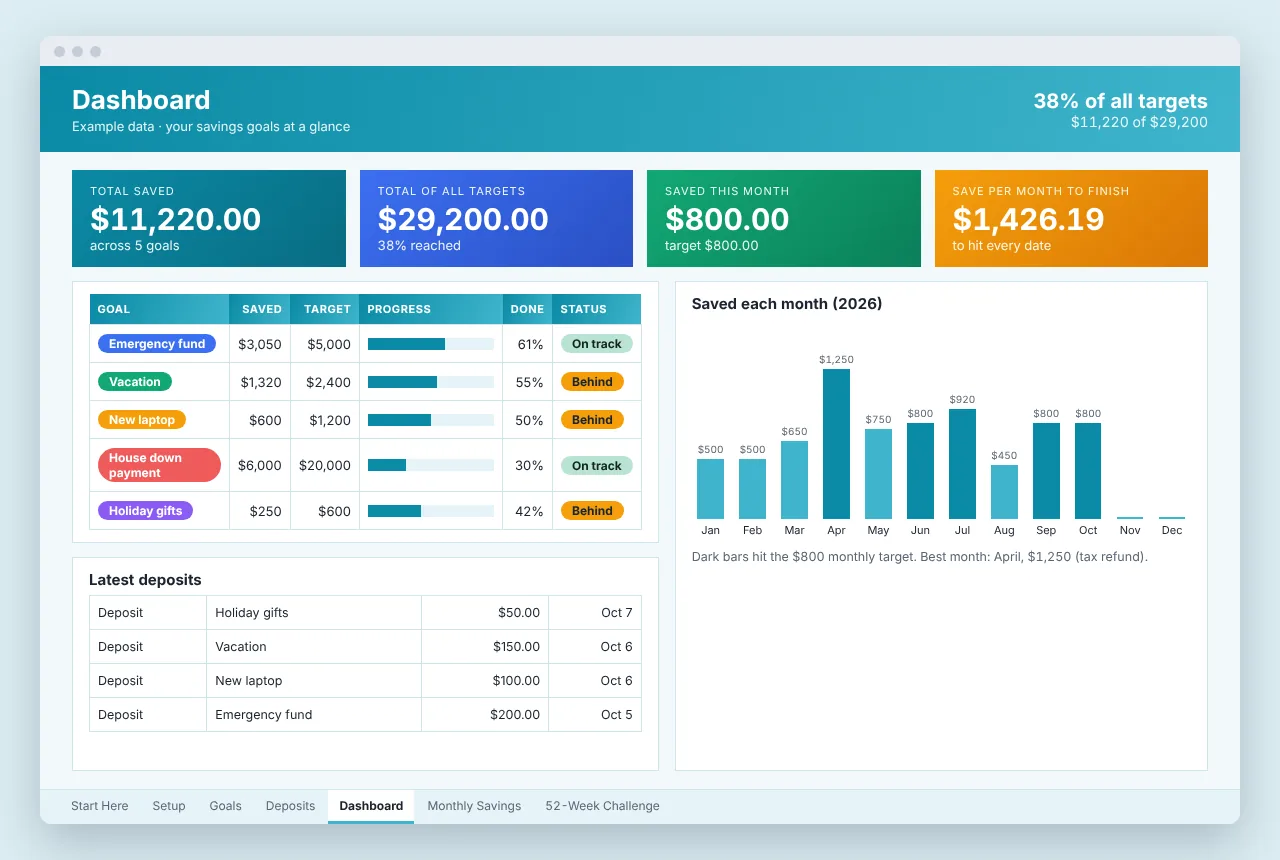
The challenge is a habit. The goals are what the money is for. The made-up person also logs monthly deposits toward six goals, each with a target:
| Goal | Saved | Target | Progress |
|---|---|---|---|
| Vacation fund | $2,500 | $3,000 | 83% |
| Emergency fund | $2,700 | $5,000 | 54% |
| New laptop | $1,200 | $1,200 | 100% |
| Holiday gifts | $810 | $900 | 90% |
| Home repair | $1,200 | $2,000 | 60% |
| Fun money | $600 | $600 | 100% |
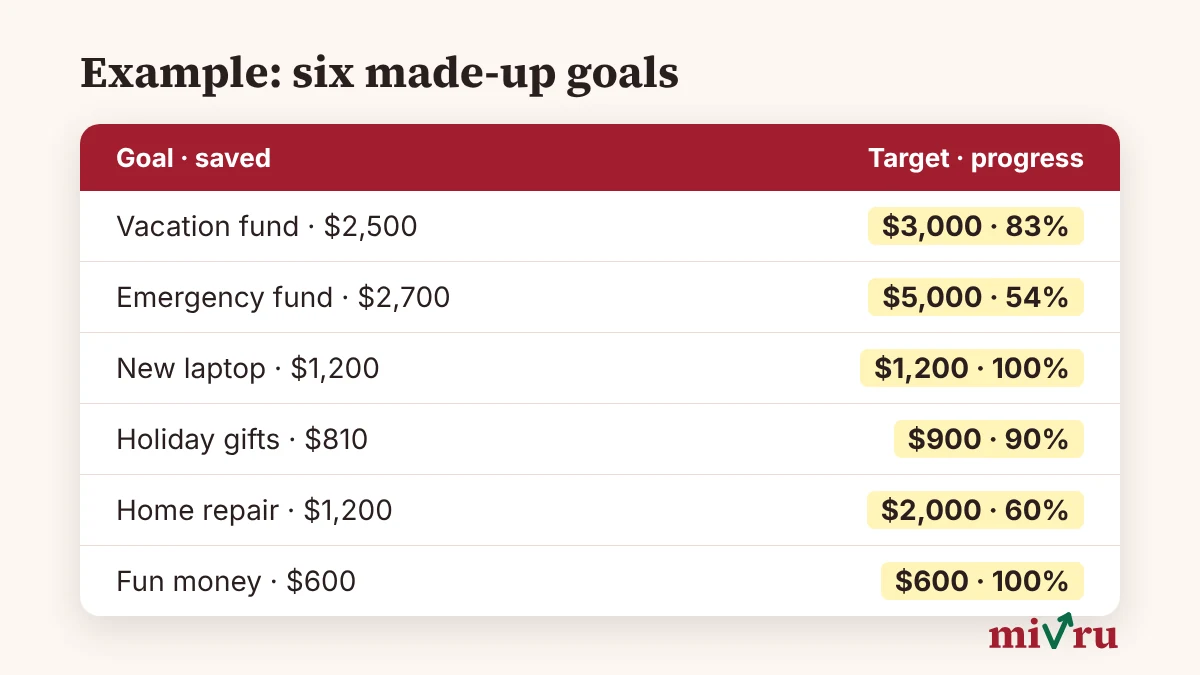
Altogether $9,010 has been deposited over 56 deposits, against $12,700 of targets, which is 71%. The laptop and fun money goals are complete.
What the example teaches
- A skipped week is not a failure. Two skipped weeks cost $26 so far. The chart makes that visible instead of vague.
- Weekly saving adds up. $835 from tick boxes would be hard to find in a bank statement without the log.
- Goals need their own bars. Seeing the emergency fund at 54% tells the person where the next deposit should go.
- Finished goals free up money. The laptop is done, so the $120 a month can go to the emergency fund.
- The numbers rise with a plan. The Consumer Financial Protection Bureau suggests setting a goal, testing a plan and then saving automatically, and the example follows that pattern.
What to do with a finished goal
When a goal reaches 100%, spend it on what it was for and move the monthly amount to the next goal. In the example, the $120 a month from the laptop could raise the emergency fund. The CFPB's guide to emergency funds says that a cash reserve is set aside for unplanned expenses such as car repairs, home repairs, medical bills or loss of income, which makes it a sensible goal to feed next.
Build your own
Read the savings challenge ideas for other formats, then build a tracker in Excel or plan a trip in Google Sheets. For a different style of goal tracker, see the savings tracker example, and for the spending side the expense tracker example. This is general information, not financial advice.
What is left on each goal
The made-up person can also see how much each goal still needs. This is the target minus the amount saved.
| Goal | Saved | Target | Still needed |
|---|---|---|---|
| Vacation fund | $2,500 | $3,000 | $500 |
| Emergency fund | $2,700 | $5,000 | $2,300 |
| New laptop | $1,200 | $1,200 | $0 |
| Holiday gifts | $810 | $900 | $90 |
| Home repair | $1,200 | $2,000 | $800 |
| Fun money | $600 | $600 | $0 |
| Total | $9,010 | $12,700 | $3,690 |
The check works both ways: $12,700 - $9,010 = $3,690, and the six "still needed" amounts also add up to $3,690.
Reading the two numbers together
The challenge has $517 still to save over the last 11 weeks. The goals need $3,690. These are two different things. The challenge is a weekly habit, and the goals are the places the money goes. In this example the challenge money could go to the emergency fund, which has the most left to save.
Example: If the person puts every remaining challenge week into the emergency fund, it grows by $517 to $3,217. That is 64% of its $5,000 target, up from 54%.
How to set up a check like this
- List your goals with a target for each.
- Log each deposit with the date and the goal.
- Add up the deposits per goal and subtract from the target.
- Look at the biggest "still needed" number once a month.
- Decide where the next deposit goes.
A word on skipped weeks
The two skipped weeks in the example, weeks 9 and 17, cost $26 in total. Nothing breaks when you skip a week. If you want to catch up, add the amount to a later deposit and tick the week. If you do not, leave it marked as skipped, so the total stays honest.
Want the example ready-made?
The Mivru Savings Challenge & Goal Tracker includes this example, so you can click around before you clear it and start your own. It has a Challenge sheet, a Deposits sheet and a Dashboard with progress bars in five color themes for Excel and Google Sheets, plus an 11-page printable. See the Savings Challenge & Goal Tracker Printables.
Frequently asked questions
What does a savings challenge example look like?
It shows each week of the plan with its amount, whether it was saved or skipped, and the running total. This page walks through a made-up one at week 41 of 52.
Are the numbers in this example real?
No. The weeks, deposits and goals are made up to show how a challenge works. Use your own numbers.
How much was saved in the example challenge?
$835 across 39 saved weeks. Two weeks (9 and 17) were skipped, which left $26 unsaved so far.
How does the challenge relate to the goals?
The challenge is a habit. The goals are what the money is for. In the example, deposits to six goals total $9,010, separate from the challenge.
Can I copy this example?
Yes. The Mivru savings challenge tracker includes this example data, so you can click around, then clear it and start your own.