Debt Snowball vs Avalanche: Which Payoff Plan Fits You?
Debt snowball pays the smallest balance first. Avalanche pays the highest interest rate first. See how each works, with a full example and free worksheet.
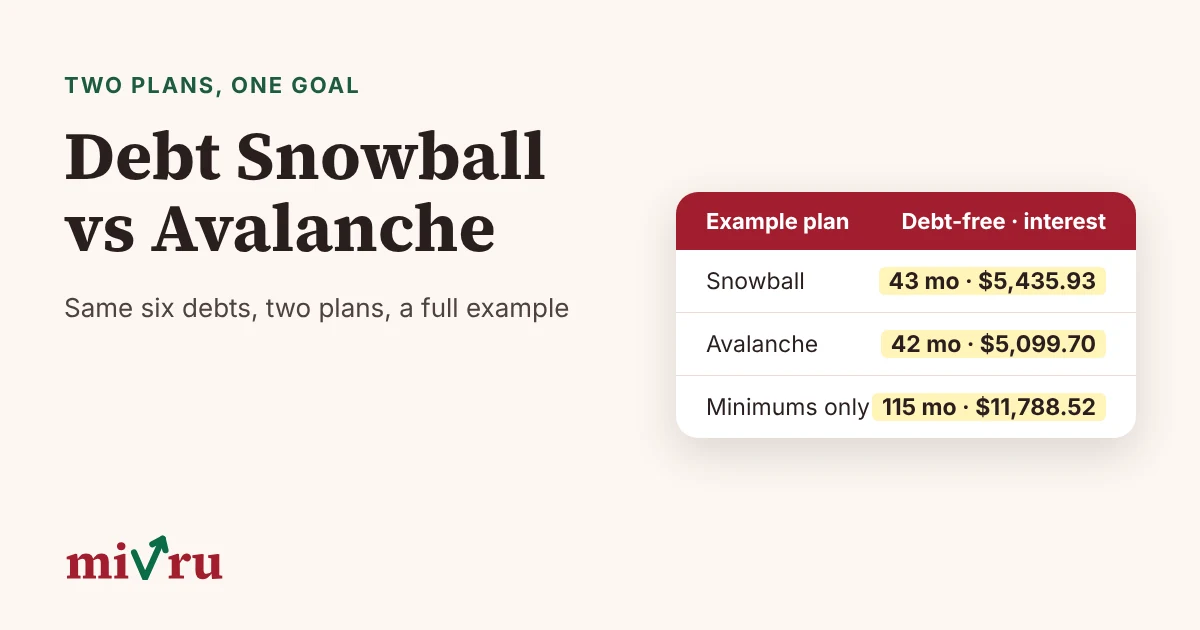
Debt snowball vs avalanche is the first question most people ask when they decide to pay off several debts. Both plans work the same way: you pay every minimum, and all your extra money goes to one debt at a time. The only difference is which debt comes first.
This guide explains both, shows what each costs in a complete example, and helps you choose. A free worksheet at the end lets you set up your own plan.
The two plans in one minute
- Snowball: list your debts from the smallest balance to the largest. Pay the extra money on the smallest. When it is gone, add its payment to the next smallest.
- Avalanche: list your debts from the highest interest rate (APR) to the lowest. Pay the extra money on the highest rate. When it is gone, add its payment to the next highest.
In both plans every other debt keeps getting its minimum payment, on time, every month. When a debt is paid off, the money that went to it rolls onto the next debt. That growing payment is the "snowball" or the "avalanche".
An example with six debts
This made-up example has six debts totalling $34,070, with minimum payments of $735 a month. The household can add $200 extra, so it pays $935 a month in total. The first payment is in August 2026.
| Debt | Balance | APR | Minimum |
|---|---|---|---|
| Credit card A | $4,200 | 24.99% | $105 |
| Credit card B | $1,850 | 19.99% | $55 |
| Store card | $620 | 29.99% | $25 |
| Car loan | $9,800 | 7.49% | $285 |
| Student loan | $14,500 | 5.05% | $160 |
| Personal loan | $3,100 | 11.50% | $105 |
Example: Calculated month by month, with interest of balance x APR / 12 each month:
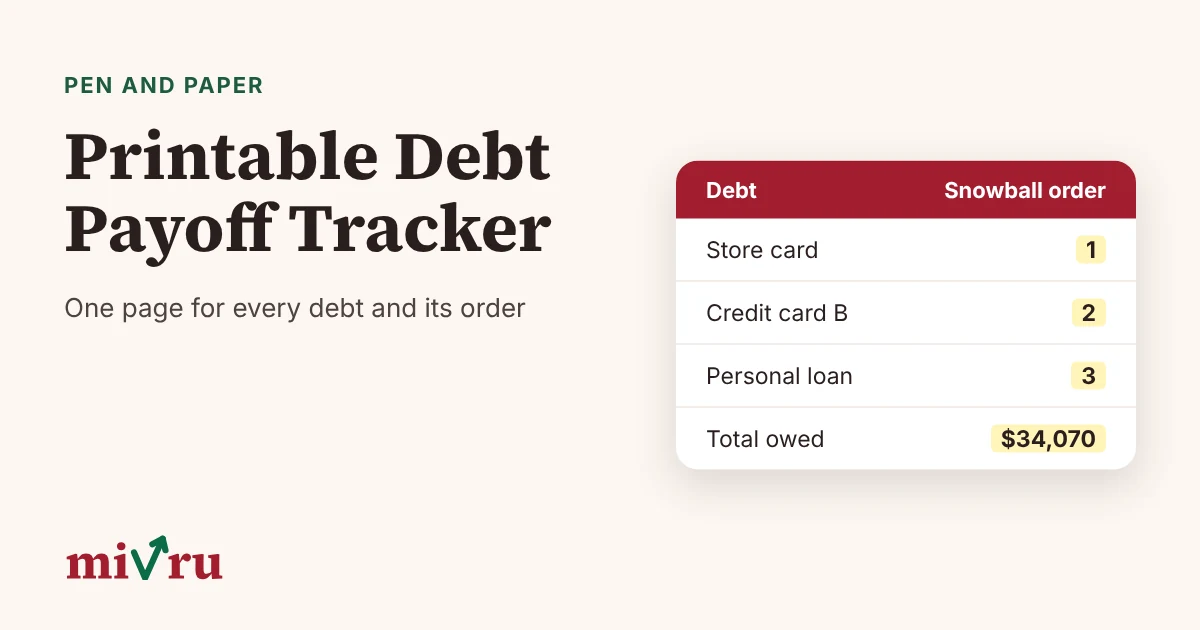
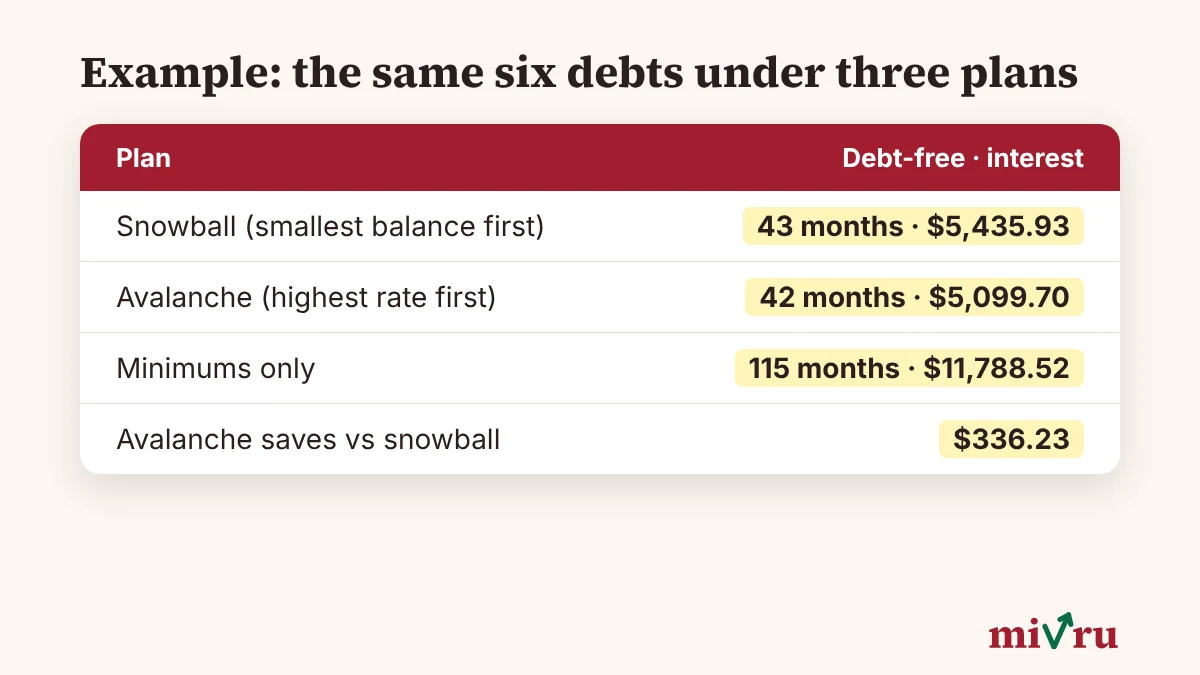
- Snowball: order is store card, credit card B, personal loan, credit card A, car loan, student loan. Debt-free after 43 months (February 2030). Interest: $5,435.93.
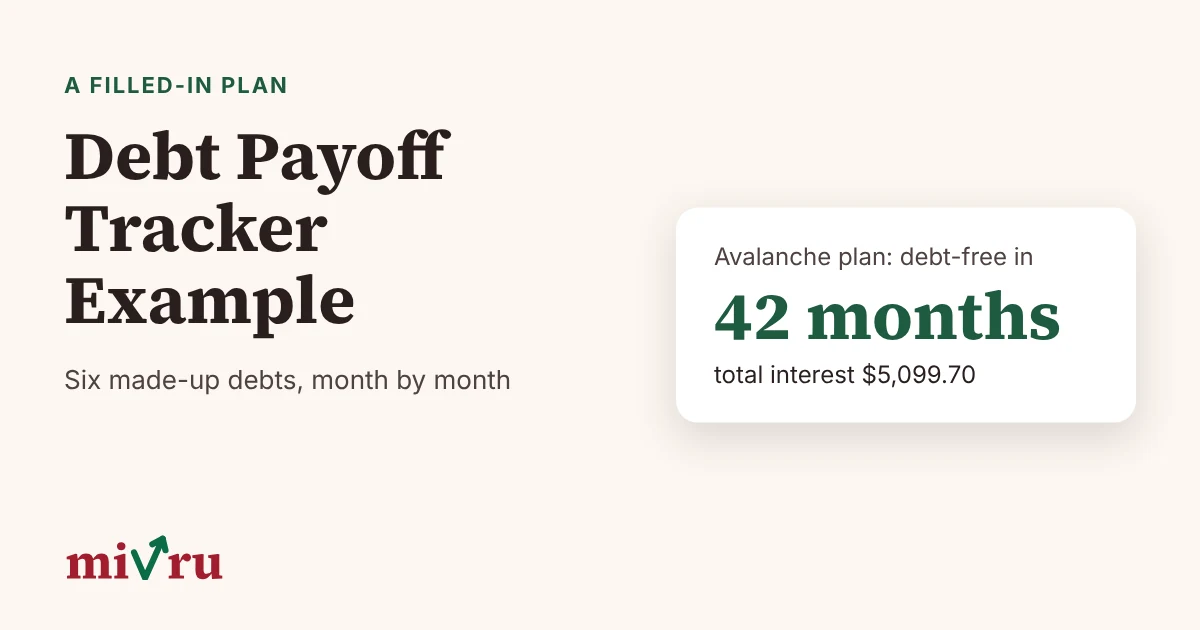
- Avalanche: order is store card, credit card A, credit card B, personal loan, car loan, student loan. Debt-free after 42 months (January 2030). Interest: $5,099.70.
- Minimums only: debt-free after 115 months (February 2036). Interest: $11,788.52.
In this example avalanche saves $336.23 in interest and finishes a month sooner than snowball. Both plans save a lot compared with paying only the minimums: avalanche saves $6,688.82 in interest and is 73 months faster.
Why the gap is small here
The store card has both the smallest balance and the highest rate, so both plans start with it. The plans only differ afterwards. When your smallest debt also has a low rate, and your highest-rate debt is large, the gap grows. When the order is similar, the gap is small.
What the research says about motivation
The numbers favor avalanche, but motivation matters too. A study in the Journal of Consumer Research by Kettle, Trudel, Blanchard and Häubl found that concentrating repayments on fewer accounts increased consumers' motivation to get out of debt, and that the effect was strongest when payments targeted the smallest accounts. That is the idea behind the snowball: seeing a debt disappear can keep you going.
How to choose
Choose snowball if: - you have several small debts and want to see one gone quickly; - you have started and stopped before and need early wins.
Choose avalanche if: - your debts have very different interest rates; - you are motivated by saving as much interest as possible.
Either plan beats not having one. The right plan is the one you will follow every month.
Rules for both plans
- Pay every minimum on time. A late fee or a higher penalty rate can undo your progress.
- Check that each minimum covers the interest. If it does not, the balance grows.
- Keep the total payment the same. When a debt is paid off, add its payment to the next one.
- Stop adding new debt. A plan only works if the total is going down.
Calculating the plan by hand takes a long time. Our debt payoff tracker example walks through the same six debts month by month, and the guide to a debt payoff tracker in Excel shows how to build the basics yourself.
If it feels like too much
This guide is general information, not financial advice. If your debt feels unmanageable, a nonprofit credit counseling organization can help you see your options. The U.S. Federal Trade Commission's guide Choosing a Credit Counselor explains what to ask first.
The three plans side by side
| Plan | Months to debt-free | Debt-free month | Interest paid |
|---|---|---|---|
| Snowball | 43 | February 2030 | $5,435.93 |
| Avalanche | 42 | January 2030 | $5,099.70 |
| Minimums only | 115 | February 2036 | $11,788.52 |
Where the first payment goes
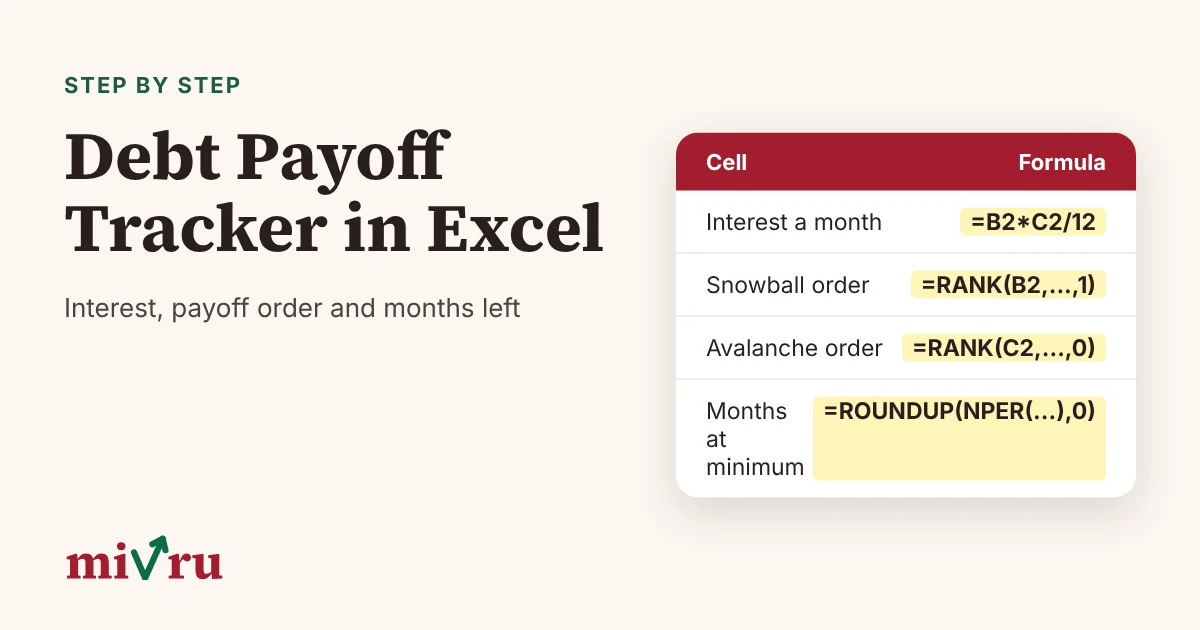
Each month, a debt's interest is its balance multiplied by its APR and divided by 12. Using that rule on the six example debts gives the first month's interest:
| Debt | Balance x APR / 12 | Interest, first month |
|---|---|---|
| Store card | $620 x 29.99% / 12 | about $15.49 |
| Credit card A | $4,200 x 24.99% / 12 | about $87.47 |
| Credit card B | $1,850 x 19.99% / 12 | about $30.82 |
| Car loan | $9,800 x 7.49% / 12 | about $61.17 |
| Student loan | $14,500 x 5.05% / 12 | about $61.02 |
| Personal loan | $3,100 x 11.50% / 12 | about $29.71 |
Example: First-month interest across all six debts is about $285.68. Of the $935 paid in month one, roughly $649.32 reduces the balances. Every minimum is larger than that debt's interest, so each balance falls even before the extra money is added.
This is why the plan order matters less than the habit of paying every month. The biggest lever you control is the total amount you pay, and the plan decides only where the extra goes.
Let a spreadsheet run both plans
The Mivru Debt Payoff Tracker calculates the snowball and the avalanche for your own debts, month by month. It shows the debt-free month, the interest each plan costs and how much you save compared with paying only the minimums. It works in Excel and Google Sheets and includes a 12-page printable planner. See the Debt Payoff Tracker Spreadsheet.
Frequently asked questions
What is the debt snowball method?
You pay the minimum on every debt, then put all the extra money on the debt with the smallest balance. When it is paid off, you add its payment to the next smallest debt, and so on.
What is the debt avalanche method?
You pay the minimum on every debt, then put all the extra money on the debt with the highest interest rate. When it is paid off, you move to the next highest rate. It usually costs less interest than the snowball.
Which is better, snowball or avalanche?
Avalanche usually costs less interest. Snowball gives quick wins, which some people find more motivating. In the example in this guide, avalanche saves $336.23 in interest and finishes one month sooner. The best plan is the one you will stick with.
Do I still pay the minimum on every debt?
Yes. Both plans start by paying every minimum payment on time. Only the extra money goes to one debt at a time.
Can I switch plans later?
Yes. Nothing stops you from switching, but each switch changes the debt-free date, so it helps to calculate the new plan first.