Household Binder Printables: What to Put in Yours
Household binder printables explained: the 8 sections to include, what to leave out, and how to set one up in an evening. Free checklist included.
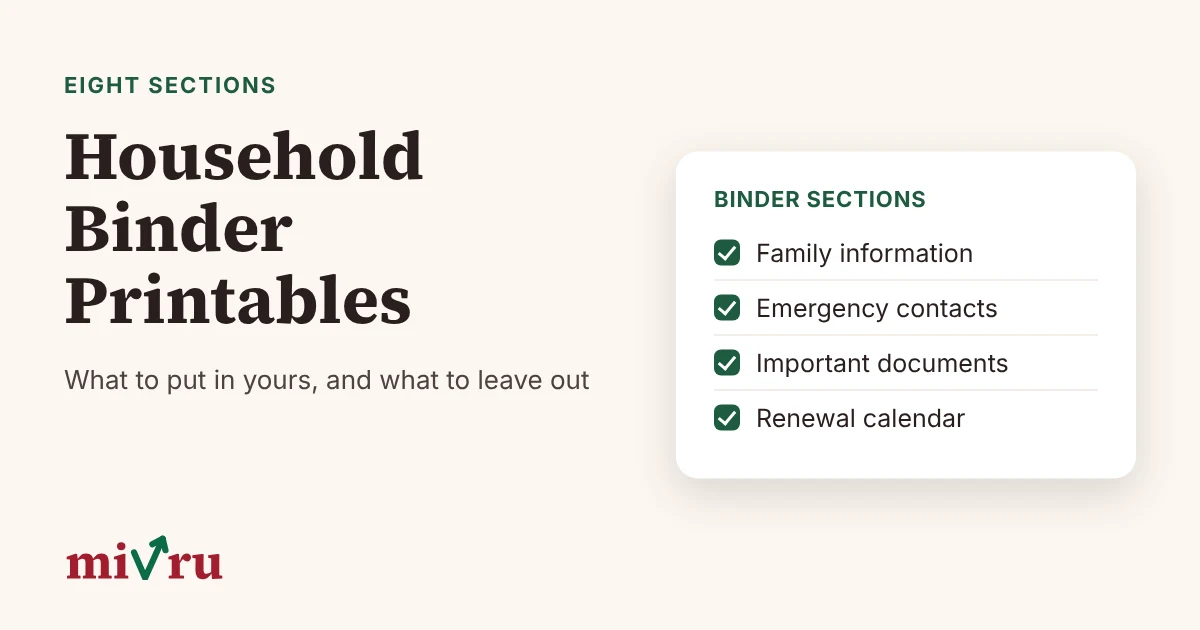
Household binder printables are ready-made pages for one binder that tells anyone in your home who to call, where the important papers are and what is coming up. You can set one up in a single evening, and it pays off the first time you need a passport number, an insurance phone line or a vet's address in a hurry.
This guide lists the eight sections worth having, what to leave out, and a simple way to keep the binder current. Every example is made up.
Why a household binder is worth an evening
Most households keep their important information in many places: a drawer, a phone, a few email accounts, a safe, someone's memory. That works until someone is sick, away or in a hurry. A binder puts the "where is it and who do I call" answers in one place that any adult can open.
Ready.gov, the US government's emergency preparedness site, tells families to gather important financial, personal, household and medical information. It suggests keeping documents somewhere reachable in a disaster, such as a safety deposit box, an external drive or cloud storage, and to be careful about sharing bank account, Social Security and credit card numbers. Its main planning page says to know how you will contact one another and reconnect if you are separated. A household binder is a practical way to do both.
The 8 sections to include
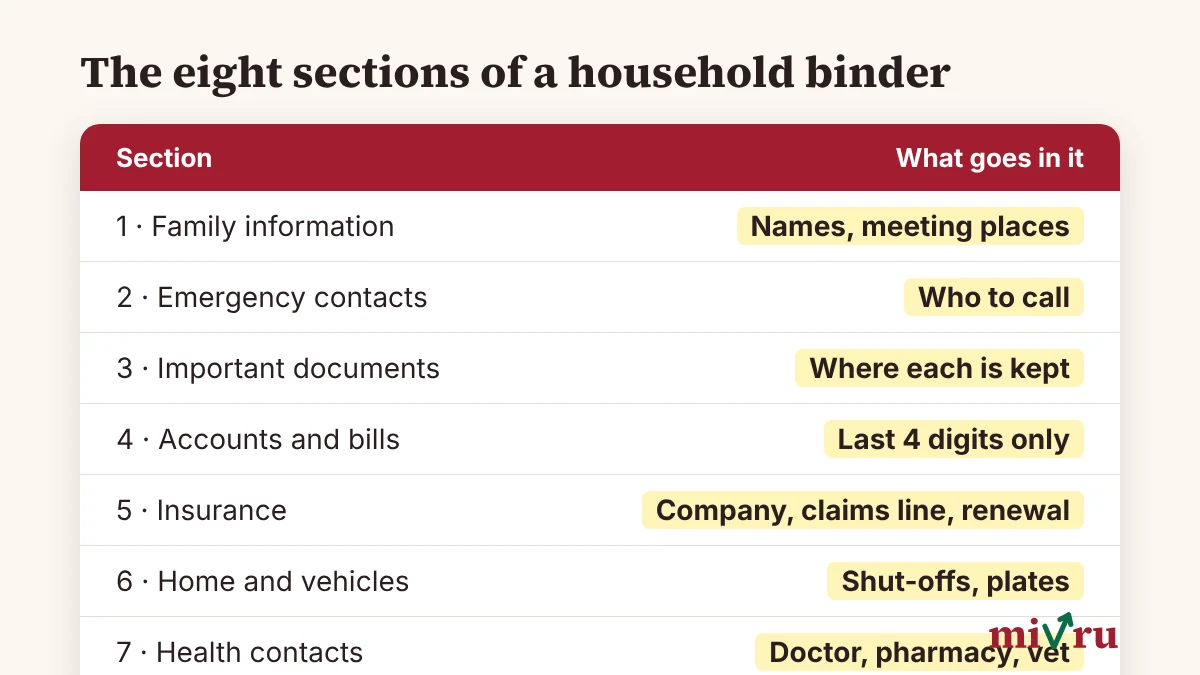
1. Family information. Names, addresses, a meeting place near home and one outside the neighborhood, and an out-of-area contact. This is the page you hand to a babysitter or a house guest.
2. Emergency contacts. Family, a neighbor, doctors, your vet, your insurance claims line, the utility outage numbers and the school or workplace. Include a person who lives far away, because local phone lines can be busy in an emergency.
3. Important documents. Not the documents themselves, but a list: what each one is, where it is kept and when it expires or renews. Passports, birth certificates, insurance policies, the car title, tax returns, a will.
4. Accounts and bills. The companies you deal with, a phone number or website, the due date and the last 4 digits of the account. Never the full number.
5. Insurance. Home or renters, auto, health, life. Note the company, the claims number and the renewal date.
6. Home and vehicles. Where the water and gas shut-offs are, where the electrical panel is, who has a spare key, plus the make, model and plate of each vehicle.
7. Health contacts. Doctor, dentist, pharmacy and vet. Add the names of medicines only if you are comfortable having them in the binder. Do not type diagnoses.
8. A renewal calendar. One page that shows the month each renewal comes up, so car registration and warranties do not slip.
What to leave out
- Passwords and PINs. Use a password manager.
- Full account or card numbers. The last 4 digits are enough to tell accounts apart.
- Social Security numbers. Note where the card is kept, not the number.
- Anything you would not want a guest to read. Keep the binder with other household papers, not on a shelf in plain sight.
Make one in an evening
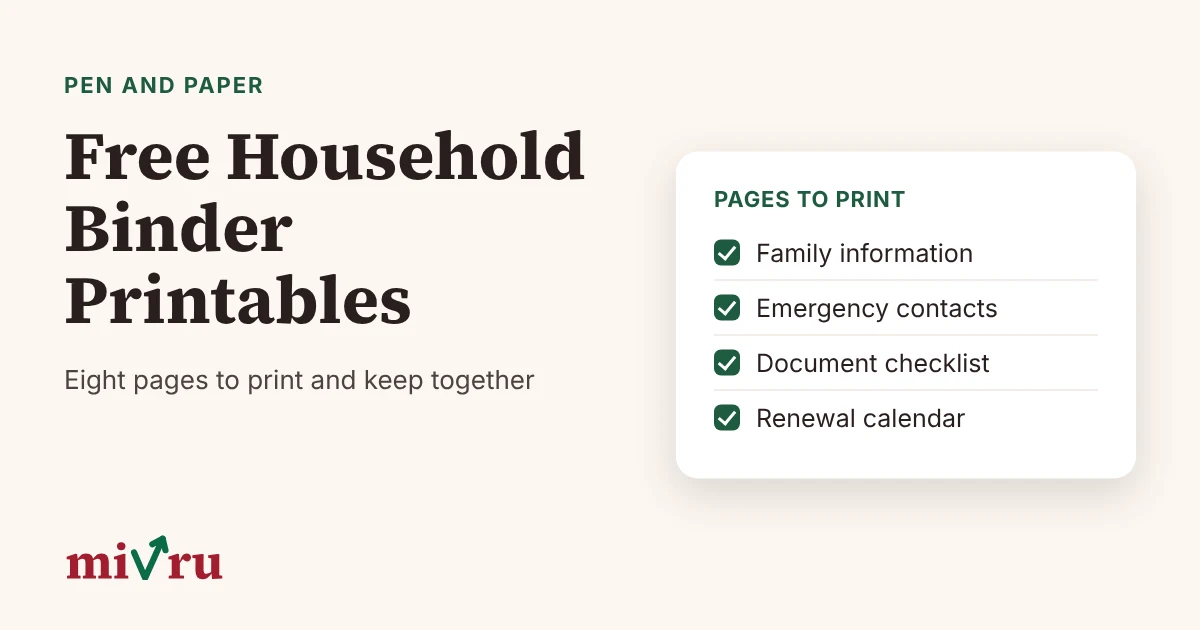
- Print the pages you need. Our free emergency contacts and key documents checklist is a good first page. Put them in a 1-inch binder with dividers.
- Start with contacts. Fill in the emergency contacts page first. It takes ten minutes and is the part you will use most.
- Walk through the house. Open the drawer, the safe and the file cabinet once and write down what is there and where. Tick off each item on the document checklist.
- List your accounts. Go through your bank statements and bills for the last two months and write each company down.
- Add dates. Wherever a document or account has a date, write it down. Then add the dates to your phone calendar too.
- Tell the others. Show every adult where the binder is. A binder only one person knows about is not much use.
Keep it current
Set two reminders a year. When the reminder comes, open the binder and look for three things: phone numbers that changed, documents that expired and accounts you closed or opened. Cross out old lines and write the new ones. Also update it after any big change, such as a move, a new job, a new baby or a new car.
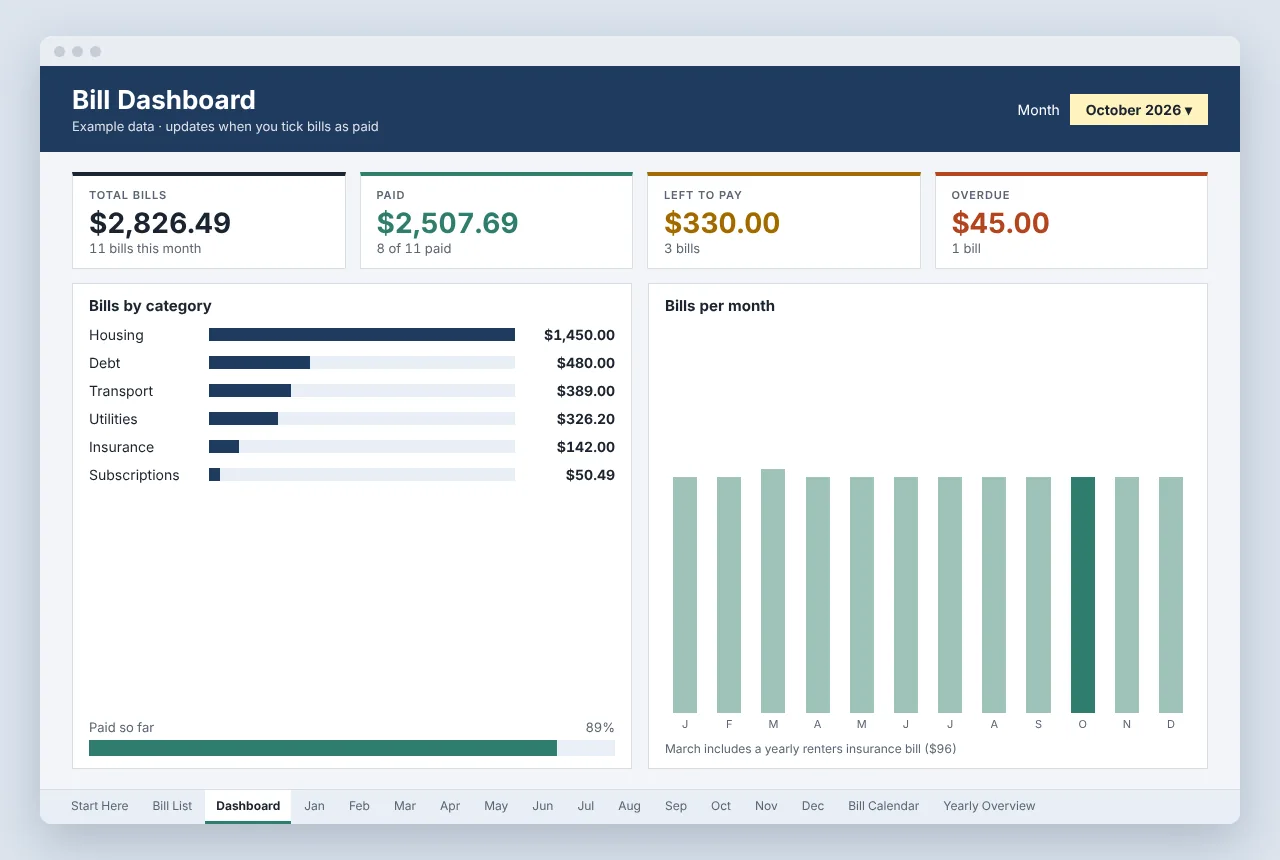
For the bills part of your binder, our guide on how to keep track of bills shows a simple monthly system, and how to track subscriptions helps with the small recurring charges that are easy to forget.
Paper, spreadsheet or both
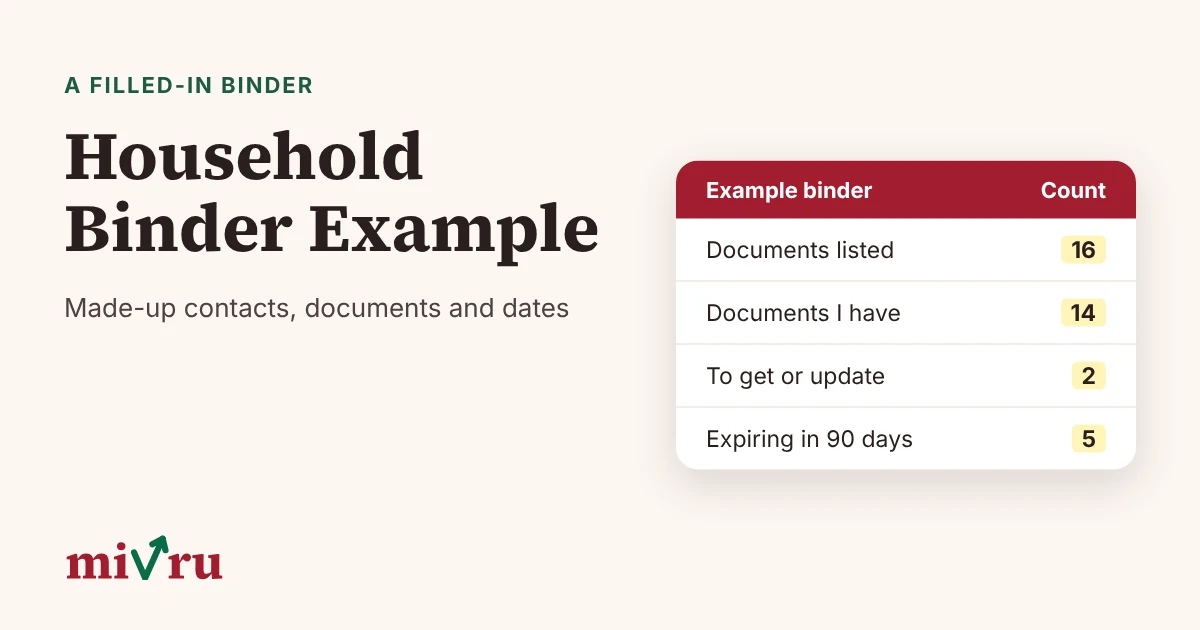
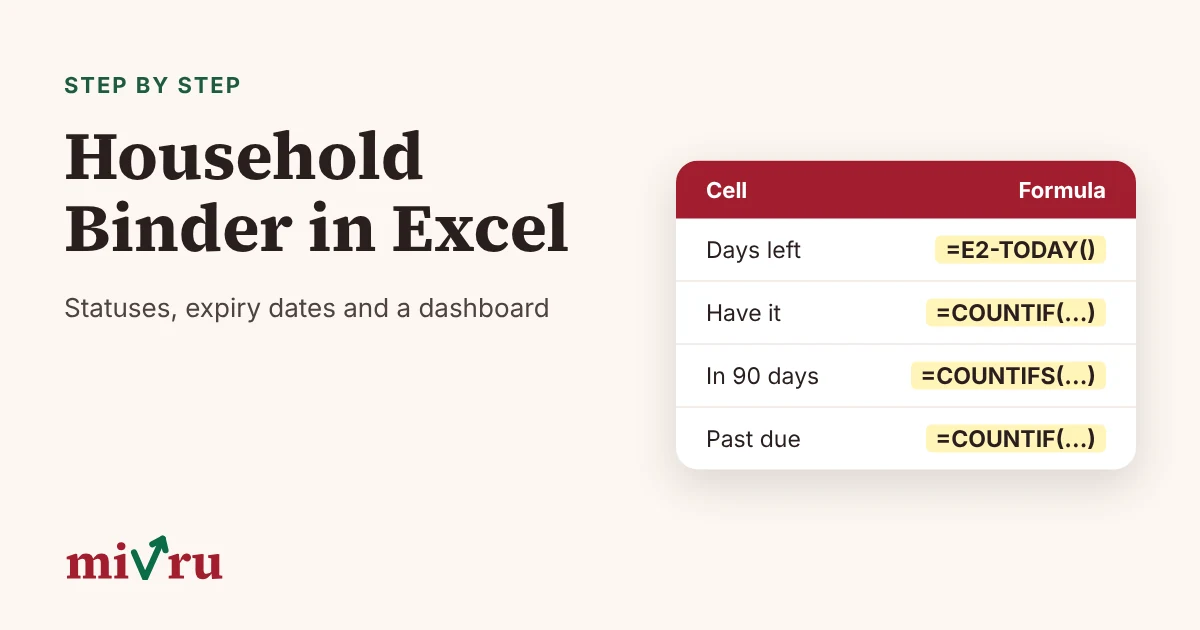
Paper is simple, visible and works when the power is out. A spreadsheet can sort by date and tell you what is expiring, so you stop checking by hand. Many people use both: a printed binder for the family and a spreadsheet for the dates. See our household binder example for what a filled-in version looks like, or build your own in Excel.
Where to start tonight
Print the contacts page, write down ten names and numbers, and put the page where everyone can find it. That alone makes your household better prepared than most. Then add one section a day until the binder is complete.
Want the pages and the spreadsheet ready-made?
The Mivru Household Binder has 11 printable pages in color and black and white, plus a spreadsheet for Excel and Google Sheets in five color themes. It has contacts, a document list, an accounts list and a dashboard that shows what you have, what you still need and what expires in the next 90 days. See the Household Binder Printables & Spreadsheet.
Frequently asked questions
What are household binder printables?
They are printable pages for a home binder: emergency contacts, a document list, an accounts list, a home and vehicle page and a renewal calendar. You print them, fill them in and keep them together in one binder.
What should I put in a household binder?
Put in emergency contacts, a list of where each important document is kept, your insurance and account contacts, home and vehicle details, medical contacts and a renewal calendar. Leave out passwords and full account numbers.
Should a household binder include passwords?
No. Use a password manager for logins. The binder should say where things are kept, not hold the secrets themselves.
How often should I update my household binder?
Check it twice a year, for example when the clocks change, and update it whenever you move, change insurance, open or close an account or have a new family member.
Where should I keep the binder?
Keep it somewhere every adult in the home knows about and can reach quickly. Keep copies of the most important pages in a safe place away from home or in cloud storage.