How to Keep Track of Bills: A Simple System That Works
List every bill once, match due dates to your paychecks, plan for yearly bills and check in for five minutes a week. A simple system with a worked example.
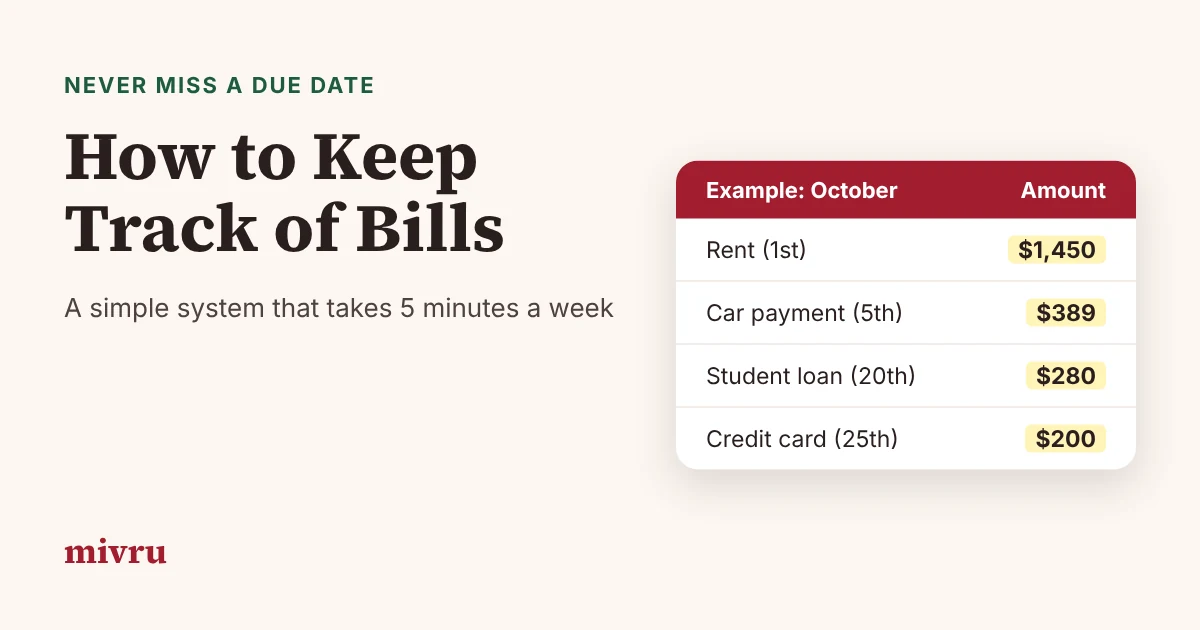
Most missed bills are not a money problem. They are a memory problem. The money was there, the bill was simply forgotten in a busy week, and now there is a late fee on top of it.
The fix is a simple system: one list of every bill, matched to the days you get paid, checked once a week. In this guide you will set it up step by step, using one worked example from start to finish: a household with 11 monthly bills that add up to $2,826.49, plus one yearly bill.
Why keeping track of bills matters
Late payments cost more than a late fee. For loans and credit cards, payment history is the biggest single part of your credit score: FICO says it makes up 35% of a FICO Score. A tidy bill list protects that number without any extra effort.
It also takes stress away. When every bill is written down with its due date, you stop wondering what you forgot. You can see at a glance what is paid, what is due this week and what is left for the rest of the month.
Step 1: Make a list of every bill
Open your last two or three months of bank and credit card statements. Every payment that repeats is a bill: rent or mortgage, utilities, phone, internet, insurance, car payment, loans, credit cards, and every subscription.
For each one, write down four things:
- Name (for example "Electric").
- Due day (the day of the month it is due).
- Usual amount. For bills that change, use your best estimate.
- How you pay it (autopay, online, check) and from which account.
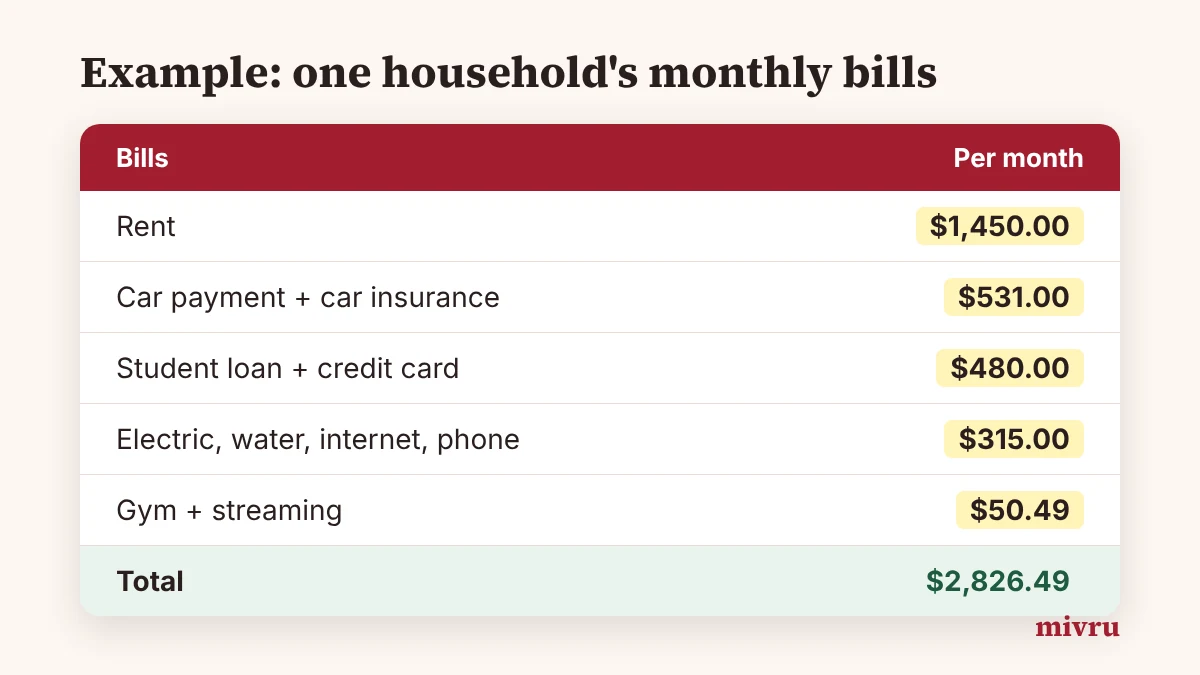
Example: Our household finds 11 monthly bills: rent ($1,450), a car payment ($389), car insurance ($142), a student loan ($280), a credit card payment ($200), electric (about $120), water ($45), internet ($65), phone ($85), a gym ($35) and a streaming service ($15.49). Together that is $2,826.49 a month. They also find one yearly bill: renters insurance, $96 every March.
Step 2: Put the bills in due-date order
Sort the list by due day, from the 1st to the 31st. This one change makes the list useful: the next bill to pay is always at the top, and you can see which part of the month is crowded.
If you use a bill calendar, write each bill on its due day instead. Either way, the goal is to see when the money has to go out, not just how much.
Step 3: Match your bills to your paychecks
Now look at when you get paid. Draw a line on your list at each payday and add up the bills between paydays. This shows whether each paycheck can cover the bills that come before the next one.
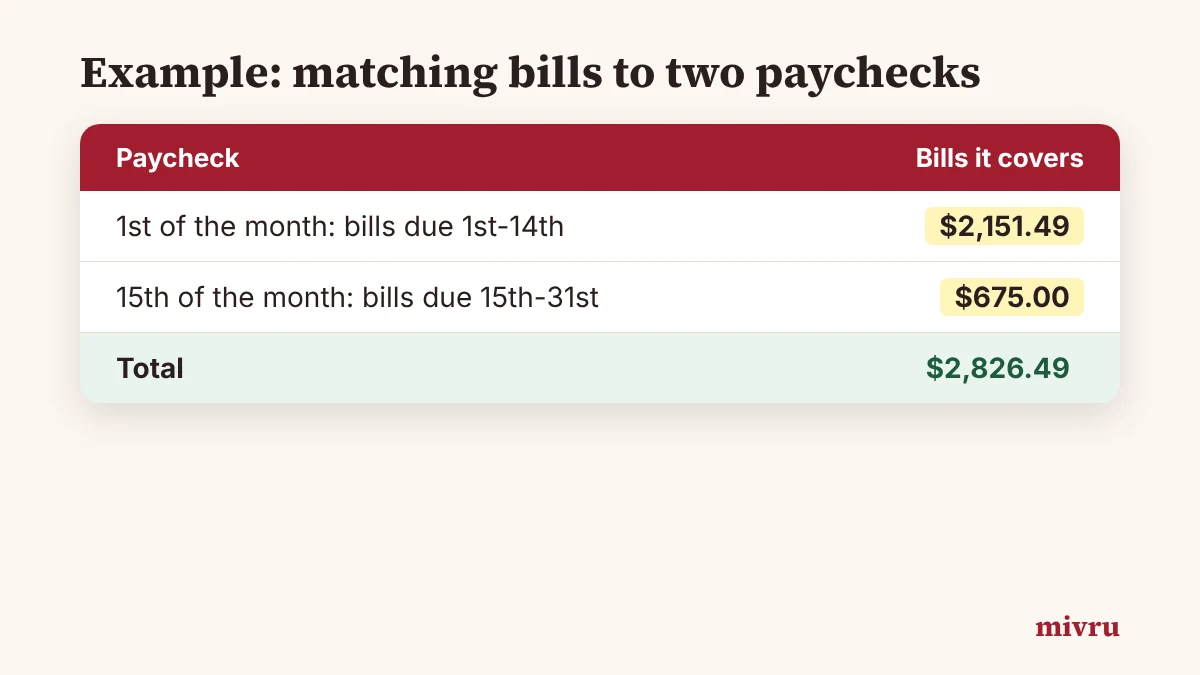
Example: Our household is paid on the 1st and the 15th. Bills due from the 1st to the 14th add up to $2,151.49 (rent, gym, car payment, streaming, car insurance and electric). Bills due from the 15th to the 31st add up to just $675. The first paycheck carries most of the load, so they keep a cushion from the second paycheck to help with rent.
If one half of the month is much heavier, you have two options: set money aside from the lighter paycheck, or ask a company to move a due date. Some lenders and utilities will change a due date if you ask, which can spread the load more evenly.
Step 4: Plan for bills that are not monthly
Yearly and quarterly bills are the ones that catch people out, because they are easy to forget for eleven months. Add them to your list with the month they are due. Then turn each one into a monthly amount: divide it by 12, or by the number of months left until it is due.
Example: Renters insurance is $96 a year, due in March. Divided by 12, that is $8 a month to set aside, so the March bill is already covered when it arrives.
Step 5: Choose where to track your bills
You do not need a complicated tool. Pick the one you will actually open every week:
- Paper. A one-page checklist on the fridge works well if you like to tick things off by hand. Print a fresh one each month. Our printable bill tracker guide shows what to include.
- Spreadsheet. Excel or Google Sheets can add up totals, show what is left to pay and mark late bills in red. You can build one in Excel in about 20 minutes or in Google Sheets.
- App. Some apps send reminders, but many cost money or ask for access to your bank account. If you use one, keep a simple list as a backup.
Step 6: Check your bills once a week
This is the step that makes the system work. Pick one day a week, such as Sunday evening, and spend five minutes on three questions:
- Which bills are due in the next seven days?
- Is there enough in the right account to cover them?
- Did everything that was due last week actually go through?
The U.S. Consumer Financial Protection Bureau recommends the same habit: make a bill calendar and review it every week. A weekly check catches a failed autopay or a surprise bill before it turns into a late fee.
Step 7: Use autopay carefully
Autopay is great for bills with a fixed amount: rent, a car payment or a loan. It removes the risk of forgetting. For bills that change, like electric or a credit card, many people prefer to check the amount first and then pay it.
Keep every autopay bill on your list anyway, marked "AP". Autopay can fail when a card expires or an account runs low, and a bill that goes up quietly every year is easy to miss when you never look at it.
Review your list once a year
Once a year, go through the whole list. Look for subscriptions you no longer use, insurance you could shop around for, and bills that crept up. Even cancelling one $15 subscription saves $180 over a year.
This is also a good time to update your due dates, your yearly bills and your monthly amounts for the year ahead.
Let a spreadsheet do the math
If you would rather not build it yourself, the Mivru Bill Tracker is ready to use in Excel and Google Sheets. You type each bill once, including yearly and quarterly ones, and it fills all 12 months, marks bills as overdue or due soon, puts them on a bill calendar and adds everything up on a dashboard.
Frequently asked questions
What is the easiest way to keep track of bills?
Write every bill on one list with its due date and amount, then tick each one off when you pay it. A one-page printable checklist or a simple spreadsheet is enough for most households; the habit of checking it once a week matters more than the tool.
How do I keep track of bills that are not monthly?
Add them to the same list with the month they are due, then divide the amount by 12 (or by the months left until it is due) and set that amount aside every month. A $96 yearly bill becomes $8 a month.
Should I put all my bills on autopay?
Autopay works best for bills with a fixed amount, like rent, a car payment or a loan. For bills that change, such as electric or a credit card, many people prefer to check the amount first. Either way, keep autopay bills on your list so you notice if one fails or goes up.
How often should I check my bills?
Once a week is enough for most people. The U.S. Consumer Financial Protection Bureau suggests reviewing your bill calendar every week. Pick a fixed day, like Sunday evening, and it takes about five minutes.
Is a spreadsheet or an app better for tracking bills?
A spreadsheet is free, works offline and does exactly what you set it up to do. An app can send reminders but may cost money or need access to your bank. Use whichever you will actually open every week.