Household Binder Example: A Filled-In Binder
A household binder example with made-up contacts, 16 documents, accounts and renewal dates, plus what each page teaches. Free printable checklist.
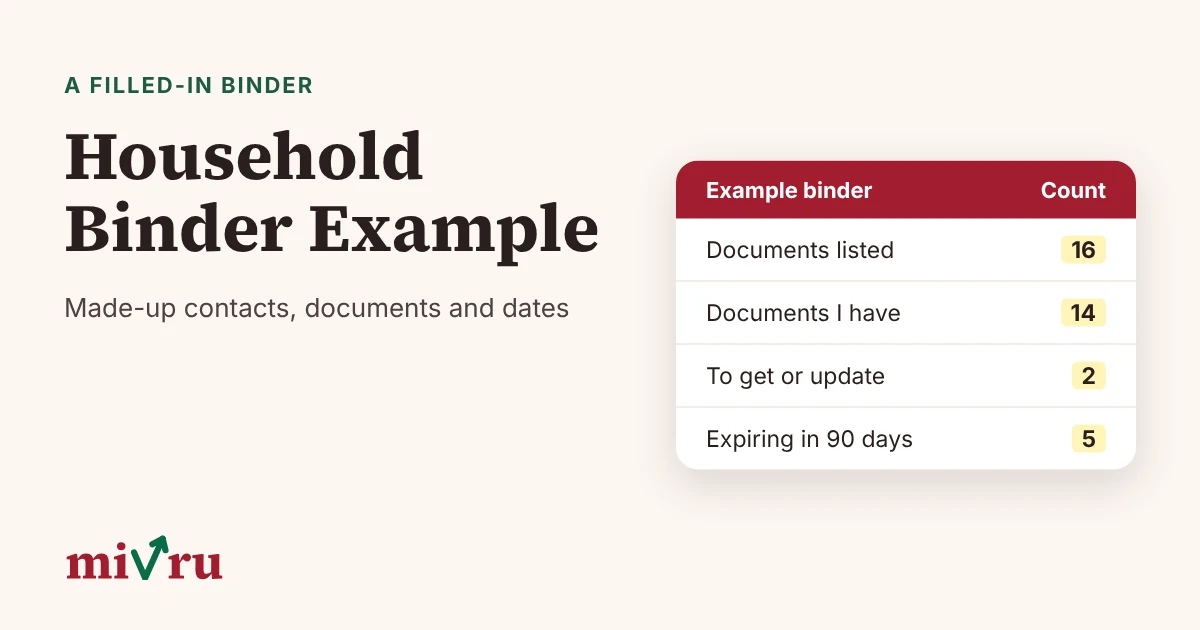
This household binder example shows what a finished binder looks like: 14 contacts, 16 documents, 8 accounts and the dates that matter. Every name and number is made up. Use it as a pattern for your own.
The household
The example family has two adults, a child at the local elementary school and a dog. They own their home (with a mortgage) and one car. Dates are shown as of October 23, 2026.
The emergency contacts page
The contacts list has 14 entries, grouped by a "type" drop-down: family, neighbor, doctor, insurance, utility, school, work and other. Two are family (the partner and an aunt who lives far away and is the out-of-area contact), one is the neighbor with a spare key, four are health contacts (family doctor, dentist, pharmacy and vet), plus the insurance claims line, two utilities, the school office, a work reception number and a plumber.
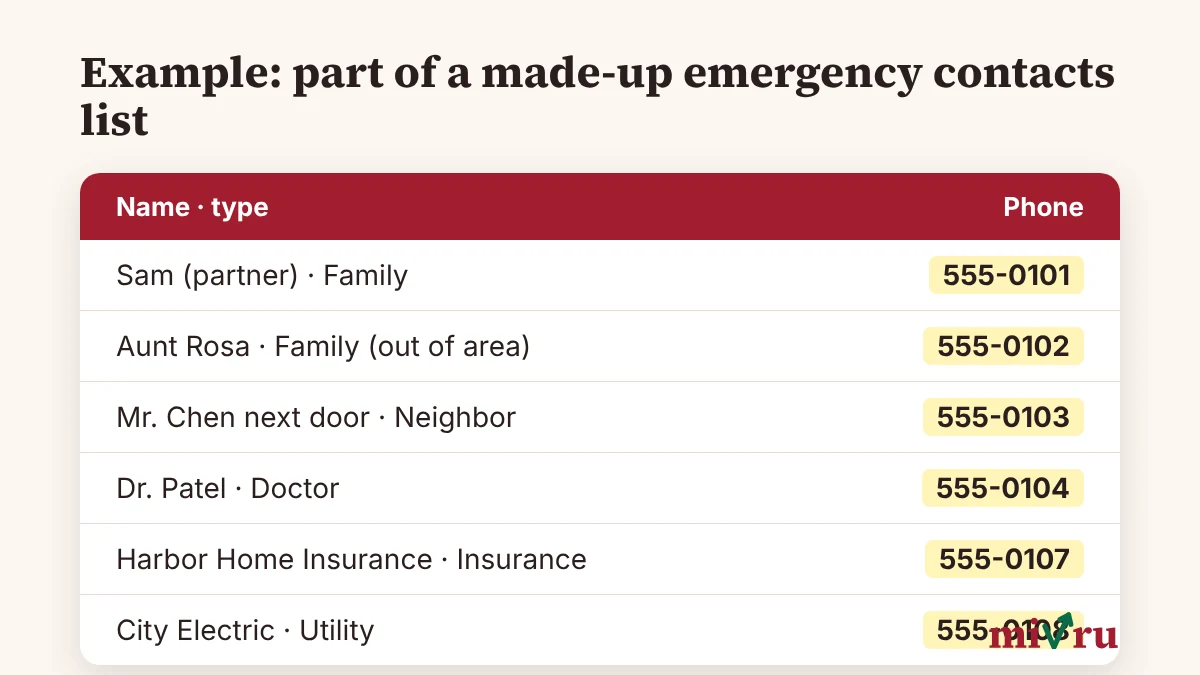
Example: If the power goes out, the page tells you the City Electric outage line. If someone is hurt, the family doctor and pharmacy are on the same sheet. If you cannot reach each other, Aunt Rosa is the person everyone calls to say they are fine.
Ready.gov's planning page says to know how you will contact one another and reconnect if separated, and the out-of-area contact is exactly that. Its financial preparedness page also suggests keeping lists of banks, insurance agents, health professionals and service providers, which is what the other contacts are.
The document list
The document list has 16 rows. Each row has the document, a type, where it is kept, a status and, if it has one, a date. Of the 16, 14 are "Have it", one is "Needs update" (the will) and one is "Need to get" (a power of attorney).
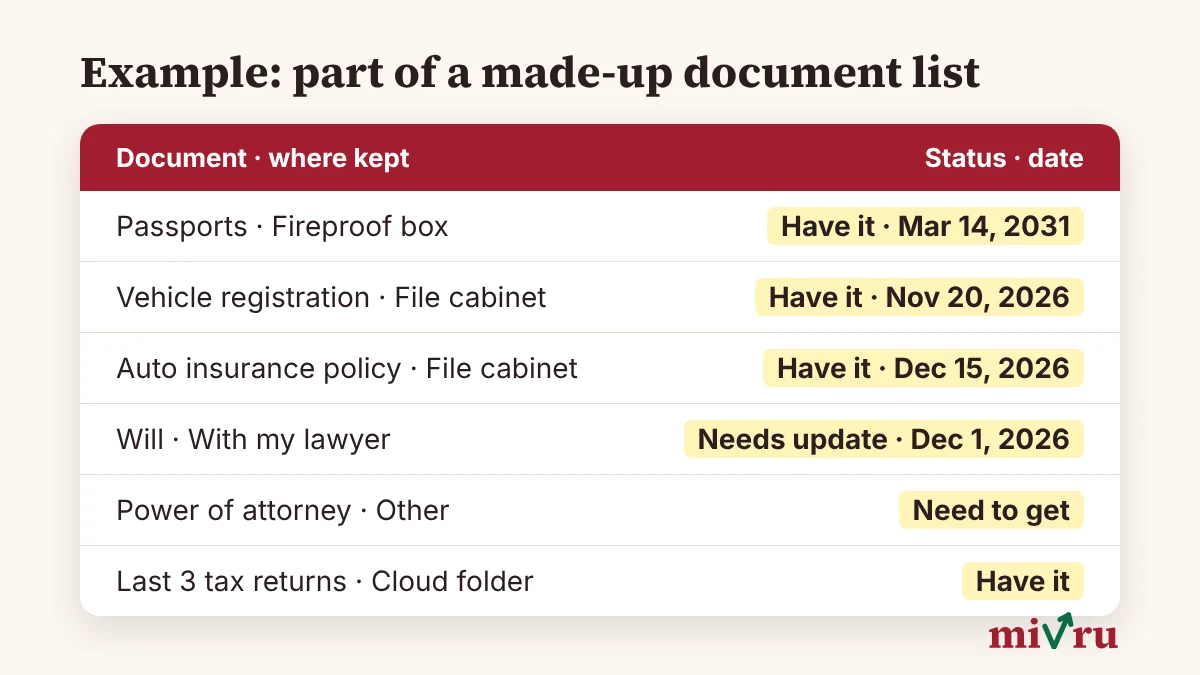
The papers are spread over several places: 7 in the file cabinet, 3 in the fireproof box, 1 in the home safe, 1 in the bank safe deposit box, 1 in a cloud folder, 1 with the lawyer and 2 listed as "Other" (the driver licenses, which live in wallets, and the power of attorney, which is not yet made). That mix is typical and the list makes it visible.
What is coming up
Five documents have a date within the next 90 days:
| Document | Date | Days left on Oct 23 |
|---|---|---|
| Vehicle registration | Nov 20, 2026 | 28 |
| Washer warranty | Nov 30, 2026 | 38 |
| Will (review) | Dec 1, 2026 | 39 |
| Auto insurance policy | Dec 15, 2026 | 53 |
| Health insurance cards | Dec 31, 2026 | 69 |
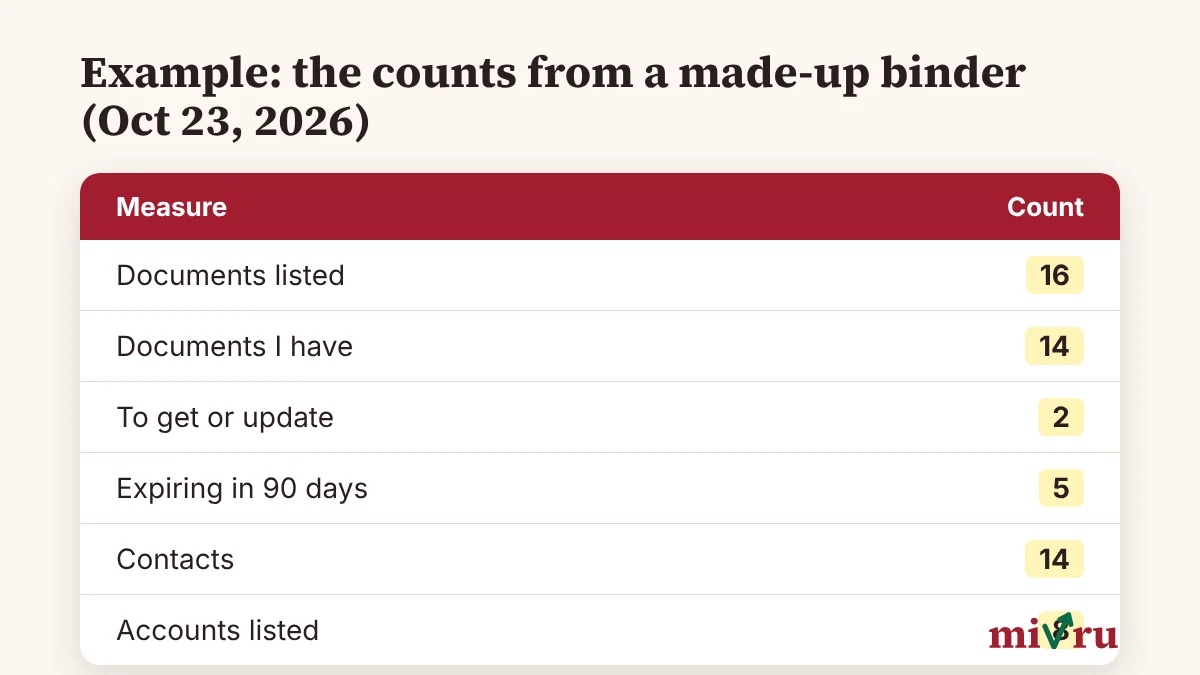
The registration is the one to deal with first. It is also the only one under 30 days, so it would show in orange or red. Without a list, a registration date like that is easy to miss until the notice arrives.
The accounts list
The accounts page lists 8 companies: electric, water, home insurance, a credit union, the doctor's office, the internet provider, a streaming service and a gym. Each row has a phone number or website, the next due date and, where it helps, the last 4 digits of the account. There are no full account numbers and no passwords.
Example: The streaming service and the gym are both due on Nov 1 and Nov 5. Seeing them next to the electric bill on Nov 10 shows that the first ten days of November are busy for bills.
For a more detailed look at monthly bills, see our bill tracker in Excel guide.
What the example teaches
- The list matters more than the paper. The household does not need copies of everything in one place. It needs to know where each thing is.
- Two gaps are easy to see. Without the status column, the missing power of attorney and the out-of-date will would stay unnoticed.
- Dates drive the work. Five items in 90 days is a small to-do list that you can plan around.
- Contacts are the part you use most. If you only fill in one page tonight, make it this one.
- Leaving secrets out keeps the binder safe. Nothing in it would help someone steal an identity.
Build your own
Read the thinking in our household binder printables guide, then build the tracker in Excel or Google Sheets. For the money side of the household, look at the expense tracker example. This is general information, not legal or financial advice.
How to review your own binder
Set a date once a year, such as the first weekend of the new year, and go through the binder with a pen:
- Check every phone number. Call one or two to make sure they still work.
- Check each document's date. Anything expiring in the next year goes on the coming-up list.
- Update the accounts list. Remove accounts you closed and add new ones.
- Tell one other adult where the binder is. A binder nobody can find does not help in an emergency.
- Write the review date on the front page, so you can see how recent it is.
Want the example ready-made?
The Mivru Household Binder includes this example, so you can click around before you clear it and enter your own contacts, documents and accounts. It has an 11-page printable in color and black and white and a spreadsheet in five color themes for Excel and Google Sheets. See the Household Binder Printables & Spreadsheet.
Frequently asked questions
What does a filled-in household binder look like?
It has a family information page, an emergency contacts list, a document list with where each item is kept and its expiry date, an accounts list and a renewal calendar. This page walks through a made-up example.
Are the names and numbers in this example real?
No. Every name, phone number, account and date is made up to show how a binder works. Use your own details.
How many documents should a household binder list?
There is no fixed number. The example lists 16 because that covers identity, insurance, home, vehicle, money, health and legal papers for one household.
What does Documents to get or update mean?
It marks papers you do not have yet or that are out of date. In the example, a power of attorney is still to get and a will needs updating.
Can I copy this example?
Yes. The Mivru household binder spreadsheet includes this example data so you can click around, then clear it and add your own.