Estate Planning Organizer Example: A Filled-In One
An estate planning organizer example with 17 made-up items, 8 people and the counts that show what is missing. Organizing only, not legal advice.
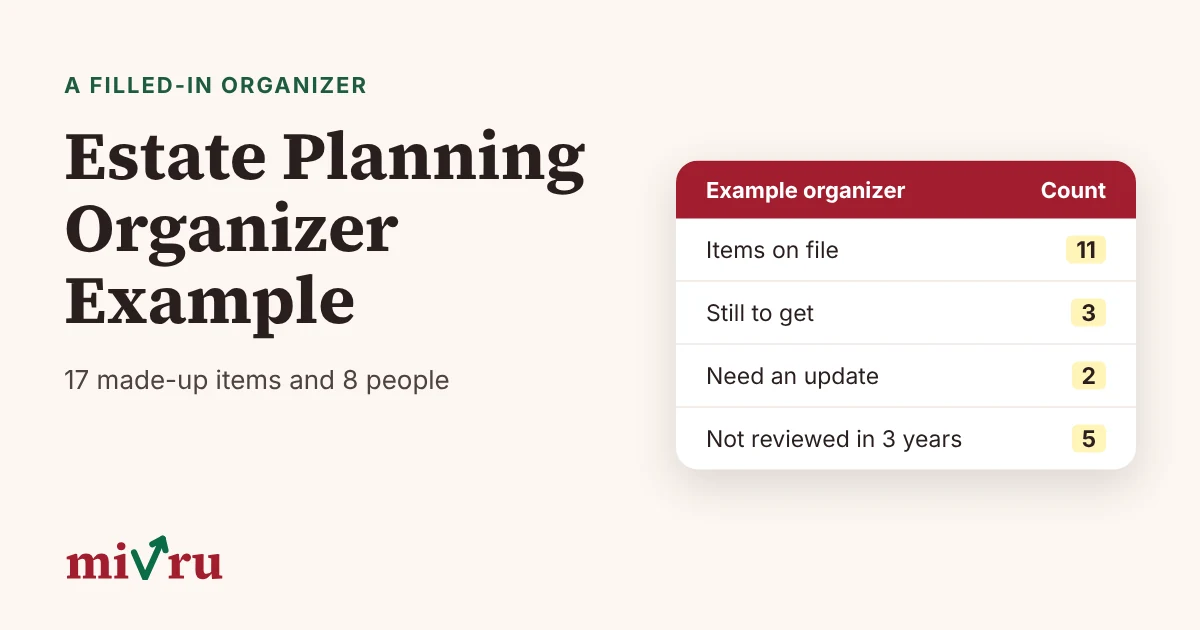
This estate planning organizer example shows a made-up household with 17 items, 8 people and the counts that tell you what is still missing. Every name and date is invented, and nothing here is legal advice. It is a pattern for organizing your own information.
The checklist
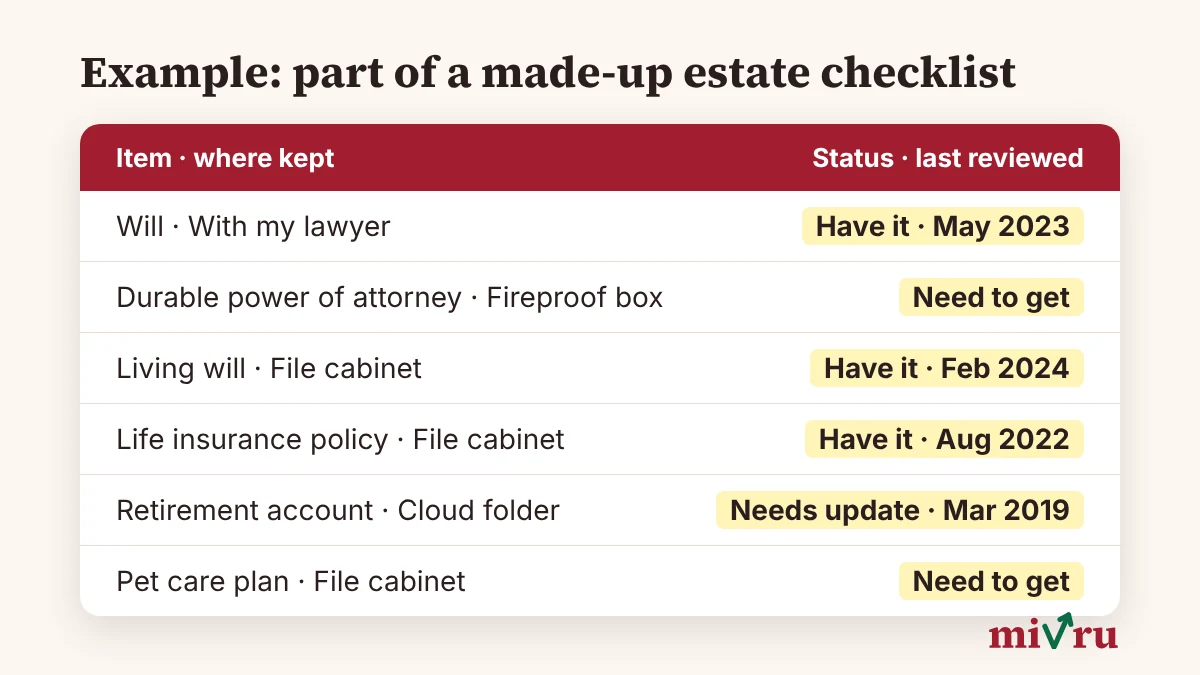
The made-up person lists 17 items across ten types: will and trust, power of attorney, health care wishes, insurance, bank and savings, retirement and pensions, property and vehicles, debts, digital accounts and other. Each row has where it is kept, a status and the date last reviewed.
The status counts
| Status | Items |
|---|---|
| Have it | 11 |
| Need to get | 3 |
| Needs update | 2 |
| Not needed | 1 |
The three need to get items are a durable power of attorney for money, a health care power of attorney and a pet care plan. The two that need an update are a retirement account (check the beneficiary form) and the email and cloud accounts (tell a trusted person where the password manager is).
Example: The to-do list writes itself: five items to get or update. The Consumer Financial Protection Bureau says that a power of attorney lets someone act on your behalf and that you should pick someone you trust who knows your wishes. In the example, that person is Sam, who is also the executor.
Items not reviewed in three years
On October 23, 2026, five items were last reviewed more than three years earlier: the will (May 2023), the life insurance policy (August 2022), the retirement account (March 2019), the house deed and mortgage (September 2021) and the email and cloud accounts (April 2022). That does not mean they are wrong. It means they are due for a look, ideally with a lawyer or adviser for the legal and money items.
Where everything is kept
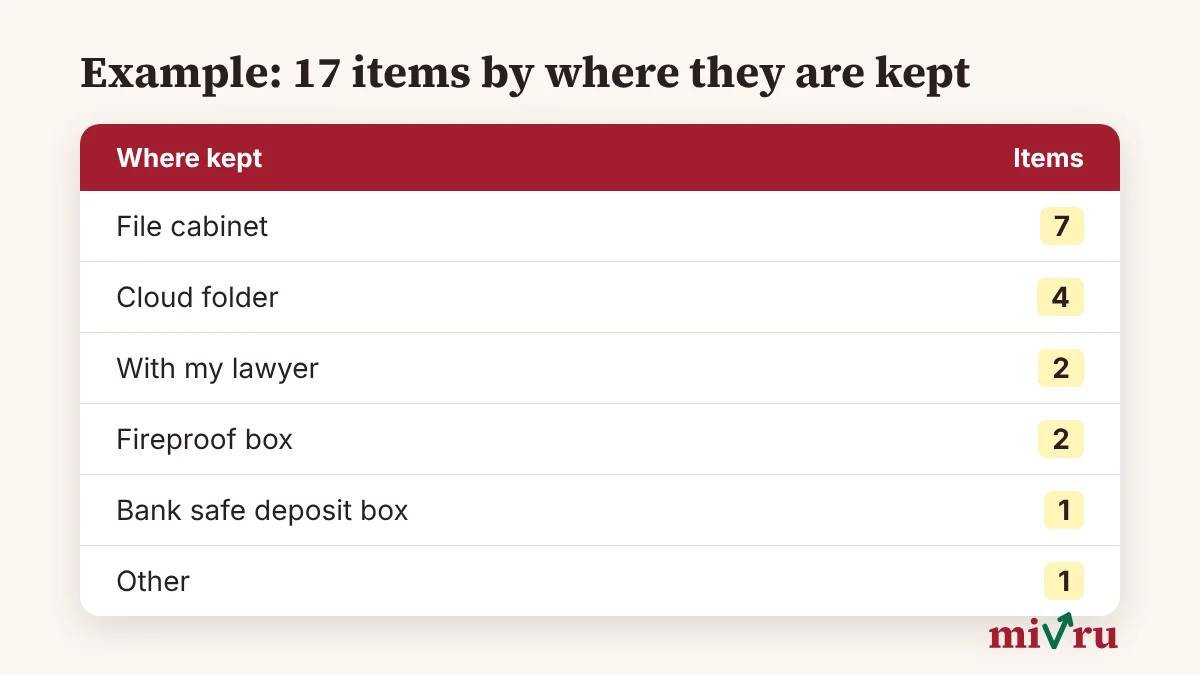
| Where | Items |
|---|---|
| File cabinet | 7 |
| Cloud folder | 4 |
| With my lawyer | 2 |
| Fireproof box | 2 |
| Bank safe deposit box | 1 |
| Other | 1 |
Seven items in one file cabinet is a sign that the cabinet is the main place. It also means the people in charge need to know it exists.
The people page
The organizer lists 8 people: Sam as executor and as power of attorney (not yet signed), Aunt Rosa as backup executor, Dr. Patel as the health care agent contact, a lawyer who holds the will, an accountant, a financial adviser and the sister who has agreed to be guardian for the children. Each row has a phone number and a note.
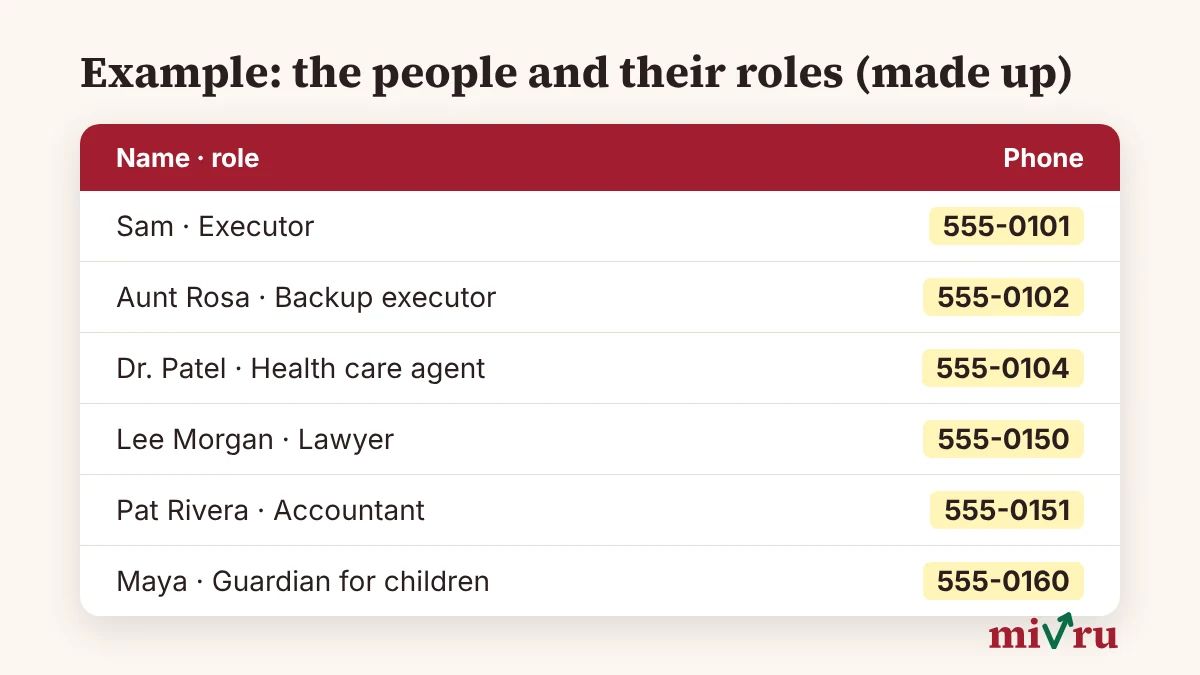
The National Institute on Aging says in its pages on advance care planning that the person you choose to speak for you should know your values and wishes. The people page is where you write down who that is and how to reach them.
What the example teaches
- A checklist shows gaps fast. Five of 17 items need action.
- Places matter. If most papers are in one cabinet, protect it and tell the right people.
- Dates make reviews easy. Five items are overdue for a look.
- The people page is half the plan. A document is only useful if someone knows to find it.
- Leaving numbers out is safer. The example records names and places, with only the last 4 digits of an account.
Build your own
Start with the estate planning checklist template guide, then build the sheet in Excel or Google Sheets. For the rest of your household papers, see the household binder example, and for accounts the password log example. This is general information, not legal advice.
The counts in one table
| Status | Items |
|---|---|
| Have it | 11 |
| Need to get | 3 |
| Needs update | 2 |
| Not needed | 1 |
| Total | 17 |
Five items need action: three to get and two to update. Five items have not been reviewed in three years, which is a separate list of things to look at.
The eight people
The organizer also lists eight people: two family members who are named as the main contacts, an aunt, a doctor, an estate lawyer, a tax preparer, a retirement adviser and others. For each, it holds a role, a phone number and a note. The note says what they know, such as "Knows where the binder is". Writing it down avoids the situation where a family member is left calling around.
How to use the example for your own organizer
- Start with the list of documents you think you have. Do not worry about perfect.
- Give each one a status. Have it, Need to get, Needs update or Not needed.
- Write where it is kept. A location is more useful than a description.
- Add the date you last looked. It shows what is old.
- List the people and what each one knows.
This is an example of how to organize information. It is not legal advice, and a lawyer can help with documents such as wills and powers of attorney.
Want the example ready-made?
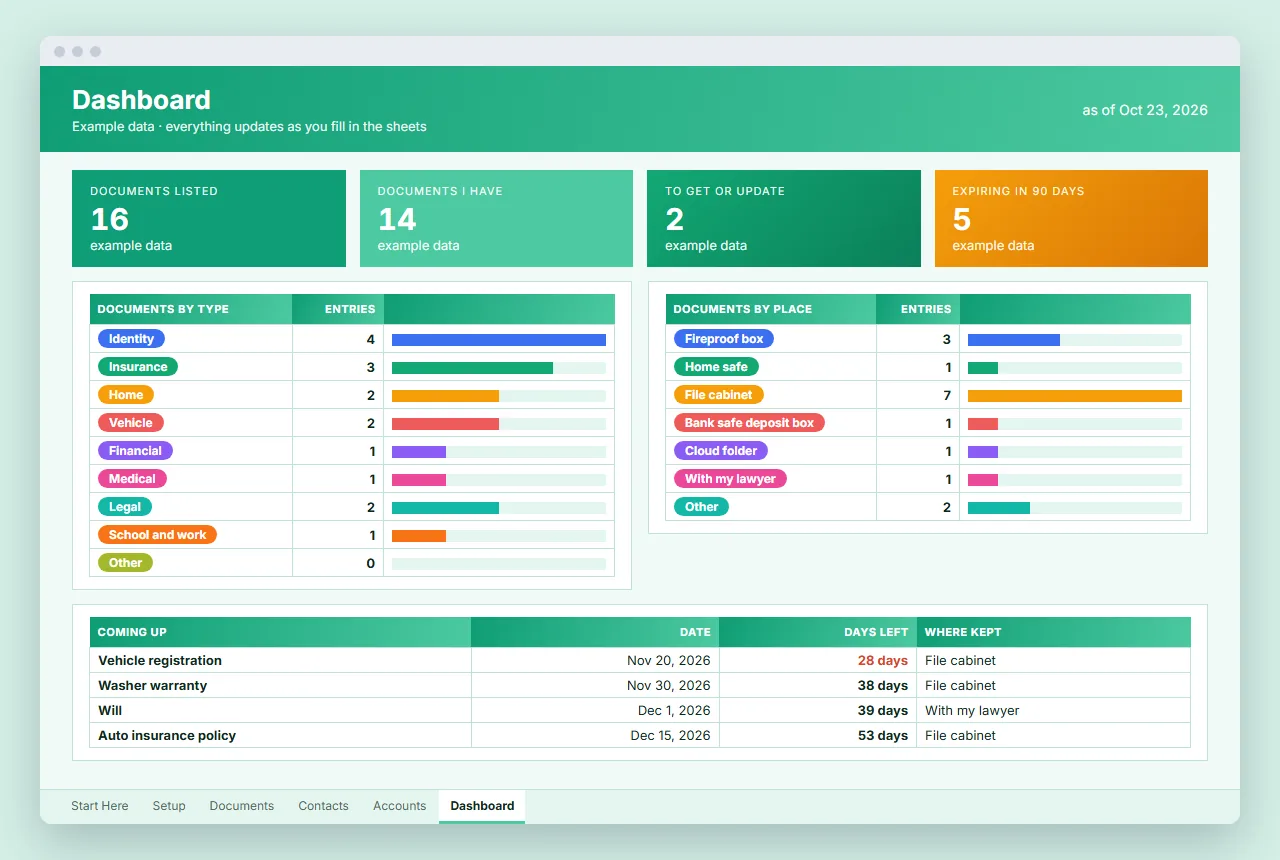
The Mivru Estate Planning Organizer & Checklist includes this example, so you can click around before you clear it and enter your own items. It has a Checklist, a People sheet and a Dashboard in five color themes for Excel and Google Sheets, plus an 11-page printable. See the Estate Planning Organizer & Checklist.
Frequently asked questions
What does a filled-in estate planning organizer look like?
It lists each item such as a will, powers of attorney, insurance, accounts and debts, with where it is kept, a status and the date it was reviewed, plus a list of the people in charge. This page shows a made-up one.
Are the names and items in this example real?
No. Every name, item and date is made up to show how an organizer works. Use your own.
What do the statuses mean?
Have it means the document exists and you know where it is. Need to get means it does not exist yet. Needs update means it exists but is out of date. Not needed means you decided it does not apply.
Is this legal advice?
No. It is an organizing example. Ask a lawyer about wills, trusts and powers of attorney in your state.
Can I copy this example?
Yes. The Mivru estate planning organizer includes this example, so you can click around, then clear it and enter your own.