Party Planning Budget Template Free: What to Include
A party planning budget template with the 10 categories to include, how to split the total and how to stay on track. Free budget and guest checklist.
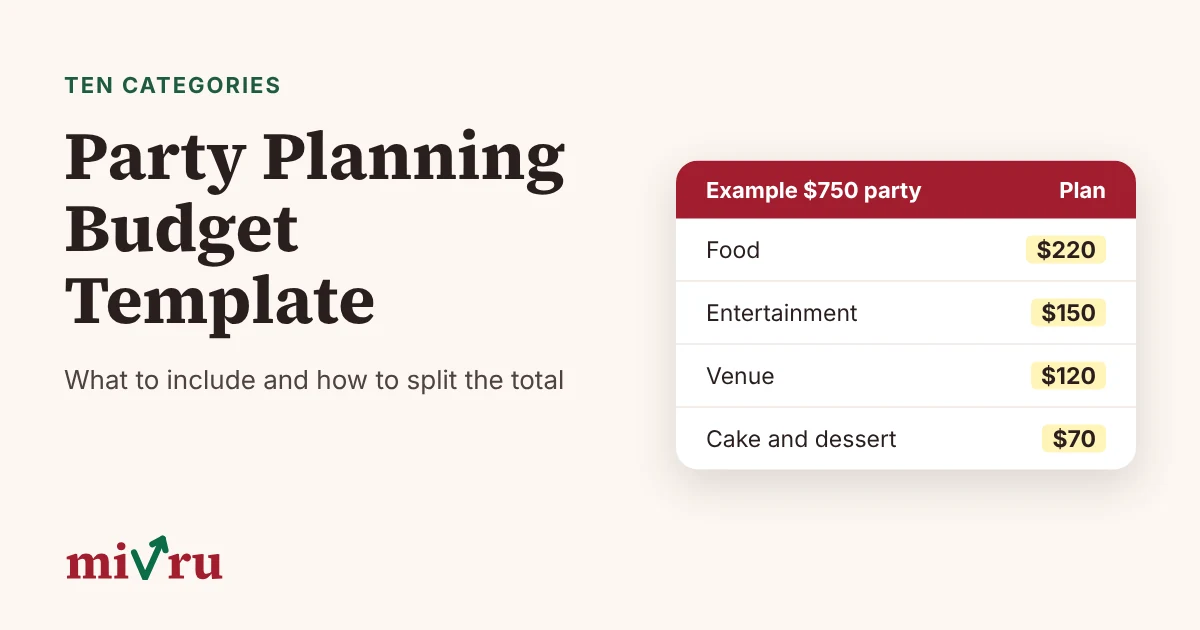
A party planning budget template is a page that splits your total between the things a party really costs, so the day is fun and the bill is no surprise. This guide lists the ten categories to include, shows how to split a total and explains how to stay on track. The numbers are made up.
The free party budget and guest checklist is a one-page version. For a filled-in example, see our party budget example.
Start with the total, not the wish list
Decide the number you can spend first. Planning from a wish list tends to end with a bill that is bigger than you expected. Once you have the total, you can spend it on what matters most to you: the food, the place, the entertainment or the guest list.
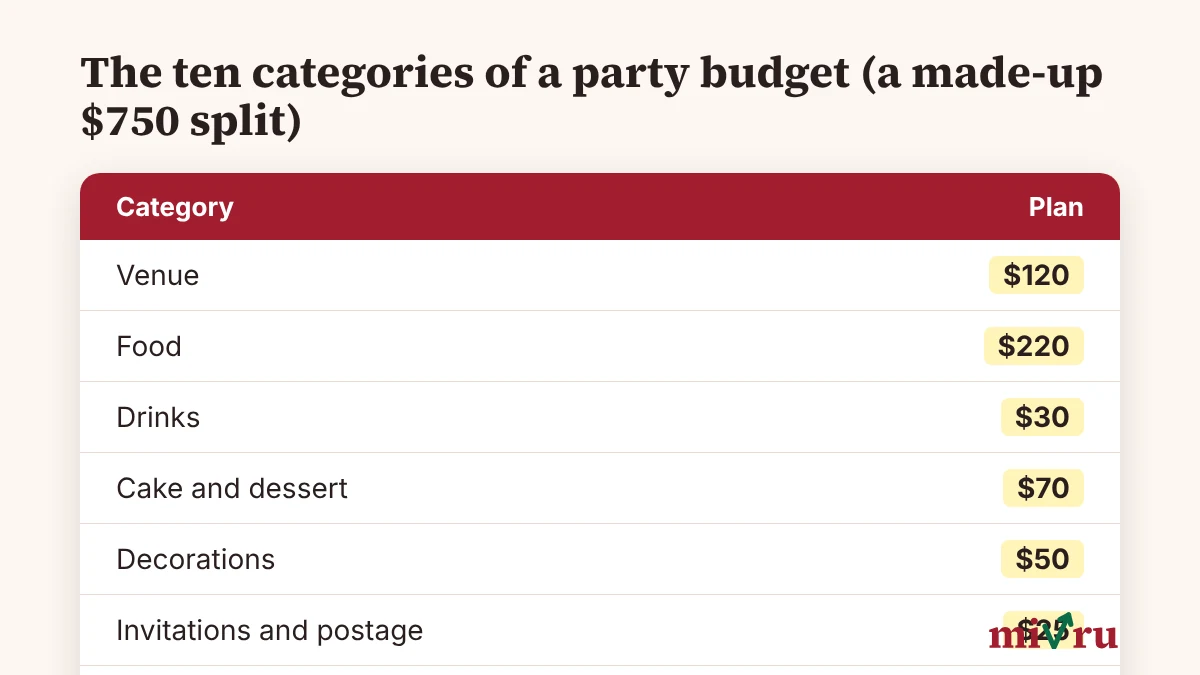
The 10 categories
- Venue. A rental, a park pavilion, a hall. Zero if you are at home.
- Food. Usually the biggest category. Count the guests.
- Drinks. Include ice and cups.
- Cake and dessert.
- Decorations. Balloons, banners, flowers, tablecloths.
- Invitations and postage.
- Entertainment and games. A magician, music, game prizes.
- Party favors. Goody bags or small thank-you gifts.
- Gifts. If you are giving a gift to a guest of honor or a host.
- Other. Plates, napkins, a folding chair rental, parking. Things you forgot.
A sample split
Example (made up): A $750 birthday party for 12 guests is split as venue $120, food $220, drinks $30, cake $70, decorations $50, invitations $25, entertainment $150, favors $60 and other $25. Food and entertainment together are about half the total.
If your total is different, keep the same proportions and adjust. If a category does not apply, such as a venue at home, move that money to a category that does, or keep it as a buffer.
Keep a 5% to 10% buffer
Party costs creep. Someone brings an extra guest, the cake costs more, you forgot napkins. A buffer of 5% to 10% of the total, held in the "other" line, absorbs those without breaking the plan. On a $750 budget that is $38 to $75.
Log every purchase
A budget only helps if you compare it with what you actually spend. Keep a log with the date, the category, the item and the amount. When you buy something, add it and subtract it from the category's plan. If a category goes over, take the difference from another one.
Count guests early
Food, drinks and favors all scale with the number of people. Invite, count the yes answers, and re-do the food line when the RSVPs arrive. A guest list with party size and RSVP status makes that easy. Our free checklist has one on the same page.
Plan for safety, not just cost
Food safety belongs in the plan. The USDA says perishable food should not sit out for more than two hours, or one hour when it is over 90°F, in its guidance on the danger zone between 40°F and 140°F. That affects how much you serve at once and whether you need extra coolers or warming trays. If your party is for young children and you use latex balloons, the Consumer Product Safety Commission advises keeping deflated balloons away from children younger than 8.
Paper or spreadsheet
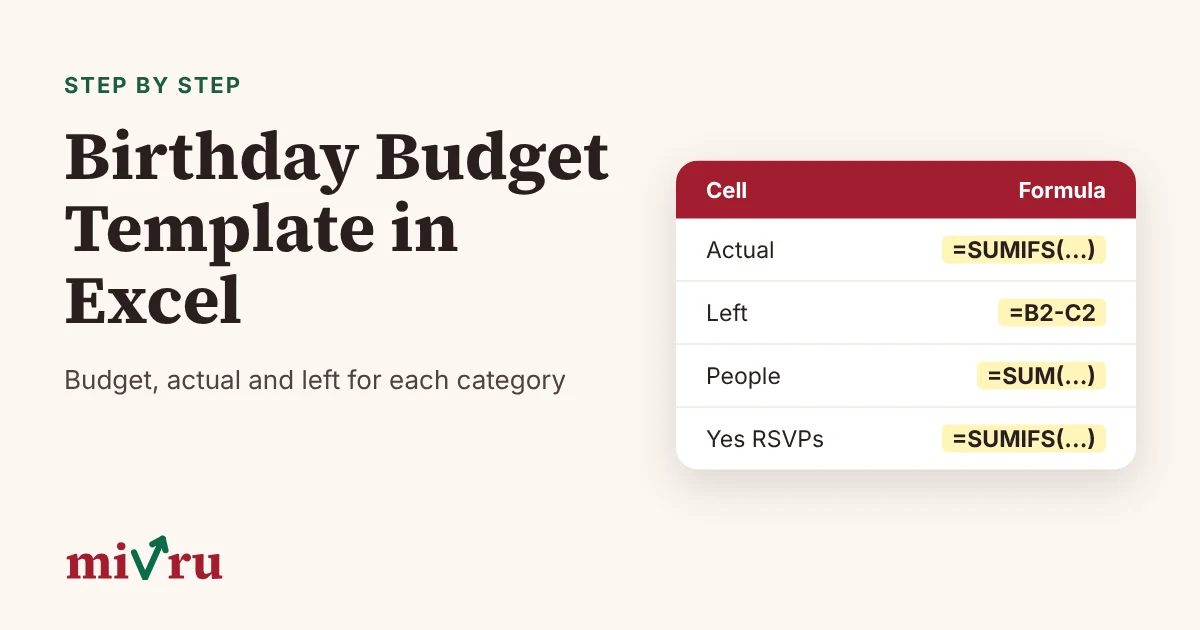
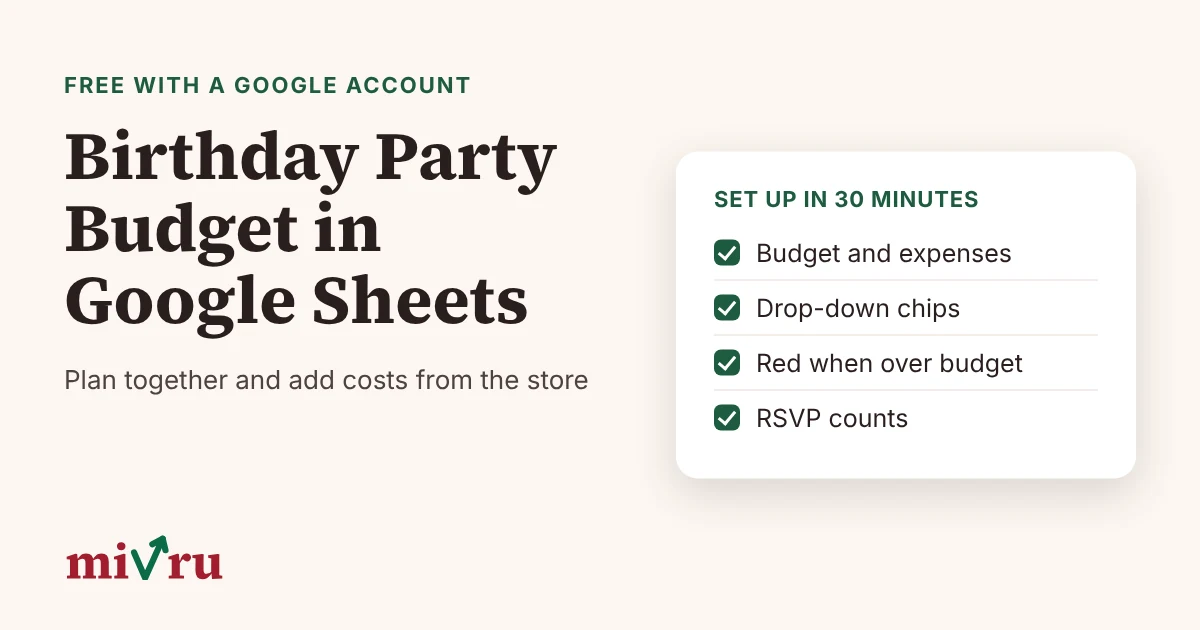
A printed budget is quick and works anywhere. A spreadsheet can compare budget and actual for several parties and add up the guest list. If you want to build one, follow our birthday budget template for Excel or the Google Sheets version. For a graduation, read the graduation party budget guide. This is general information, not financial advice.
The sample split in a table
| Category | Amount | Share of $750 |
|---|---|---|
| Venue | $120 | 16% |
| Food | $220 | 29% |
| Drinks | $30 | 4% |
| Cake and dessert | $70 | 9% |
| Decorations | $50 | 7% |
| Invitations | $25 | 3% |
| Entertainment and games | $150 | 20% |
| Party favors | $60 | 8% |
| Other | $25 | 3% |
| Total | $750 | 100% |
The amounts add up to $750. For 12 guests that is $750 / 12 = $62.50 a guest, and food alone is $220 / 12 = $18.33 a guest.
How the same total changes for a home party
If the party is at home, the venue line drops to zero. The $120 can go three ways: more food, a better entertainment budget or a bigger buffer. Decide before you shop, and write the change on the plan so the totals still add up.
Before the party and after
- A week before: count the RSVPs and redo the food line.
- Two days before: buy what is left and log the receipts.
- The day after: compare each category's plan with what you spent.
- Write one note for next time, such as "food was too much" or "buy fewer favors".
A note like that makes the next party's plan better than this one's.
A quick test of the plan
Add up the category amounts and check they equal the total. Then divide the total by the number of guests. If the cost per guest is more than you want to spend, cut a category, not the buffer.
Want it ready-made?
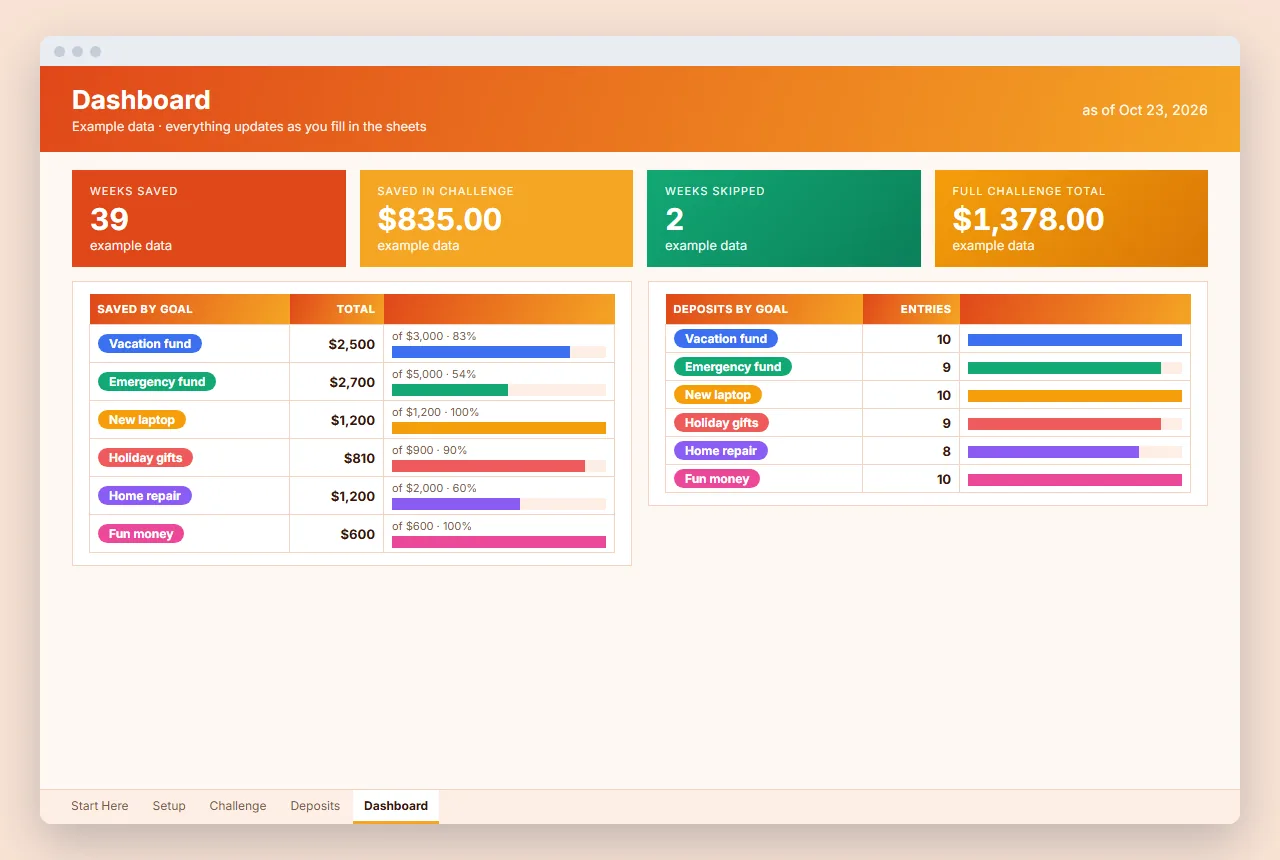
The Mivru Party Budget Planner & Guest List compares budget and actual for up to three parties, logs every purchase, tracks RSVPs and has an 12-page printable in color and black and white, in five color themes for Excel and Google Sheets. See the Party Budget Planner & Guest List.
Frequently asked questions
What should a party budget include?
Venue, food, drinks, cake and dessert, decorations, invitations and postage, entertainment and games, party favors, gifts and a small other line for things you forgot.
How do I decide how much to spend on a party?
Start with what you can afford, then divide it between categories. Food and venue are usually the largest parts. Keep 5% to 10% of the total as a buffer for extras.
How do I stay on budget?
Write every purchase in a log the day you buy it, compare it with the plan for that category and adjust the other categories if one goes over.
What is cost per guest?
It is the total you spent divided by the number of guests. It helps you compare parties and plan the next one.
Is there a free party budget template?
Yes. Mivru has a free one-page party budget and guest checklist as a PDF. You get the link when you join the email list.