Medical Bills Tracker Spreadsheet Free: Build in Excel
Build a medical bills tracker spreadsheet in Excel for free: a log with drop-downs, SUMIFS totals by person and month, and a missing receipts count.
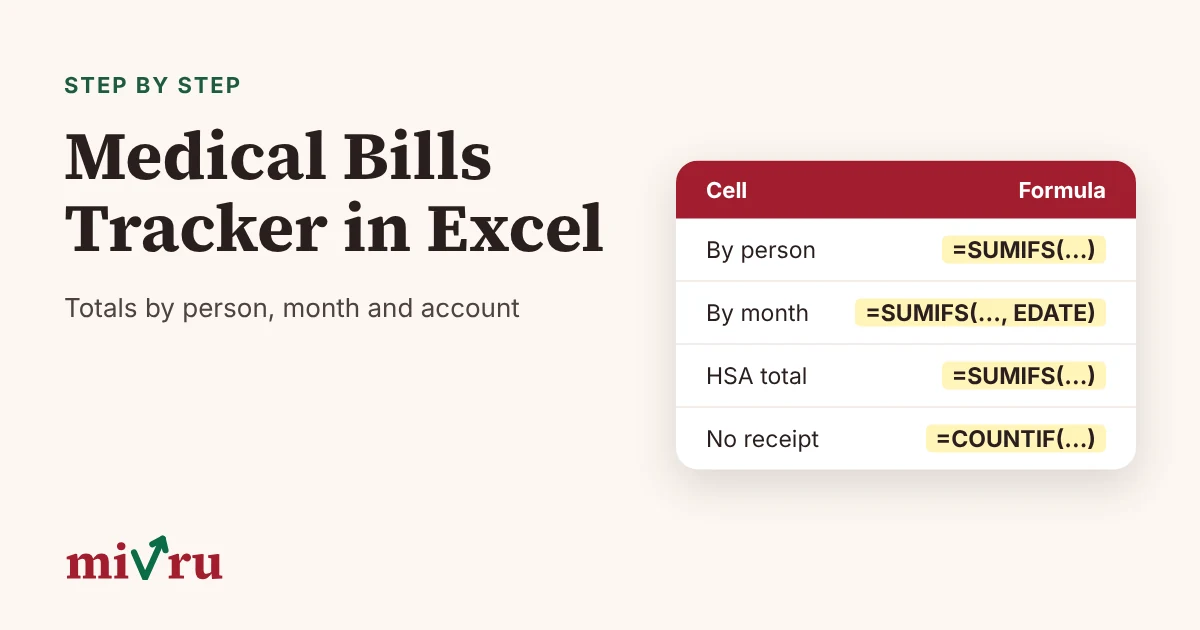
A medical bills tracker spreadsheet in Excel takes about 40 minutes to build and shows what your family spent by person, category and month, plus which receipts are missing. This guide builds it with made-up numbers. It is a record-keeping tool, not medical, tax or insurance advice, and it never needs a diagnosis.
The data matches our medical expense tracker example. For what to record, see the medical expense tracker template guide.
What you will build
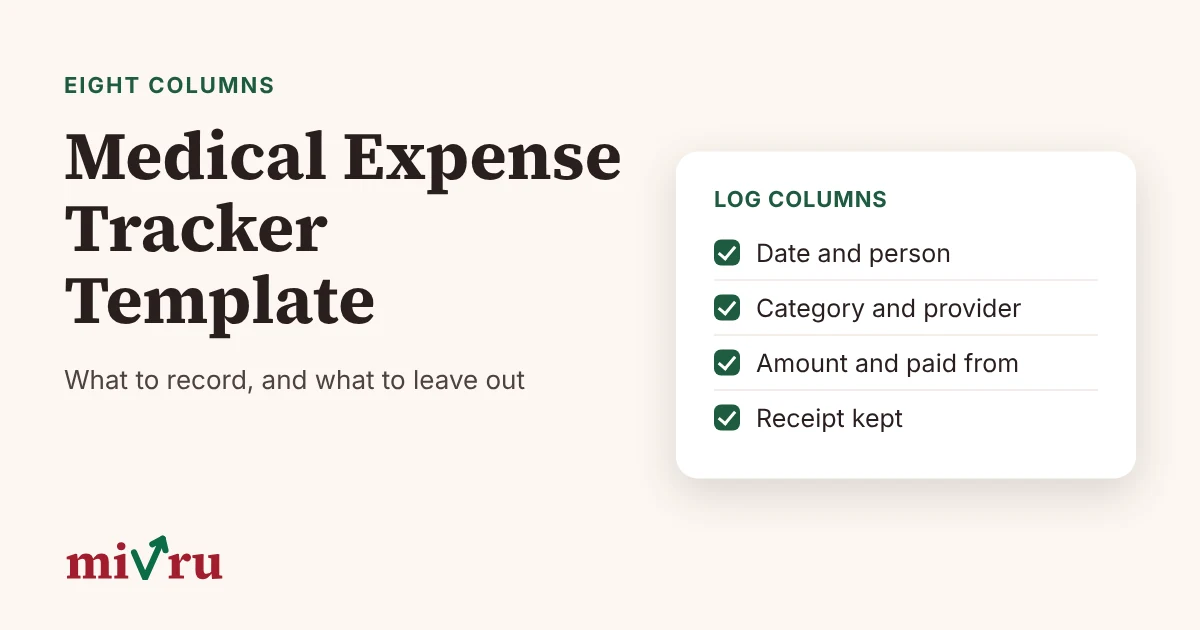
- A Log sheet: Date, Person, Category, Provider, Amount, Paid from, Receipt kept.
- A Lists sheet for the drop-downs.
- A Summary sheet with totals by person, category, month and account.
Step 1: Lists
On Lists, type the people in A2:A5 (Me, Partner, Child 1, Child 2), the categories in B2:B10 (Doctor visits, Dental, Vision, Prescriptions, Hospital and lab, Therapy and counseling, Equipment and supplies, Travel to care, Other), and in C2:C4 HSA, FSA and Own money.
Step 2: The Log
On Log type in row 1: Date, Person, Category, Provider, Amount, Paid from, Receipt kept, Notes. Add a few made-up rows, for example 1/15/2026, Me, Doctor visits, Dr. Patel office, 40, HSA, Yes, Yearly check-up copay.
Step 3: Drop-downs
Select B2:B700, choose Data > Data Validation, set Allow to List and Source to =Lists!$A$2:$A$5. Repeat for Category (=Lists!$B$2:$B$10) and Paid from (=Lists!$C$2:$C$4). For Receipt kept use the list Yes,No. Microsoft explains the dialog on its page about applying data validation to cells. Drop-downs matter because the totals below match exact words.
Step 4: Total by person and by category
On Summary, list the people in A2:A5 and enter in B2:
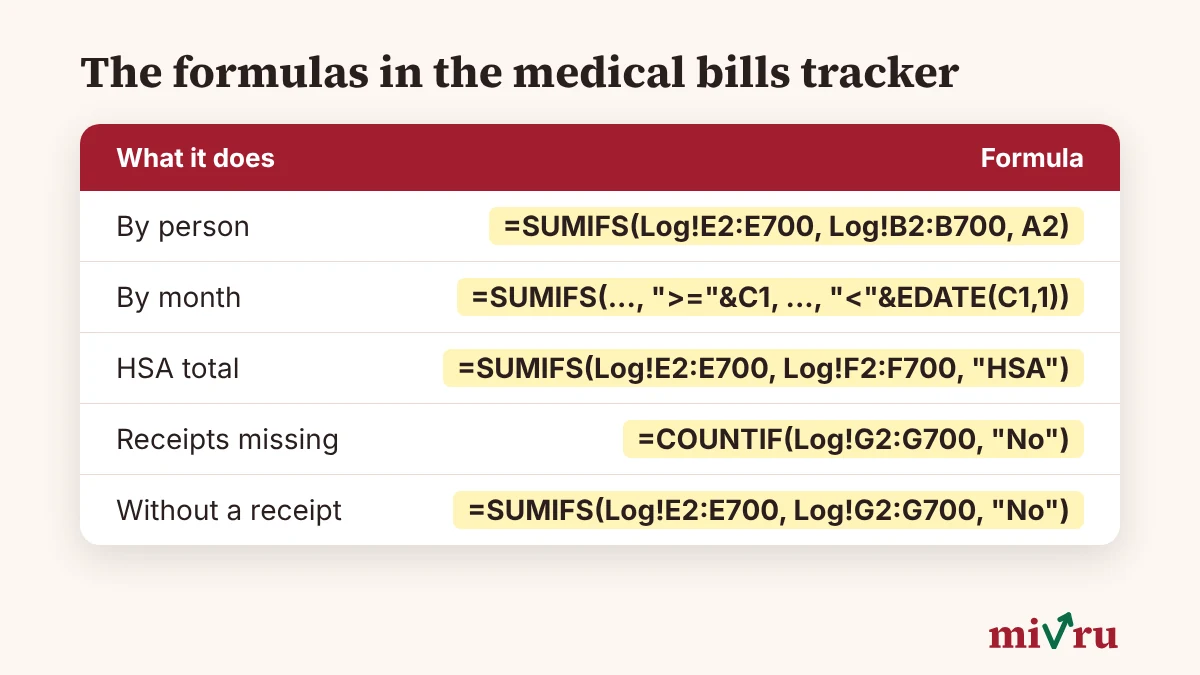
=SUMIFS(Log!$E$2:$E$700,Log!$B$2:$B$700,A2)
Copy it down, and do the same for categories using column C of the Log. SUMIFS adds the amounts where the person or category matches. In the example, Me comes to $609.00 and Vision to $314.00.
Step 5: Total by month
Put the first day of each month across a row (1/1/2026, 2/1/2026, and so on). Under each enter:
=SUMIFS(Log!$E$2:$E$700,Log!$A$2:$A$700,">="&C1,Log!$A$2:$A$700,"<"&EDATE(C1,1))
EDATE gives the same day one month later. September comes to $279.60 in the example and July to $49.15.
Step 6: Paid from
| Label | Formula |
|---|---|
| HSA total | =SUMIFS(Log!$E$2:$E$700,Log!$F$2:$F$700,"HSA") |
| FSA total | =SUMIFS(Log!$E$2:$E$700,Log!$F$2:$F$700,"FSA") |
| Own money total | =SUMIFS(Log!$E$2:$E$700,Log!$F$2:$F$700,"Own money") |
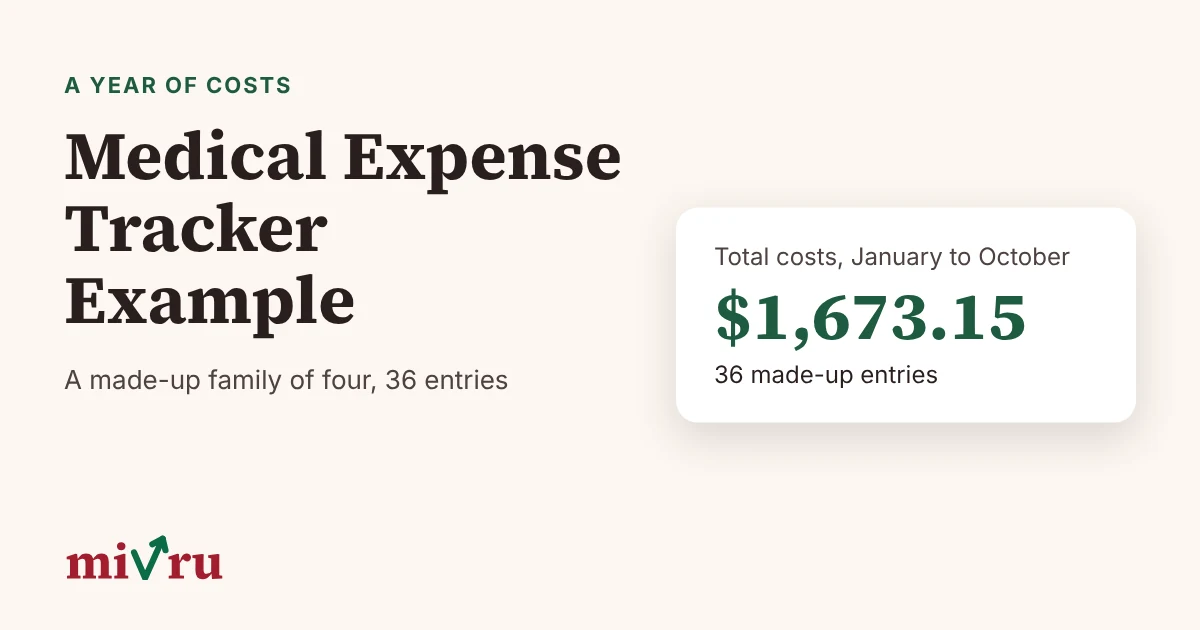
In the example they are $795.55, $244.00 and $633.60, which add up to the $1,673.15 total. The IRS says that if you use a Health Savings Account you should keep records showing distributions were used only for qualified medical expenses, so this table is a quick way to see what to back up with receipts.
Example: $795.55 + $244.00 + $633.60 = $1,673.15, the same as the sum of the Amount column. If the two totals ever differ, a row has a blank or misspelled "Paid from".
Step 7: Missing receipts
| Label | Formula |
|---|---|
| Receipts kept | =COUNTIF(Log!$G$2:$G$700,"Yes") |
| Receipts missing | =COUNTIF(Log!$G$2:$G$700,"No") |
| Amount without a receipt | =SUMIFS(Log!$E$2:$E$700,Log!$G$2:$G$700,"No") |
Microsoft's COUNTIF page explains the criteria. In the example: 32 kept, 4 missing, $211.00 without a receipt. Add a rule with Conditional Formatting > New Rule > Use a formula, =G2="No", and a red fill, so missing receipts jump out. Microsoft's page on conditional formatting shows the dialog.
Keep it private
A medical spreadsheet is private. Keep it in a folder only you can open, avoid diagnoses, and think about File > Info > Protect Workbook > Encrypt with Password. Do not type policy or account numbers beyond the last 4 digits.
Related guides
For the Google Sheets version, see the medical expense tracker in Google Sheets, and for the HSA side the HSA expense tracking spreadsheet guide. For everyday spending, read the expense tracker in Excel. This is general information, not medical, tax or insurance advice.
What the Summary should show
| Check | Value in the made-up year |
|---|---|
| Me | $609.00 |
| Partner | $542.00 |
| Child 1 | $255.00 |
| Child 2 | $267.15 |
| Total | $1,673.15 |
| HSA / FSA / Own money | $795.55 / $244.00 / $633.60 |
| Receipts kept / missing | 32 / 4 |
| September / July | $279.60 / $49.15 |
If something does not work
- A person shows zero. The name on Log does not match the name on Lists. Use the drop-down.
- A month is empty. Check that the first day of each month is a real date.
- The paid-from totals differ from the sum. A row has a blank or a misspelled name in the Paid from column.
- The receipt counts are off. A cell in the Receipt kept column is blank.
A yearly routine
At the end of the year, add up each column, match the totals with your statements and put the file and the receipts in one folder with the year on it. Medical information is private, so keep the folder where only you can open it.
Questions the workbook answers
- Who cost the most? The people table.
- What kind of cost is biggest? The categories table.
- Which month was heaviest? The monthly view, where September stands out.
- Which receipts are missing? The red rows in the Log, four in the example.
Keeping the workbook tidy
Use the drop-downs for every name, log each cost the day you pay it and save a copy at the start of each month. A tidy log is quick to check against statements.
Skip the build
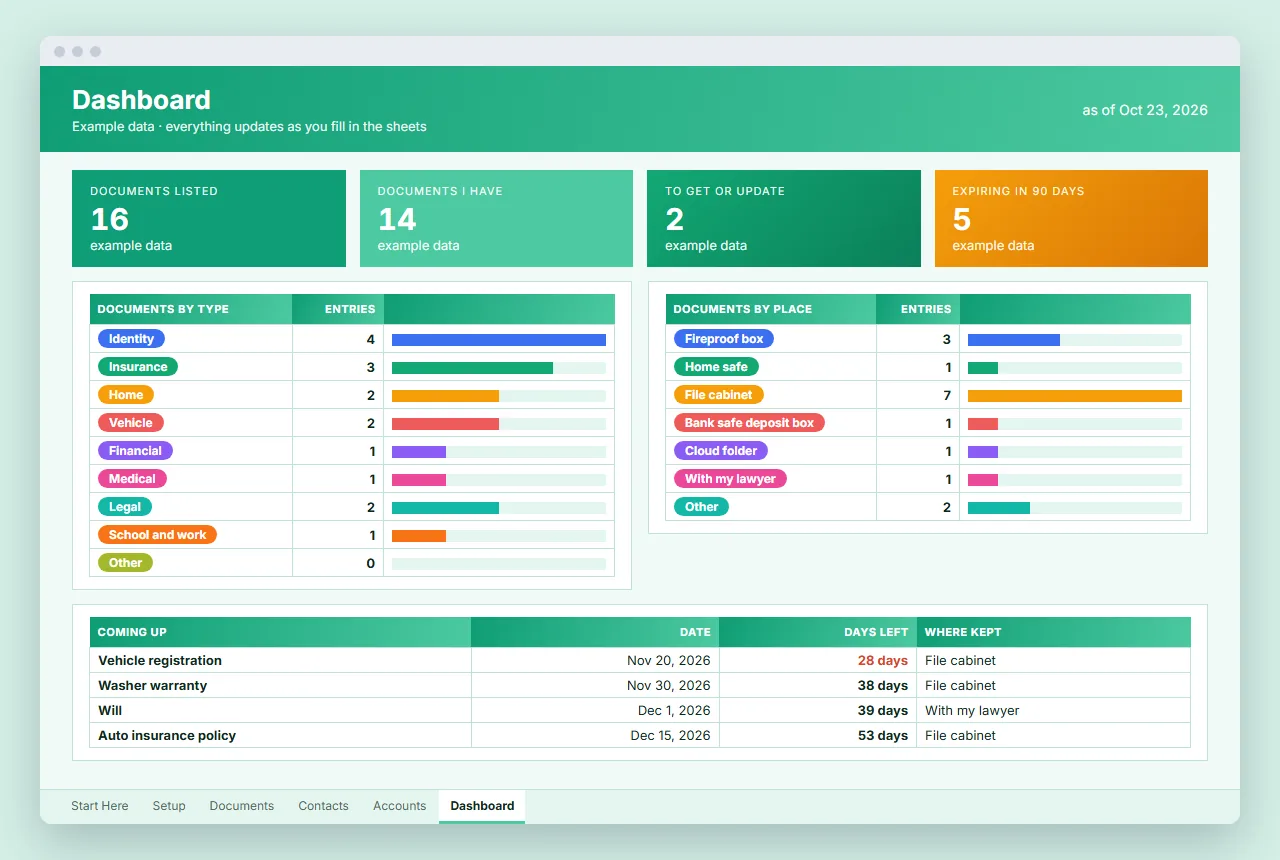
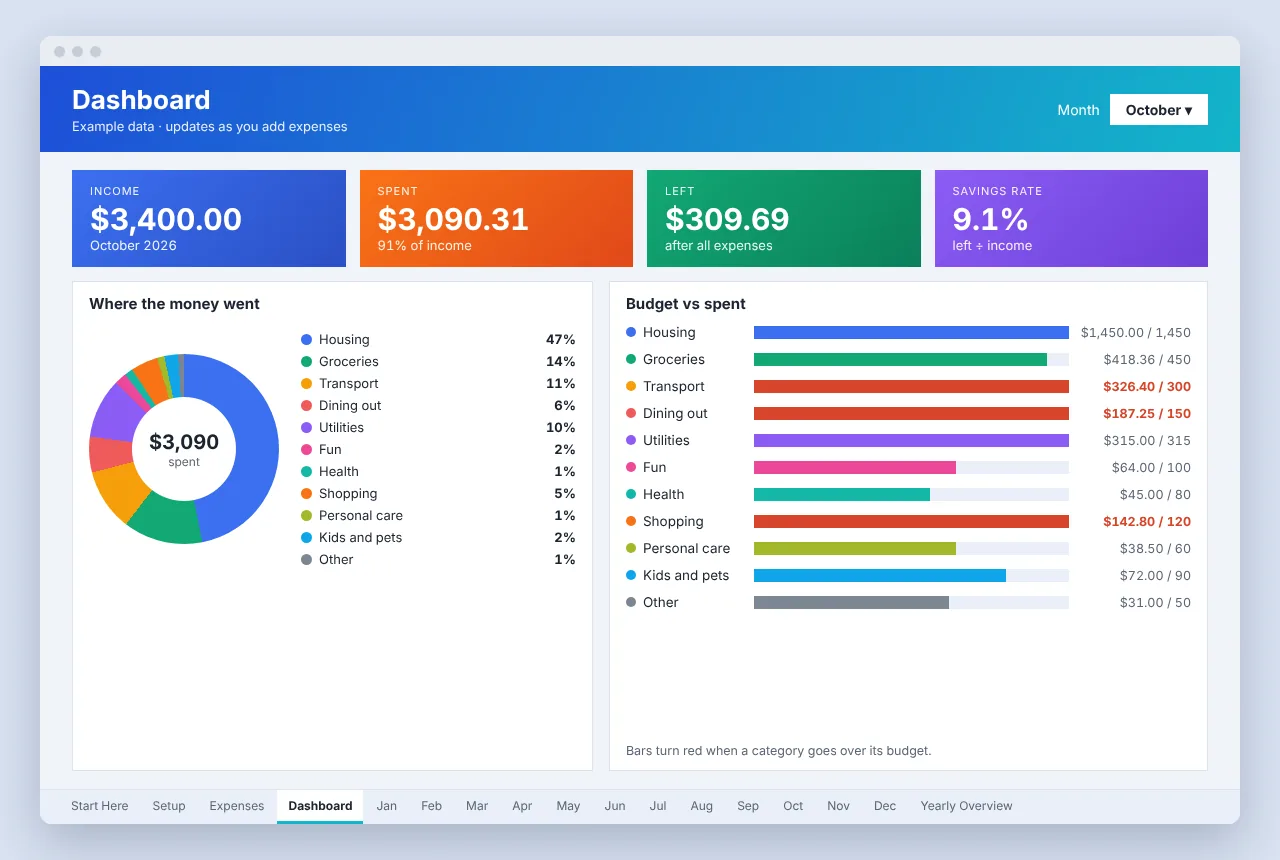
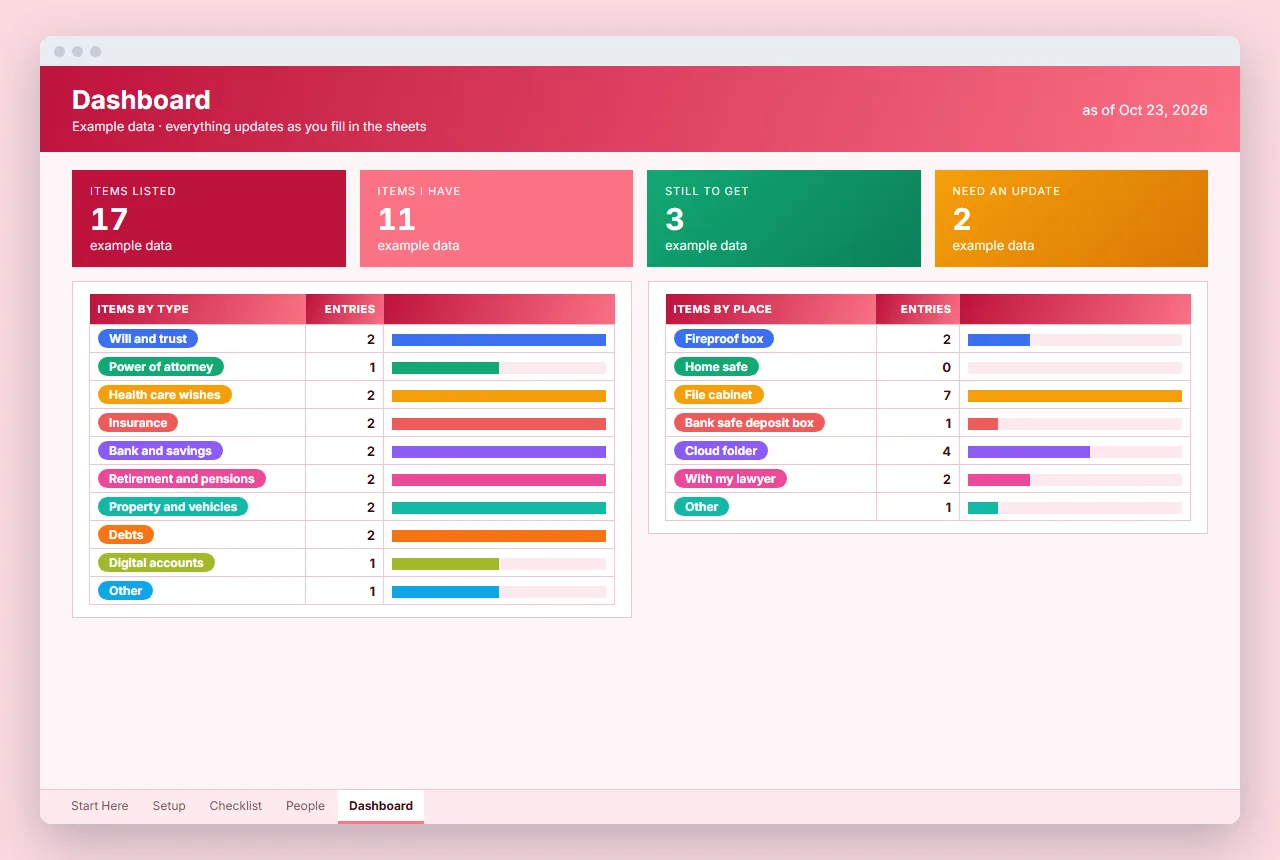
The Mivru Medical & HSA Expense Tracker has all of this ready: the log, drop-downs, a dashboard with a month picker, a Monthly sheet, a Paid From & Receipts sheet, five color themes and an 12-page printable. See the Medical & HSA Expense Tracker.
Frequently asked questions
Can I build a medical bills tracker in Excel?
Yes. A log sheet with drop-downs and a few SUMIFS and COUNTIF formulas gives you totals by person, category and month and a count of missing receipts.
Which formulas do I need?
SUMIFS for totals by person, category and month, COUNTIF for receipts kept or missing, and EDATE to get the start of the next month.
How do I add a drop-down list in Excel?
Select the cells, choose Data > Data Validation, set Allow to List and point Source at the cells with your list items.
Should I type diagnoses?
No. Use short notes like check-up or lab work and keep detailed medical information out of the file.
Is there a ready-made version?
Yes. The Mivru Medical & HSA Expense Tracker has the log, dashboard, monthly sheet and receipts sheet built in, in five color themes, plus an 12-page printable.