Donation Tracker for Taxes: Records to Keep
A donation tracker for taxes starts with good records: what to log for each gift, what to keep and what to ask. Record-keeping only, not tax advice.
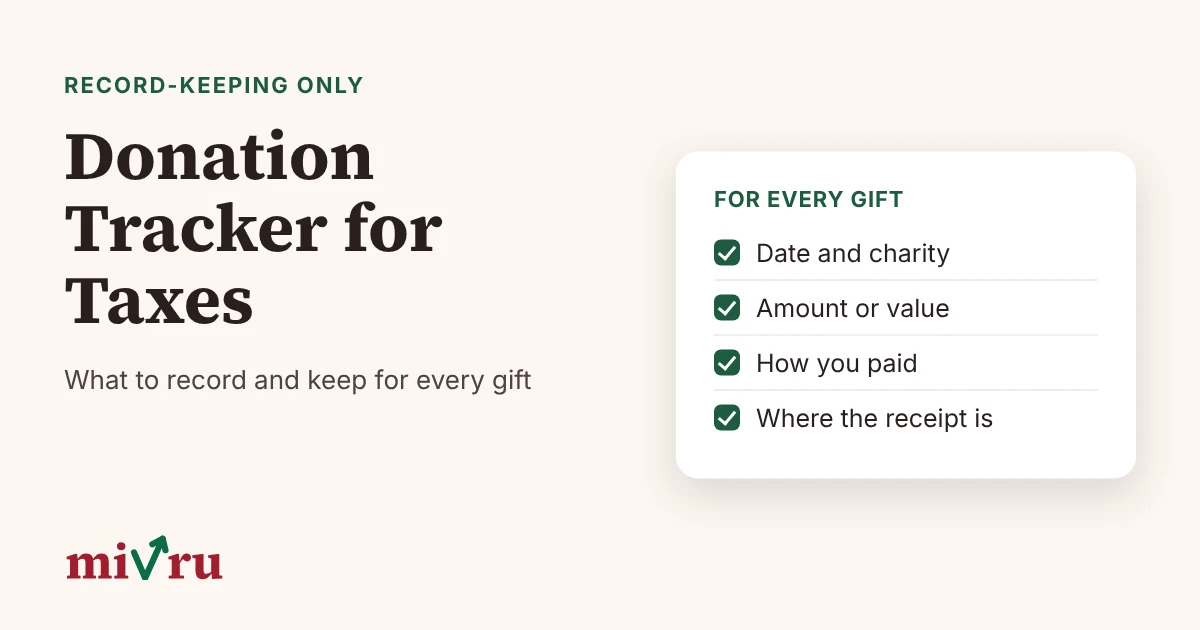
A donation tracker for taxes is mostly a donation tracker with good habits: write every gift down on the day, keep the receipt and know where the record is. This guide covers what to record and keep. It is record-keeping information only, not tax advice, and the rules depend on your situation, so ask the charity or a tax professional what applies to you.
The sample numbers are made up. The free printable donation log has a receipt box for each gift.
What the IRS says, briefly
The IRS page on charitable contribution deductions explains several points that make record-keeping worthwhile:
- You may deduct contributions to organizations that qualify under the tax code, including many charitable, religious and educational organizations. Contributions to foreign organizations are generally not deductible.
- Contributions of money or property are deductible only if you itemize.
- Contributions must be actually paid before the end of your tax year.
- There are limits based on a percentage of your adjusted gross income.
- For property other than cash, you generally may deduct fair market value.
- The page points to Publication 1771 for substantiation and disclosure requirements.
The page does not list the receipt rules itself, which is why you should read that publication or ask a professional.
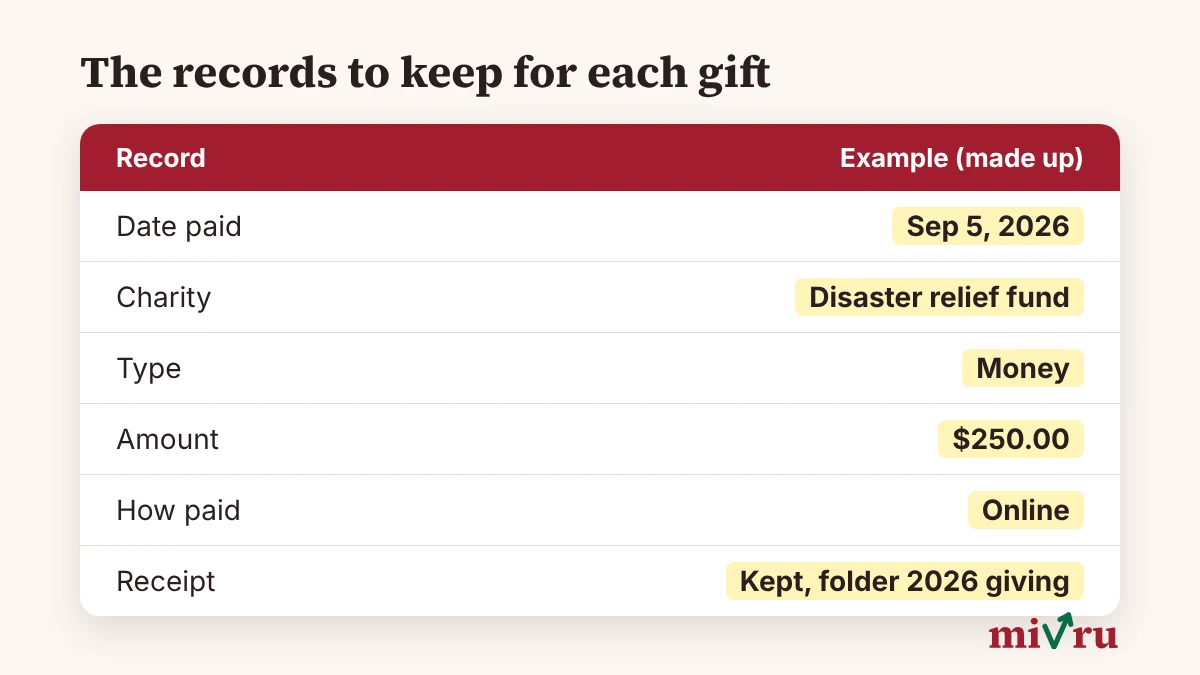
The 7 things to record for every gift
- Date paid. Use the day the money left your account or the item left your hands.
- Charity name. As on the receipt.
- Type. Money, goods or other.
- Amount, or estimated value of goods.
- How you paid. Card, check, online or cash.
- Receipt kept. Yes or no, and where.
- Notes. Anything useful, such as "event ticket, part was a meal" or "blankets and food".
Check the charity first
Before you give, check the organization. The FTC suggests searching its name along with words like "complaint" or "scam", checking charity watchdogs and confirming it is registered, in its advice before giving to a charity. For tax purposes, the FTC points to the IRS Tax Exempt Organization Search to confirm that the organization is registered with the IRS as tax-exempt.
Pay in a way that leaves a record
The FTC recommends paying by credit card or check, and says that requests for cash, gift cards, wire transfers, payment apps or cryptocurrency are warning signs. For tax records, a card or check also gives you a statement to back up your log.
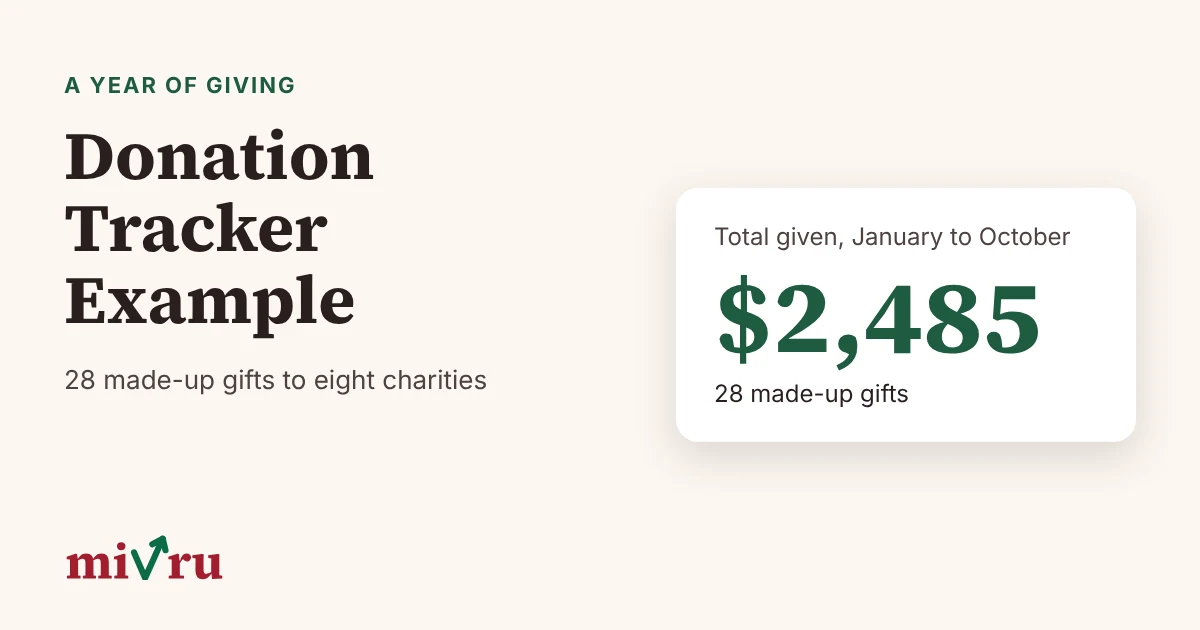
Example (made up): A year of giving has 28 gifts totaling $2,485. Twenty-four were paid by check, card or online, and four in cash. Twenty-five have receipts and three do not, all cash gifts totaling $100. The cash gifts are the ones to ask the charity about.
Keep records in one place
Use one log for the whole year. Put paper receipts in an envelope or folder for the year, and save emailed receipts in a folder with a clear name. When you add a gift to the log, write the folder or envelope in the notes. At the end of the year, check each log line against a receipt or statement.
Large gifts and goods
For large gifts and donated goods, ask the charity what written acknowledgment it can provide and ask a tax professional what you need. Keep a record of how you decided the value of goods, such as a thrift-store price list or a photo of the items. Keep the receipt the charity gives you.
Volunteer time and mileage
Keep a separate log of volunteer hours. If you have costs related to volunteering, such as driving, ask a tax professional what is allowed before you rely on any figure, and write the dates and distances down. A simple log of date, place, purpose and miles is a good start.
Paper or spreadsheet
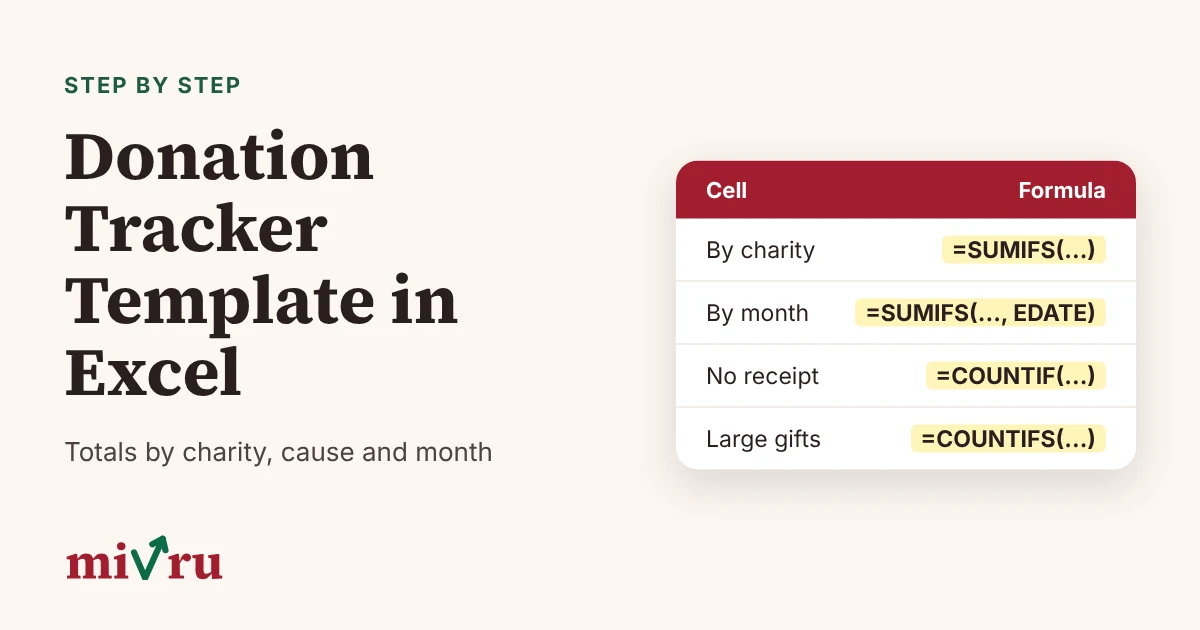
A printed log works. A spreadsheet adds up by charity and month and counts gifts without receipts. Build one in Excel or Google Sheets. For the same kind of records on the medical side, see our medical expense tracker template guide, and for papers your family may need, the estate planning checklist guide. This is general information, not tax advice.
A made-up gift record
| Field | Example |
|---|---|
| Date paid | Mar 14, 2026 |
| Charity | Animal shelter |
| Type | Money |
| Amount | $75 |
| How paid | Online |
| Receipt kept | Yes, folder "2026 giving" |
| Notes | Annual gift |
The year in the example
| Check | Value |
|---|---|
| Gifts | 28 |
| Total | $2,485 |
| Paid by check, card or online | 24 |
| Paid in cash | 4 ($140) |
| Receipts kept | 25 |
| Receipts missing | 3 ($100) |
Twenty-four of the 28 gifts leave a record at the bank or card company. The cash gifts are the weak spot, so write them down the same day.
A year-end checklist
- Add up the log and check it against your statements.
- Find the missing receipts and ask the charity for a copy.
- Put the log and receipts in one folder with the year on it.
- Write down questions for a tax professional, such as how to value goods.
- Keep the folder as long as your tax professional advises.
This guide describes record-keeping, not tax advice.
Want it ready-made?
The Mivru Donation & Charitable Giving Tracker logs every gift with a receipt column, totals giving by charity, cause and month, and flags large gifts that have no receipt. It has an 11-page printable and five color themes for Excel and Google Sheets. See the Donation & Charitable Giving Tracker.
Frequently asked questions
What should a donation tracker for taxes record?
For each gift: the date, the charity, the amount or the estimated value of goods, how you paid and where the receipt or bank record is.
Are all donations tax deductible?
No. The IRS says contributions are generally deductible only for qualified organizations and only if you itemize. Ask the charity or a tax professional what applies to you.
Do I need a receipt for every gift?
Keep a receipt or bank record for every gift. The IRS points to Publication 1771 for the substantiation rules. Ask a tax professional what you need.
How do I record donated goods?
Write what you gave, the date, the charity and your estimate of the value, and keep the receipt. The IRS says that for property other than cash you generally may deduct fair market value.
Is this tax advice?
No. This is general information about keeping records. Ask a tax professional about your situation.