Donation Tracker Example: A Year of Giving
A donation tracker example with 28 made-up gifts totaling $2,485: giving by charity, cause and month, how gifts were paid and which receipts are missing.
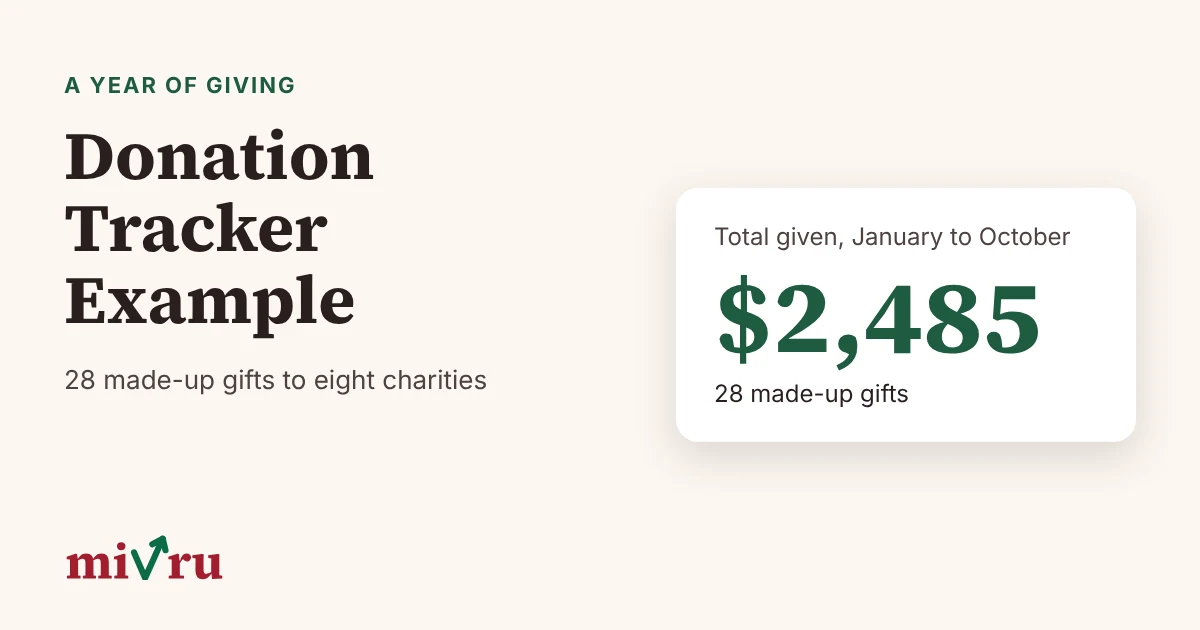
This donation tracker example shows a made-up year of giving: 28 gifts to eight charities, $2,485 in all, with totals by charity, cause and month and a short list of receipts still to find. Every name and amount is invented. Use it as a pattern for your own tracker. It is a record-keeping example, not tax advice.
The giving
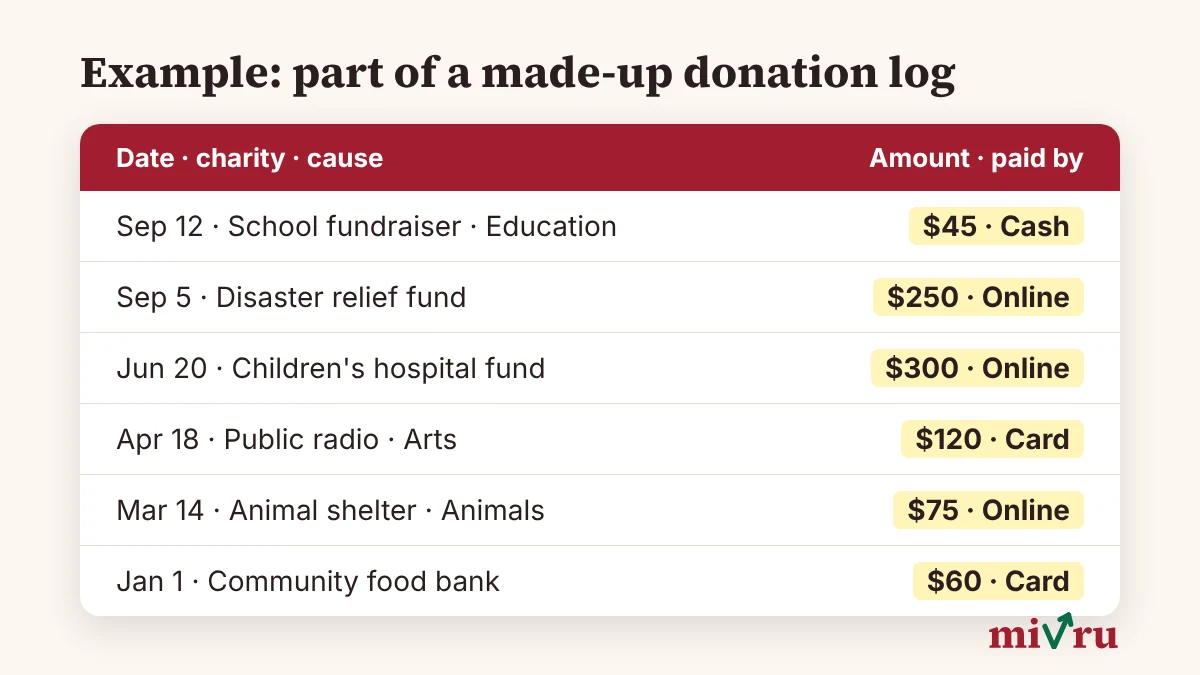
The made-up giver has two monthly gifts (a local church and a community food bank) and a handful of one-off gifts. Each row has a date, the charity, the cause, the type (money or goods), the amount, how it was paid and whether the receipt was kept. The log covers January to October 2026.
Giving by charity
| Charity | Gifts | Total |
|---|---|---|
| Local church | 10 | $1,000 |
| Community food bank | 10 | $600 |
| Children's hospital fund | 1 | $300 |
| Disaster relief fund | 1 | $250 |
| Public radio | 1 | $120 |
| Animal shelter | 2 | $115 |
| School fundraiser | 2 | $75 |
| Neighborhood library | 1 | $25 |
| Total | 28 | $2,485 |
Example: The two monthly gifts make up 64% of the total ($1,600 of $2,485). Three one-off gifts, to the hospital, the disaster fund and public radio, add another $670. Monthly gifts are easy to budget, and the log shows them clearly.
Giving by cause
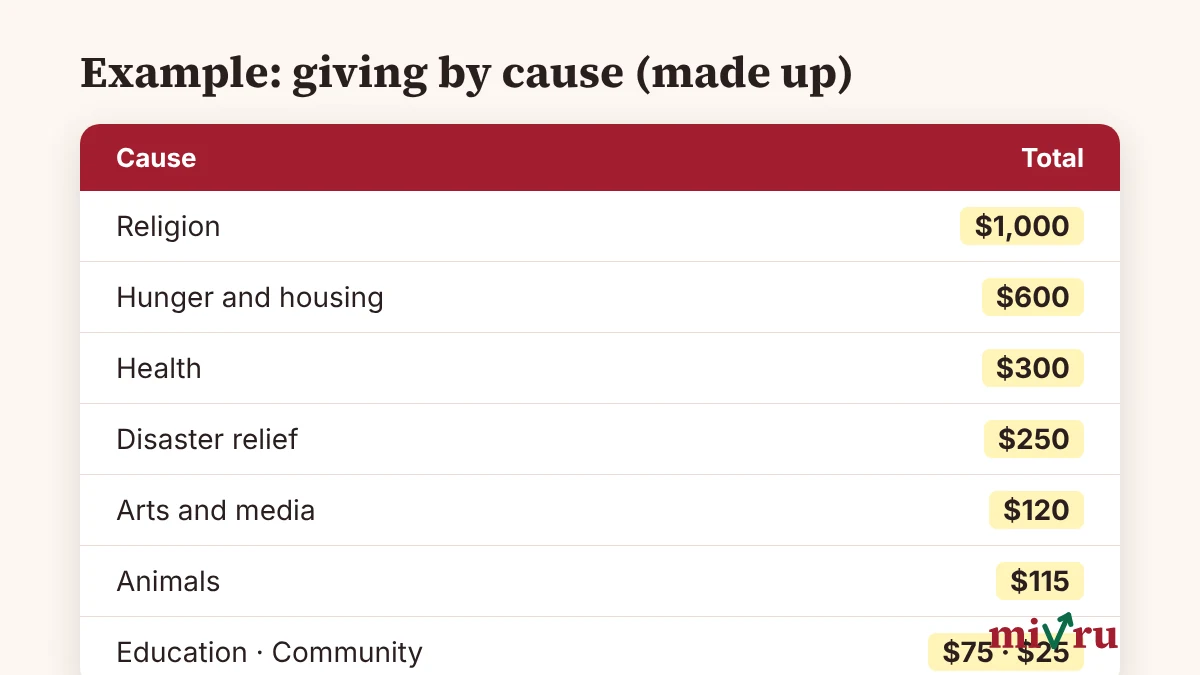
Religion ($1,000) and hunger and housing ($600) are the biggest causes, followed by health ($300), disaster relief ($250), arts and media ($120), animals ($115), education ($75) and community ($25). A cause view makes it easy to ask whether your giving matches your values.
Month by month
| Month | Given |
|---|---|
| January | $160 |
| February | $190 |
| March | $235 |
| April | $280 |
| May | $160 |
| June | $460 |
| July | $160 |
| August | $160 |
| September | $455 |
| October | $225 |
June is the highest month at $460 because of a $300 gift to the children's hospital fund. September is next at $455 with a $250 disaster relief gift. The base is $160 a month from the two regular gifts.
How the gifts were paid
| Paid by | Gifts | Total |
|---|---|---|
| Check | 10 | $1,000 |
| Card | 11 | $720 |
| Online | 3 | $625 |
| Cash | 4 | $140 |
The FTC advises donors to pay by credit card or check, which leave a record, and to keep a record of every donation. In the example, 24 of 28 gifts were paid by check, card or online. The four cash gifts are small ($30, $45, $25 and $40) and are where receipts tend to go missing.
Receipts
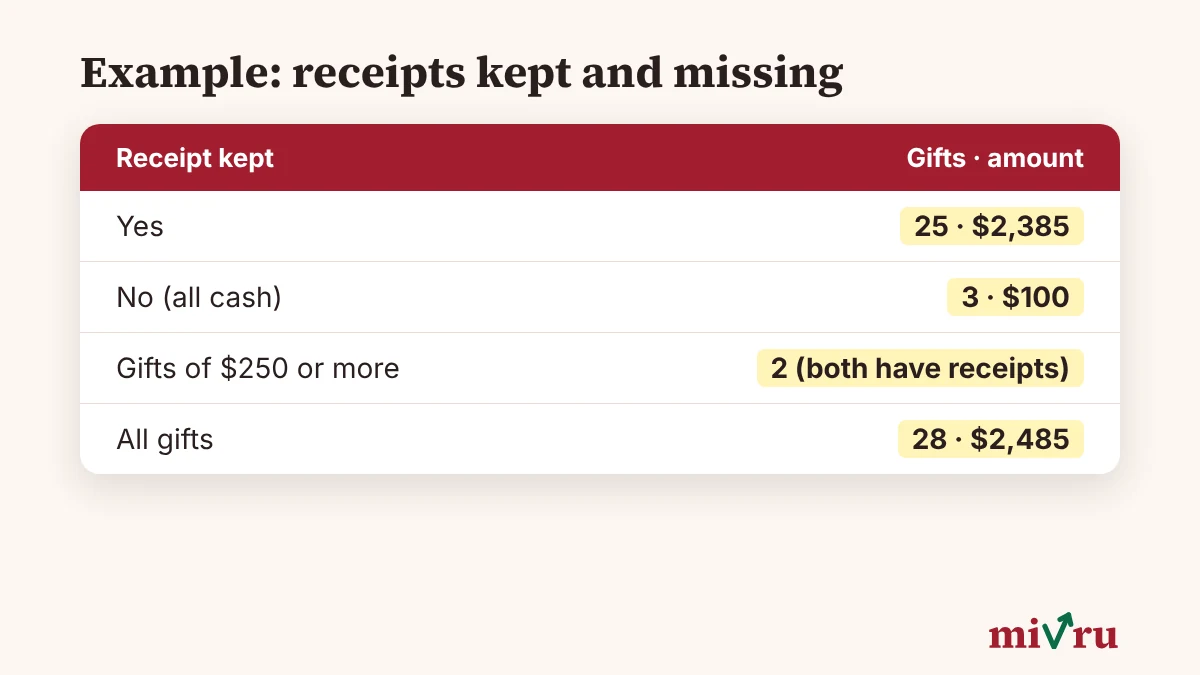
25 gifts have a receipt ($2,385) and 3 do not ($100): two small school fundraiser gifts in cash ($30 and $45) and a $25 cash gift at a library book sale. None of the missing three is a large gift. The two gifts of $250 or more (the hospital and the disaster fund) both have receipts, so the "large gifts without a receipt" count is zero.
What the example teaches
- Regular gifts are the base. Two monthly gifts gave $1,600 of $2,485.
- Cash is the weak spot. All three gifts without receipts were paid in cash.
- One-off gifts are lumpy. June and September look big because of single gifts.
- A cause view shows priorities. Religion and hunger take most of the giving.
- Goods can be logged too. The $40 shelter gift of blankets and food is recorded with a note, as an estimated value.
The IRS explains in its page on charitable contribution deductions that contributions are generally deductible only for qualified organizations and only if you itemize, and that Publication 1771 covers the record rules. The example does not say what is deductible for anyone: ask the charity or a tax professional.
Build your own
Start with the donation goal tracker template guide, then build the sheet in Excel or Google Sheets. For the records side, read donation tracker for taxes, and for everyday spending the expense tracker example. This is general information, not tax advice.
Each charity's share of the year
| Charity | Total | Share of $2,485 |
|---|---|---|
| Local church | $1,000 | 40% |
| Community food bank | $600 | 24% |
| Children's hospital fund | $300 | 12% |
| Disaster relief fund | $250 | 10% |
| Public radio | $120 | 5% |
| Animal shelter | $115 | 5% |
| School fundraiser | $75 | 3% |
| Neighborhood library | $25 | 1% |
The shares are rounded, so they may not add to exactly 100%. The two monthly gifts, the church and the food bank, are 64% together.
Averages
| Measure | Value |
|---|---|
| Average per gift | $88.75 |
| Average per month (10 months) | $248.50 |
| Largest gift | $300 |
These come from $2,485 divided by 28 gifts and by 10 months. The average gift is pulled up by the few large gifts, while most gifts are much smaller.
Checks the sheet makes
- The months add up. $160 + $190 + $235 + $280 + $160 + $460 + $160 + $160 + $455 + $225 = $2,485.
- The payment methods add up. $1,000 + $720 + $625 + $140 = $2,485.
- The gift counts add up. 10 + 11 + 3 + 4 = 28.
If a total does not match, one row has a blank or a misspelled name.
Want the example ready-made?
The Mivru Donation & Charitable Giving Tracker includes this example, so you can click around before you clear it and add your own gifts. It has a Donations log, a Dashboard, a Monthly sheet and a Receipts sheet in five color themes for Excel and Google Sheets, plus an 11-page printable. See the Donation & Charitable Giving Tracker.
Frequently asked questions
What does a donation tracker example look like?
It lists each gift with the date, charity, cause, amount, how it was paid and whether you have the receipt, then adds up by charity, cause and month. This page shows a made-up one.
Are the numbers in this example real?
No. The charities, gifts and amounts are made up to show how a tracker works. Use your own numbers.
How much was given in the example?
$2,485 across 28 gifts from January to October 2026.
Why track how each gift was paid?
A card, check or online gift leaves a bank record. Cash gifts do not, so they are the ones to get a receipt for.
Can I copy this example?
Yes. The Mivru donation tracker includes this example data, so you can click around, then clear it and add your own.