Budget Spreadsheet for Personal Finance: A Simple Guide
Budget spreadsheet for personal finance in plain steps: what to include, how to set it up and keep it up. With a worked example and a free printable.
A budget spreadsheet for personal finance has four parts: your income, a planned amount for each spending category, a log of what you really spend, and a view that compares the plan with the actual. Once those four are in one file, you can see in minutes whether the month is on track.
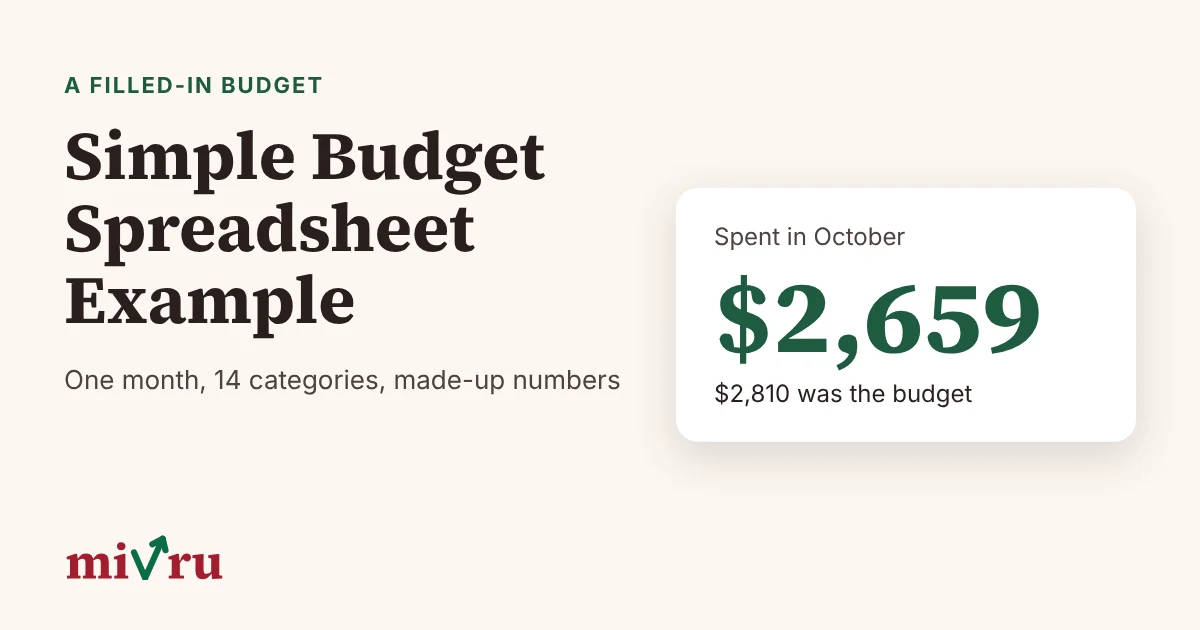
This guide shows what to put in each part and how to keep it going. The numbers are a made-up example, used again in our simple budget spreadsheet example.
Why a spreadsheet works for a budget
A spreadsheet adds things up for you, so you only record what happened. It also shows the whole month at once and keeps every number in one place. The U.S. Consumer Financial Protection Bureau suggests tracking a month of spending and sorting it into categories so you can see which costs repeat and which you could cut. A budget spreadsheet turns that tracking into a plan.
The four parts
| Part | What it holds | How often you touch it |
|---|---|---|
| Income | Each paycheck, side income and refunds | Each time you are paid |
| Budget | A planned amount for each category | Once, then when life changes |
| Spending log | One row for each purchase | Once or twice a week |
| Comparison | Plan vs actual, what is left | Read once a month |
Step 1: Write down your income
List what comes in each month. If your pay varies, use a low month as the plan and treat extra as a bonus.
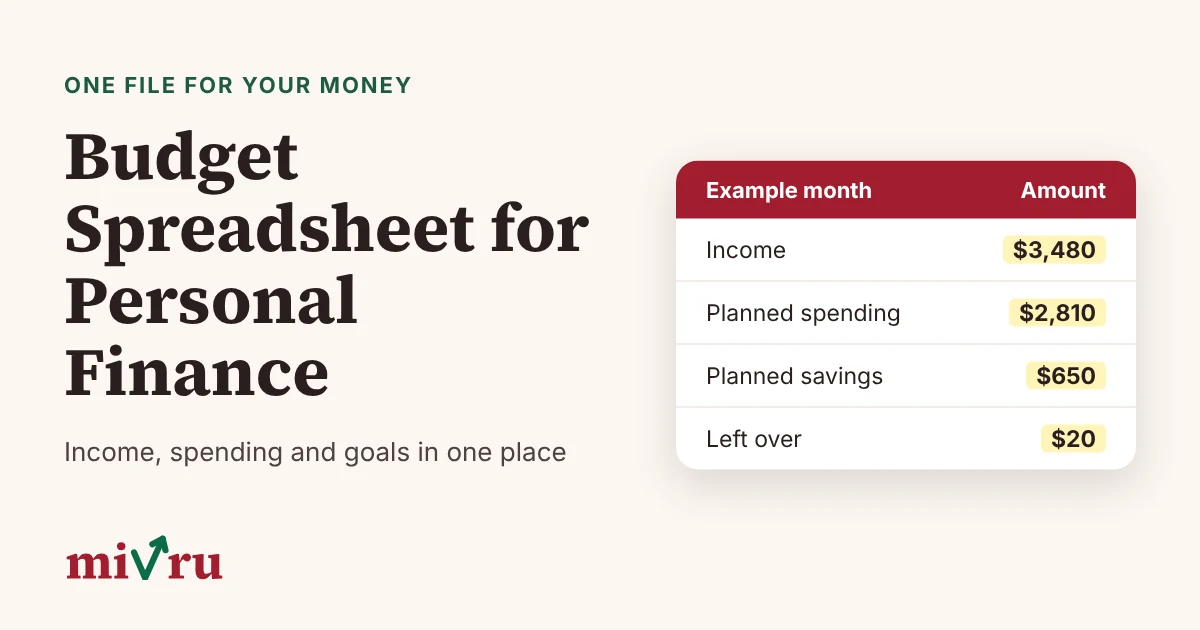
Example: Two paychecks of $1,740 a month make $3,480. A few months also have a side-job payment, which goes in as extra income on the day it arrives.
Step 2: Choose your categories
Start from the bills you cannot skip, then food and transport, then the rest. Ten to fifteen categories is plenty. Fourteen are used here: housing, utilities, groceries, dining out, transport, insurance, health, phone and internet, subscriptions, shopping, fun and travel, kids and pets, gifts and giving, and other.
Step 3: Set a monthly budget for each
Look at what you actually spent last month, not what you wish you had spent, and plan from there. Fixed bills are easy. For flexible ones such as groceries, start with last month's total and trim it a little.
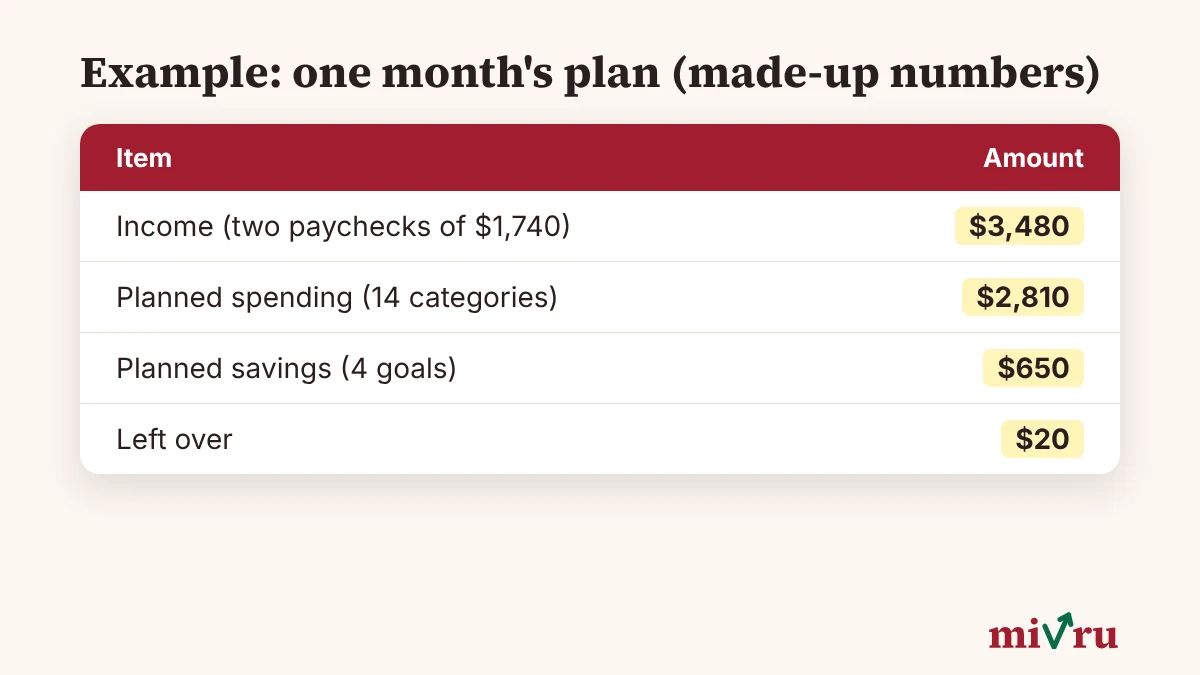
Example: Housing $1,250, groceries $440, transport $190, dining out $100, and ten other lines add up to $2,810. Savings of $650 are planned too. $3,480 - $2,810 - $650 leaves $20.
Step 4: Plan savings first
Decide how much goes to savings before you decide how much is free to spend. The CFPB suggests setting a goal, making a plan and saving automatically. In the example, four goals receive money each month: an emergency fund, a vacation, a new car and home projects.
Step 5: Log what you spend
Add one row for each purchase: the date, the category and the amount. Do it twice a week and it takes a few minutes. Use a drop-down for the category so the names always match, which the totals need.
Step 6: Read the comparison once a month
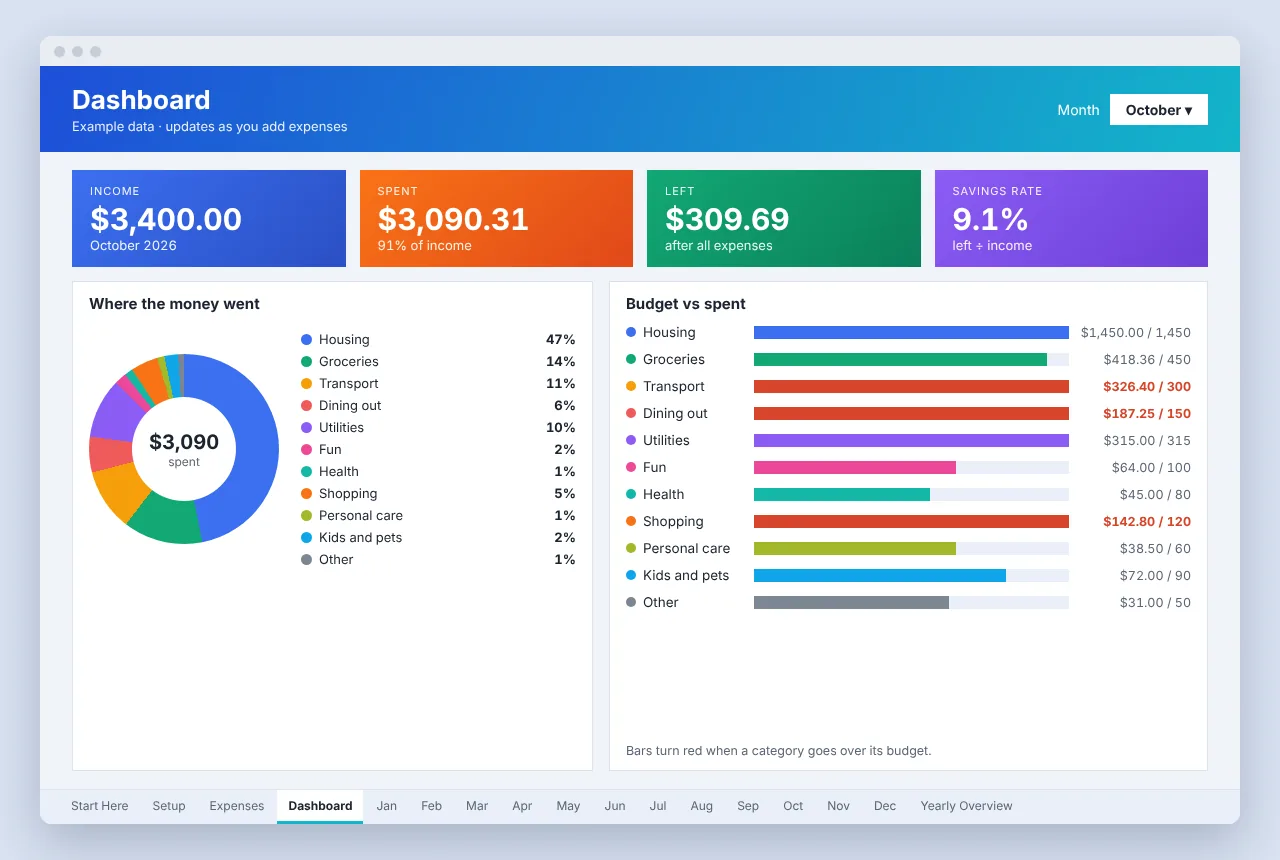
At month end, look at each category's actual next to its plan. A category that is over once is a blip. One that is over month after month needs a bigger budget or a smaller habit, and either choice is fine as long as it is a choice. Our expense tracker example shows what a month of spending looks like.
Common mistakes
- Too many categories. If the log feels like a chore, you will stop. Merge the small ones.
- A budget that is a wish. Plan from last month's real spending.
- Forgetting yearly costs. Insurance, gifts and car repairs arrive once a year. Add a line for them or save a little each month.
- No review. A budget you never read is only a list.
The example plan in one table
This is the whole made-up plan for one month, so you can see how a plan of $2,810 is spread across 14 categories.
| Category | Planned |
|---|---|
| Housing | $1,250 |
| Groceries | $440 |
| Transport | $190 |
| Insurance | $160 |
| Utilities | $140 |
| Phone and internet | $130 |
| Dining out | $100 |
| Shopping | $100 |
| Fun and travel | $100 |
| Kids and pets | $70 |
| Health | $40 |
| Subscriptions | $30 |
| Gifts and giving | $30 |
| Other | $30 |
| Total | $2,810 |
Example: Of the $3,480 of income, $2,810 (81%) is planned for spending and $650 (19%) for savings. That leaves $20, which is less than 1% of income. A small cushion like this is tight, so a real plan may want a bigger buffer.
A monthly review in five questions
- Did income match the plan? If not, which paycheck or payment changed?
- Which categories went over? Write the amount, not just a feeling.
- Was the overspend a one-off or a pattern? Look at the last three months.
- Did the savings go where they should? Check the goal balances against your accounts.
- What is one change for next month? Pick one, so it happens.
Five questions take about ten minutes and turn a spreadsheet from a record into a decision tool.
Want it ready-made?
You can build all of this yourself in an hour or two. If you would rather start today, the Mivru All-in-One Budget Planner has it built in: a monthly budget for 14 categories, spending, income and savings logs, a dashboard with a month picker, budget vs actual and savings goals, in five color themes. It works in Excel and Google Sheets and includes a 13-page printable. See the All-in-One Budget Planner. This is general information, not financial advice.
Frequently asked questions
What should a personal finance budget spreadsheet include?
Your income, a planned amount for each spending category, a log of what you really spend, your savings goals and a view that compares plan and actual. Everything else is optional.
How many categories do I need?
Ten to fifteen is enough for most people. Too few hides where the money goes, and too many makes the log tiring to keep up.
How often should I update a budget spreadsheet?
Add purchases once or twice a week and review the totals once a month. A short regular update works better than a long one every few months.
Is Excel or Google Sheets better for a budget?
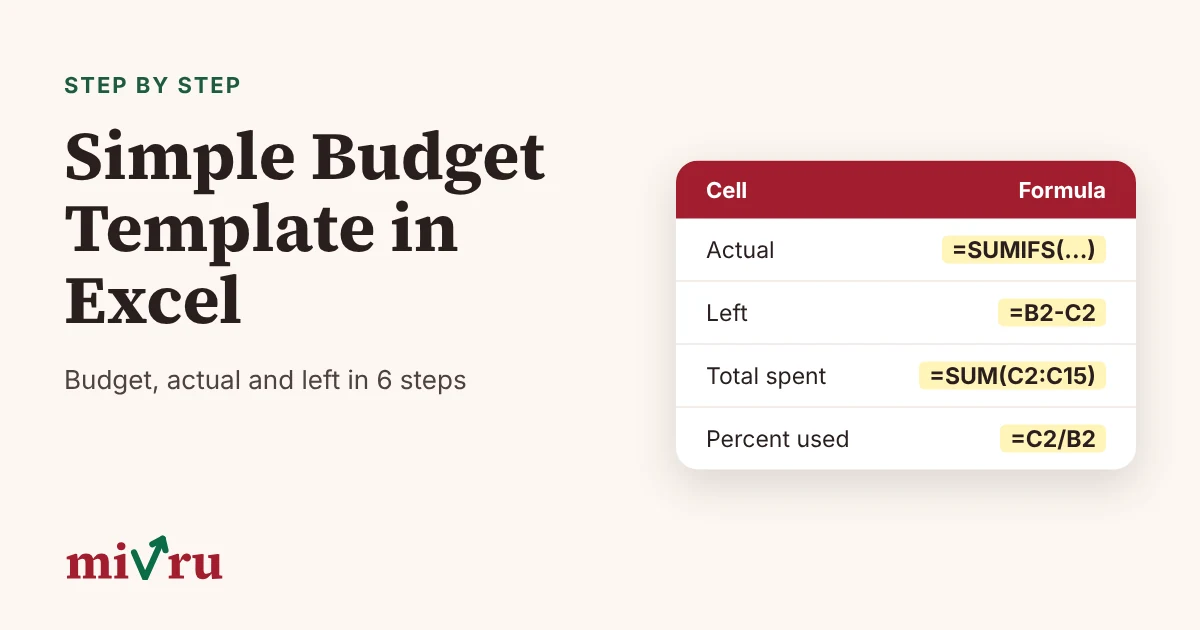
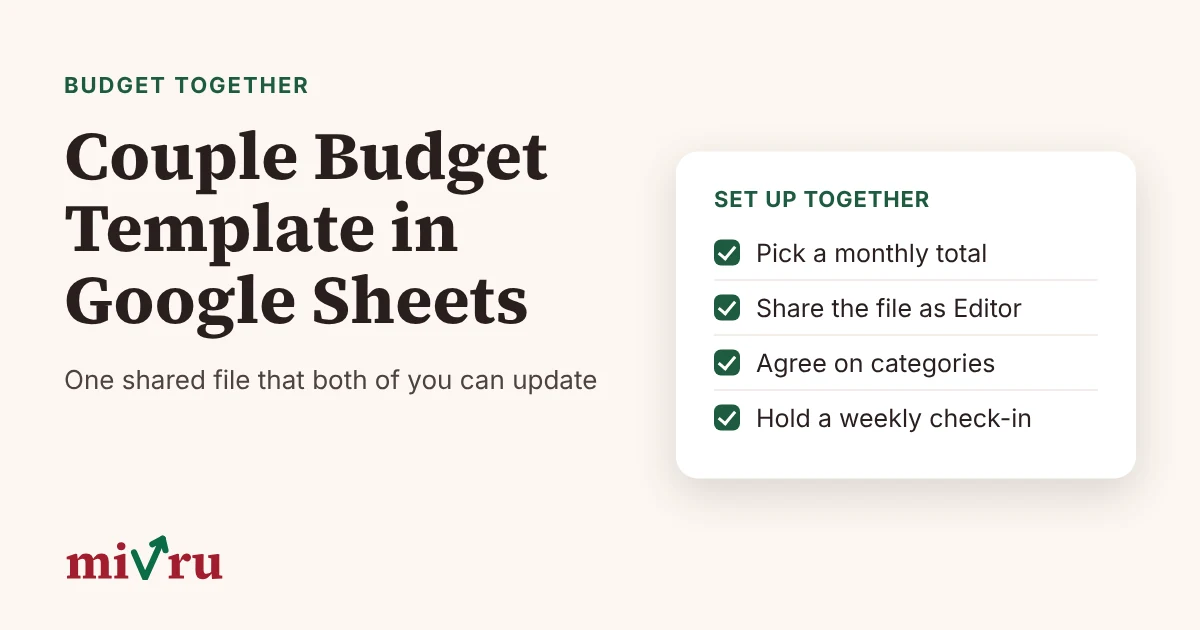
Both work. Excel is good offline. Google Sheets is free, works on a phone and can be shared with a partner. The formulas in this guide work in both.
Should savings come out of the budget first?
Many people plan savings as their first line, so the money moves on payday instead of being whatever is left at the end of the month.